
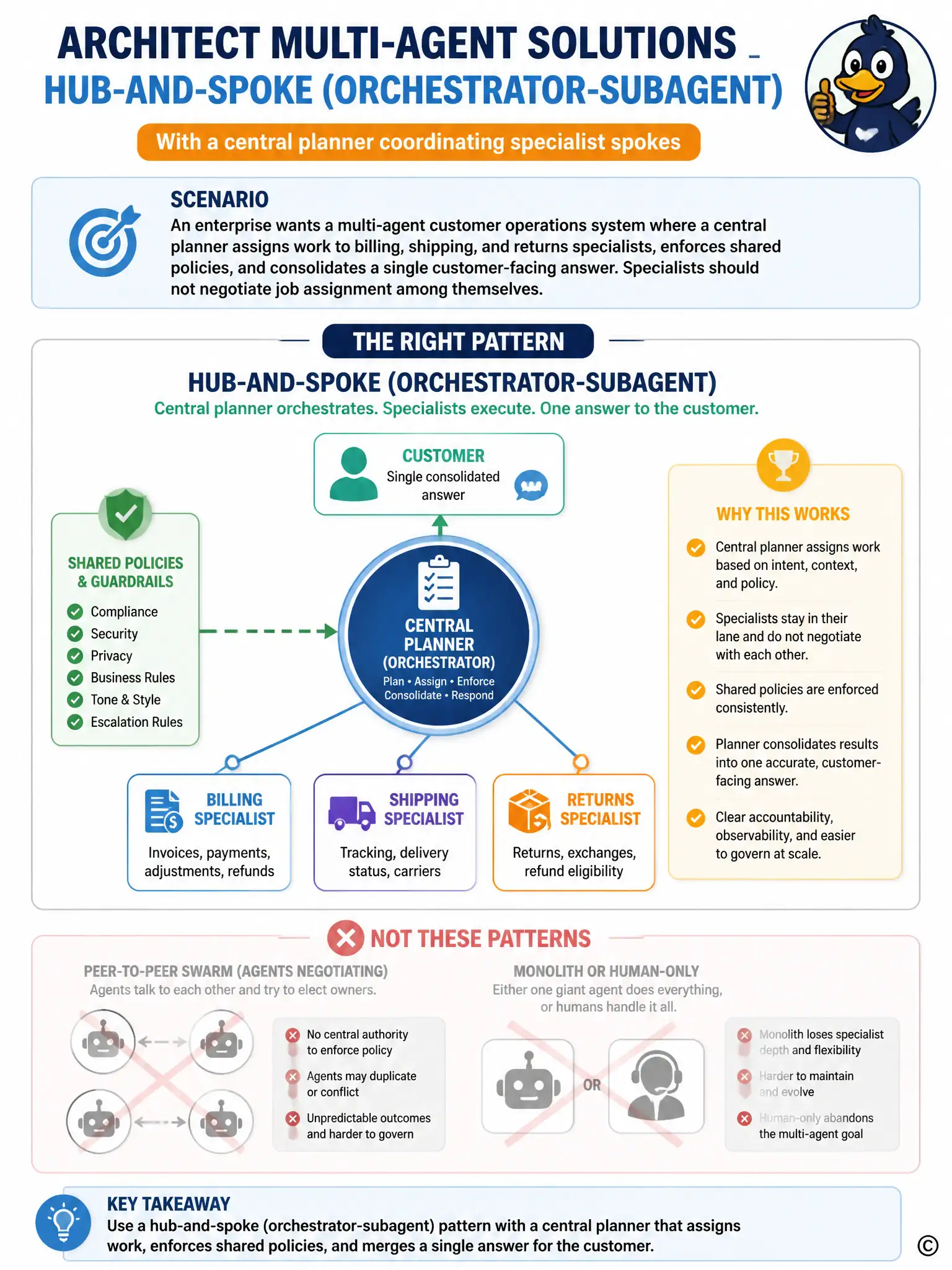
An enterprise wants a multi-agent customer operations system where a central planner assigns work to billing, shipping, and returns specialists, enforces shared policies, and consolidates a single customer-facing answer. Specialists should not negotiate job assignment among themselves. Which logical orchestration pattern best matches this requirement?
Select an answer to reveal the explanation.
Short Explanation
You want a central planner assigning work, enforcing policy, and merging one answer—that's hub-and-spoke/orchestrator-subagent, not a peer swarm electing owners. Monolithic design throws away specialist decomposition, and human-only queueing abandons the multi-agent goal.
Full Explanation
The hub-and-spoke (orchestrator-subagent) pattern is correct. Architecting multi-agent solutions includes choosing workflows and patterns such as hub-and-spoke and orchestrator-subagent when centralized assignment, policy enforcement, and answer consolidation are required and specialists should not self-organize work.
The fully peer-to-peer swarm where every specialist messages every other specialist to elect work owners is incorrect because peer-to-peer negotiation conflicts with the requirement that specialists do not assign work among themselves and complicates consistent policy enforcement.
The single monolithic agent with no decomposition into specialists is incorrect because a monolith forgoes the specialist decomposition the enterprise needs for billing, shipping, and returns expertise.
The human-only queue with no AI agents involved is incorrect because removing AI agents fails the stated multi-agent product goal.