
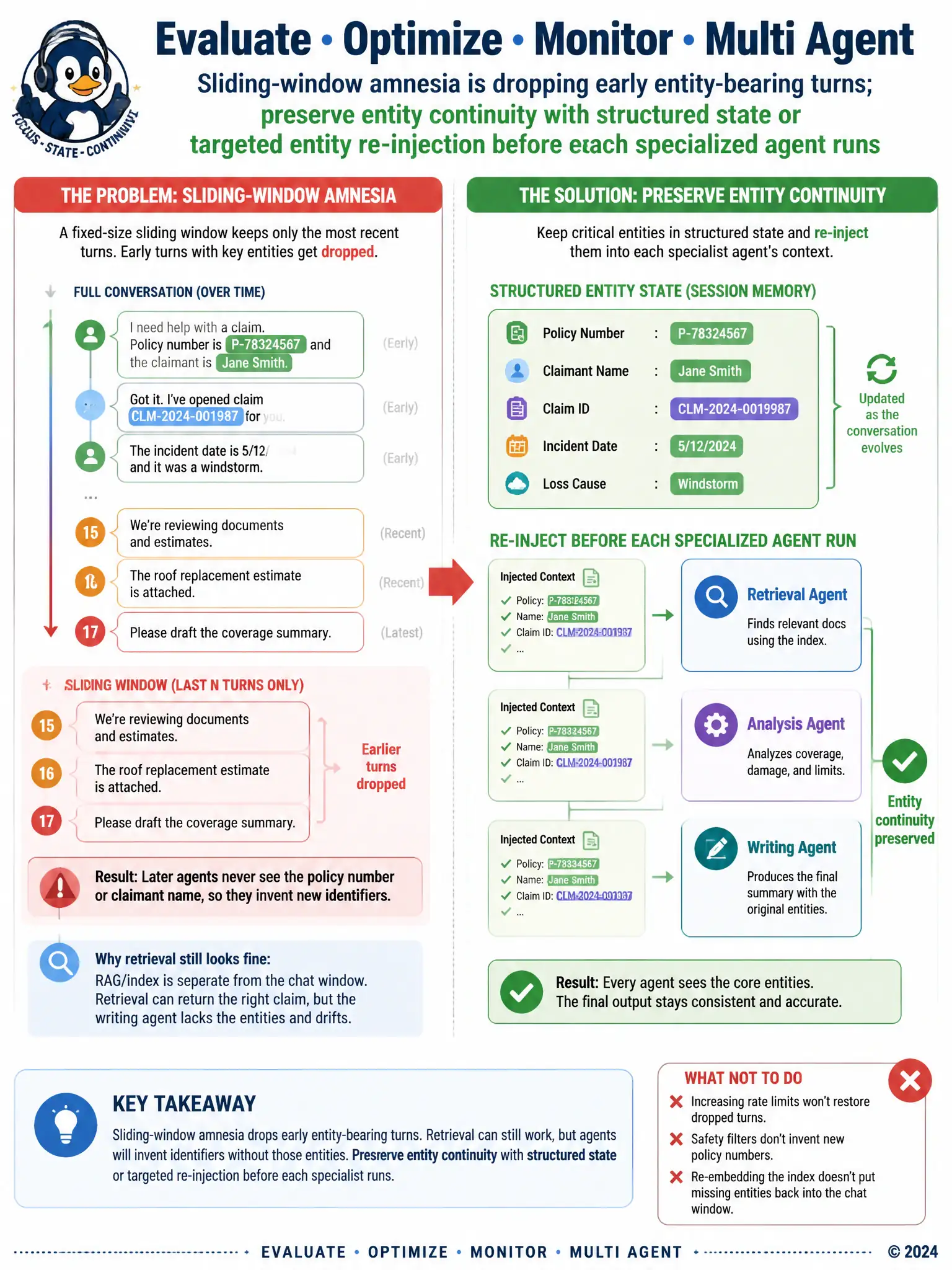
A multi-agent claims assistant in Microsoft Foundry keeps a rolling conversation context using a fixed-size sliding window. Over long claims investigations, the policy-number entity and claimant name that were established in the first few turns disappear from later agent prompts, and downstream agents begin inventing identifiers. Offline evaluation shows retrieval still finds the correct claim, but the writing agent no longer mentions the original entities. Which diagnosis best explains the failure mode, and what should the team address first?
Select an answer to reveal the explanation.
Short Explanation
You're seeing classic sliding-window amnesia: the fixed window quietly drops the early turns where the policy number and claimant name were established, so later agents invent identifiers. Preserve entity continuity with structured state or targeted entity re-injection before each specialized agent runs. Bigger quotas, safety filters, and re-embedding won't put missing entities back into the prompt.
Full Explanation
The sliding-window amnesia diagnosis is correct. Fixed-size sliding windows discard oldest turns as conversations grow. When identity-bearing facts live only in those early natural-language turns, later agents lose entity continuity even if retrieval still surfaces the right claim documents. The observed mismatch—successful retrieval but hallucinated identifiers in generation—points to conversational context continuity, not retrieval quality. The primary remediation is architectural: store durable entities (policy number, claimant name, claim id) in multi-tier state and inject them into each agent prompt, or use summary-plus-entity memory that explicitly preserves identifiers. Address entity continuity before throughput, safety, or embedding changes.
The frontier model deployment rate-limit diagnosis is incorrect because throughput quotas affect how many tokens you may send per minute, not which historical turns the window retains. Raising rate limits does not prevent the window from dropping early content.
The content safety filters stripping claim identifiers diagnosis is incorrect because content safety may block certain categories of harmful content; it does not systematically remove claim identifiers and then cause agents to invent replacement numbers. Disabling safety for internal agents is also a security regression unrelated to the root cause.
The outdated embedding model diagnosis is incorrect because embedding refresh can improve retrieval quality, but the stem states retrieval already finds the correct claim. The failure is in conversational context continuity for generation, not vector search precision.