
Your team must evaluate a multi-agent claims solution in Microsoft Foundry before wider release. Stakeholders want structured human review of agent outcomes, not only automated scores. Which approach best designs the human review process?
Select an answer to reveal the explanation.
Short Explanation
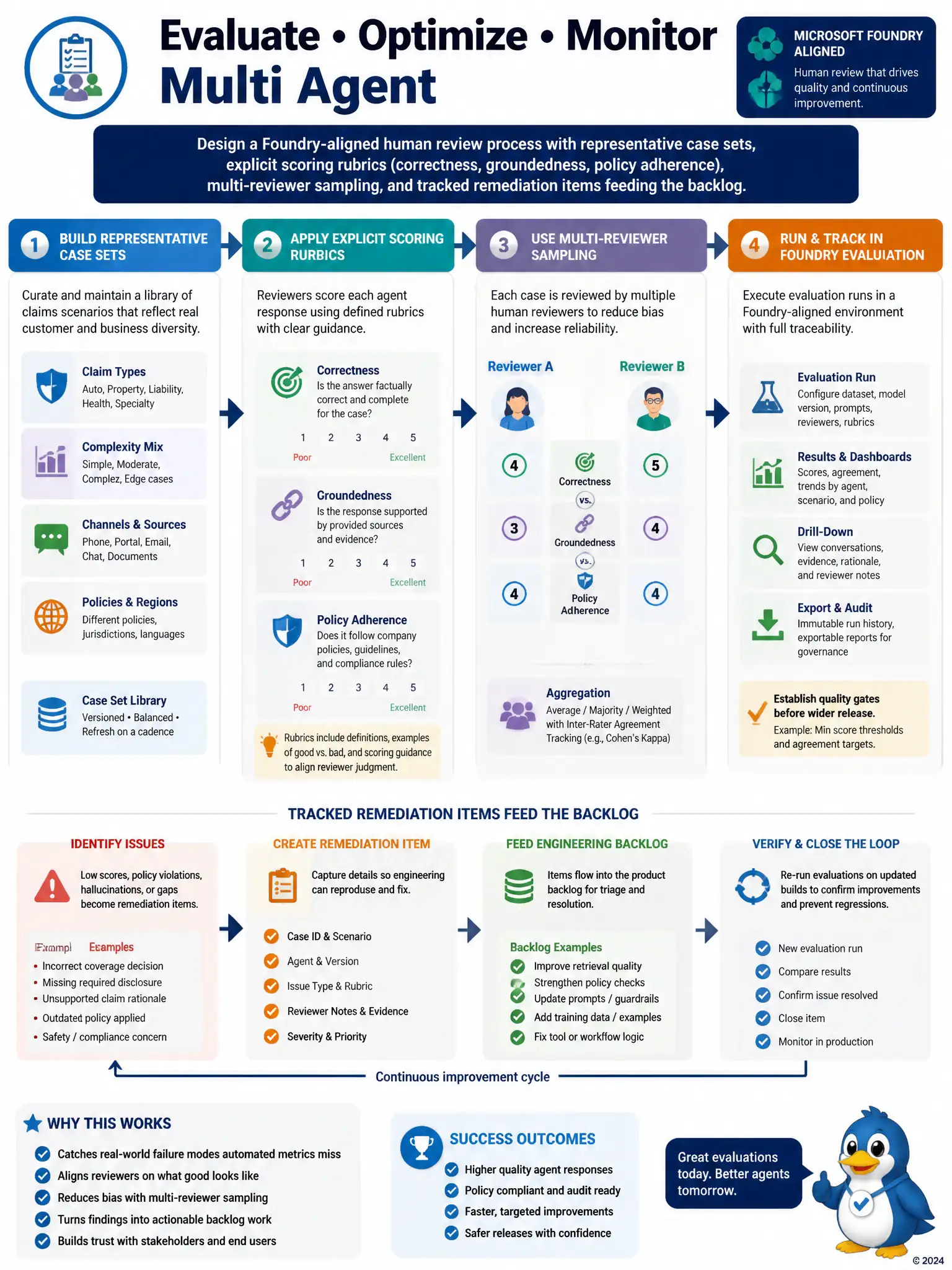
You need structured human review in Foundry: representative cases, explicit rubrics for correctness, groundedness, and policy adherence, multiple reviewers, and tracked remediation items feeding the backlog. Ship-and-hope ratings, informal skims, and CPU dashboards don't gate answer quality.
Full Explanation
Evaluate-domain skills include designing and implementing human review processes for Foundry solutions. The structured Foundry-aligned process with representative cases, explicit rubrics for correctness, groundedness, and policy adherence, multi-reviewer sampling, and tracked remediation items feeding the backlog provides rigor, coverage, and an engineering feedback loop. Shipping without review and relying on app store ratings postpones quality control until customer harm is possible. Informal skims of happy-path chats lack inter-rater consistency and auditability. CPU utilization dashboards measure infrastructure, not multi-agent decision quality. Combine human review with automated evaluations for memory, tools, and prompts where possible. Exam tip: Human review needs rubrics and sampling strategy, not vibes.