
Wide World Importers is selecting models for a multi-agent supply-chain suite in Microsoft Foundry. Tasks include: (1) high-volume SKU classification from short structured fields, (2) multi-step negotiation email drafting with careful tone, and (3) overnight batch reconciliation of millions of line items with strict cost caps. Which model capacity matching approach is most appropriate?
Select an answer to reveal the explanation.
Short Explanation
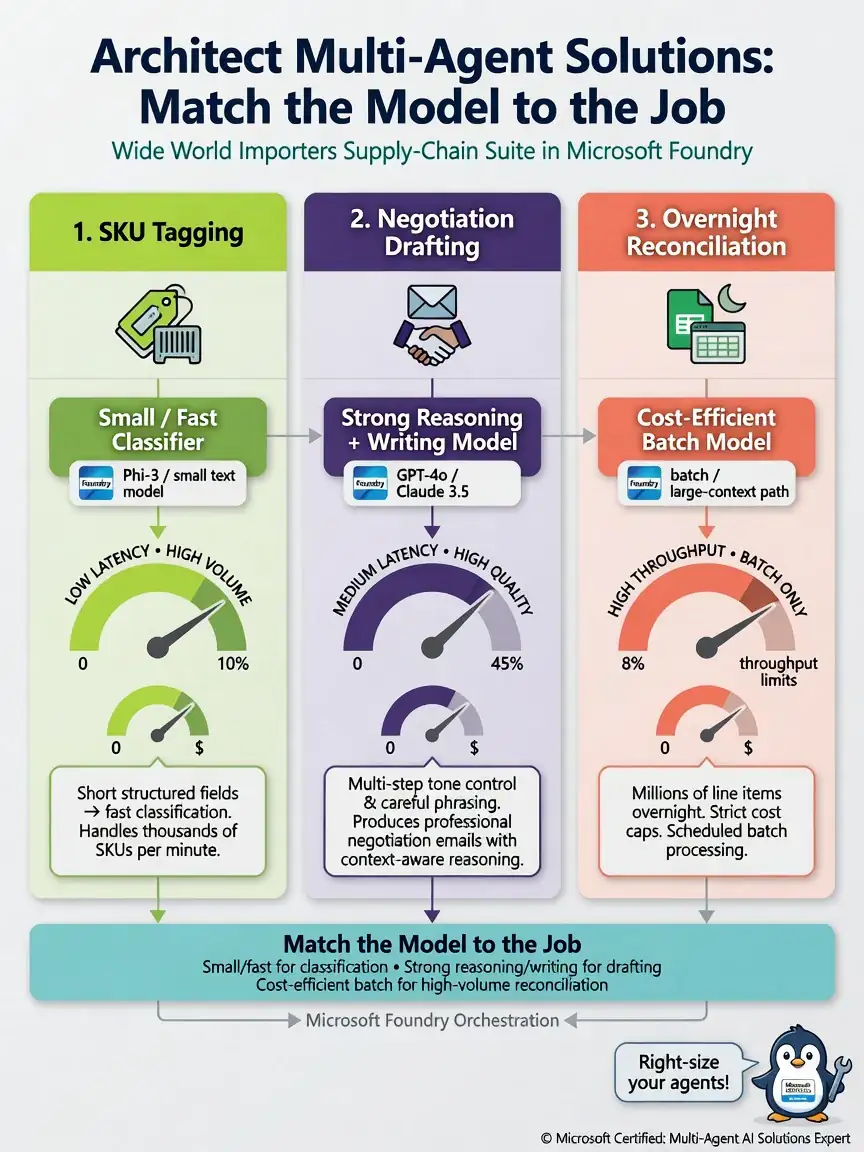
Match the model to the job. You want small/fast for short structured item tagging, a stronger reasoning/writing model for careful negotiation drafting, and a cost-efficient batch path for overnight reconciliation under caps. That keeps quality where it matters and controls cost.
Full Explanation
Architects must match task demands to model family capacities. The correct approach assigns a small/fast classification-capable model to item tagging, a stronger reasoning/writing model to negotiation drafting, and a cost-efficient batch-oriented model path for overnight reconciliation with throughput limits. This differentiates latency/cost-sensitive classification, quality-sensitive writing/reasoning, and batch cost-constrained reconciliation. Using the largest frontier model for every agent ignores cost and latency budgets; frontier models are rarely optimal for high-volume trivial classification. Forcing all agents to share one vision-language deployment for text-only inputs mismatches modality and wastes capacity. Disabling model selection and hard-coding regexes underfits complex negotiation language and exception-heavy reconciliation narratives that benefit from language-model agents with tools. Exam tip: Multi-agent systems often use heterogeneous models per agent role rather than one global model.