
A finance multi-agent system can draft vendor payments. Policy requires that any payment instruction above a threshold receive human approval before the payment tool executes. Agents must not bypass this for “urgency.” How should you implement human-in-the-loop?
Select an answer to reveal the explanation.
Short Explanation
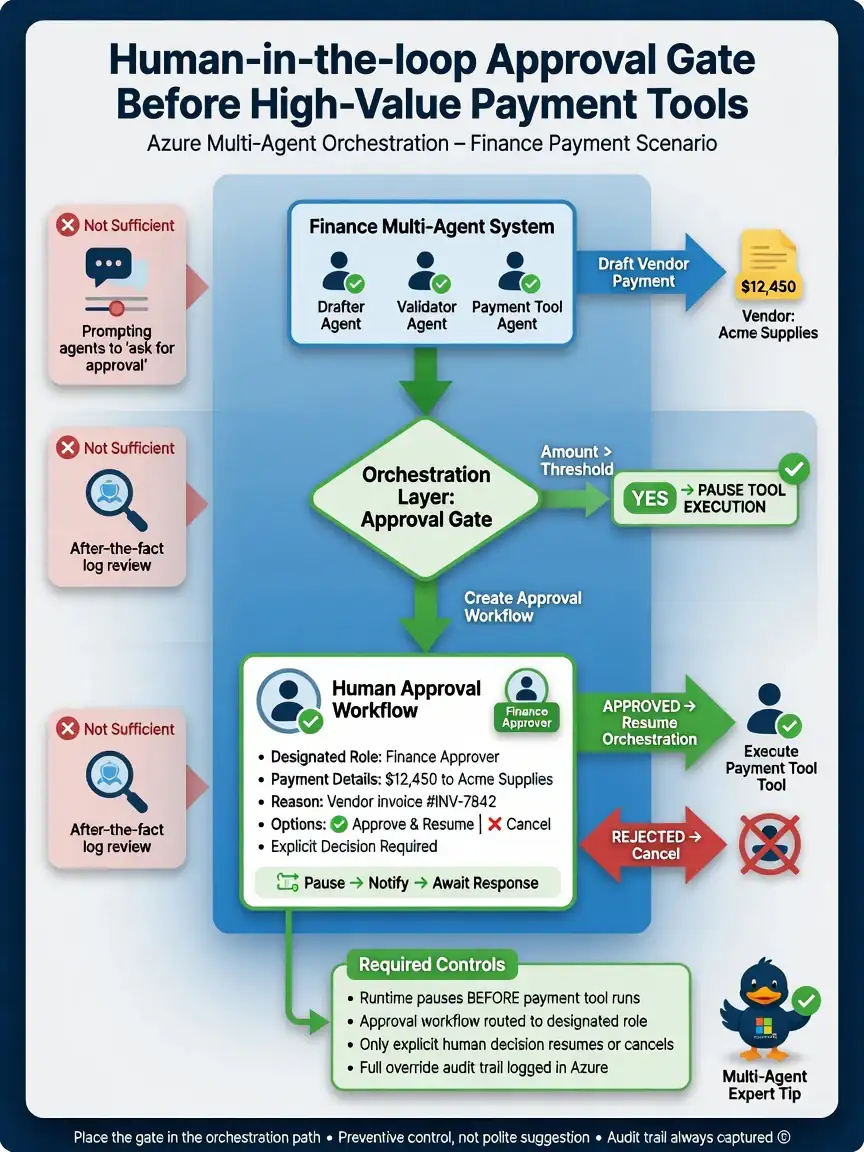
You need a hard approval gate in the orchestration path. When amount exceeds threshold, pause tool execution, create an approval workflow for a designated role, and resume or cancel only after an explicit human decision with an override audit trail. Soft suggestions, after-the-fact logs, and temperature changes won't enforce the policy.
Full Explanation
Correct Answer — the approval gate in the orchestration path
Human-in-the-loop processes include approval workflows, overrides, and edge-case handling. For payment instructions above threshold, the orchestration must block tool execution until a designated human approves or rejects, recording overrides. That is a control-plane gate, not a stylistic prompt change. Build human-in-the-loop as a hard gate in the workflow graph, such as an Agent Framework interrupt, LangGraph interrupt, or Foundry approval pattern; these are conceptually the same.
Why the soft suggestion option is wrong: Soft prompt suggestions are not enforceable and fail under social-engineering "urgency."
Why the post-execution logging option is wrong: Post-execution logging does not prevent unauthorized payments; it only supports later review. It is detective, not preventive.
Why the lower-temperature option is wrong: Temperature affects sampling randomness, not authorization policy.
Exam tip: High-risk tools → hard approval interrupt in the orchestration path before execution.