
Your team must expose an internal order-status API to several Foundry agents as standardized tools that multiple orchestrations can reuse. Agents should discover tools consistently, and platform engineers want centralized auth, throttling, and versioning at the edge. Which design best fits Microsoft multi-agent tool ecosystems?
Select an answer to reveal the explanation.
Short Explanation
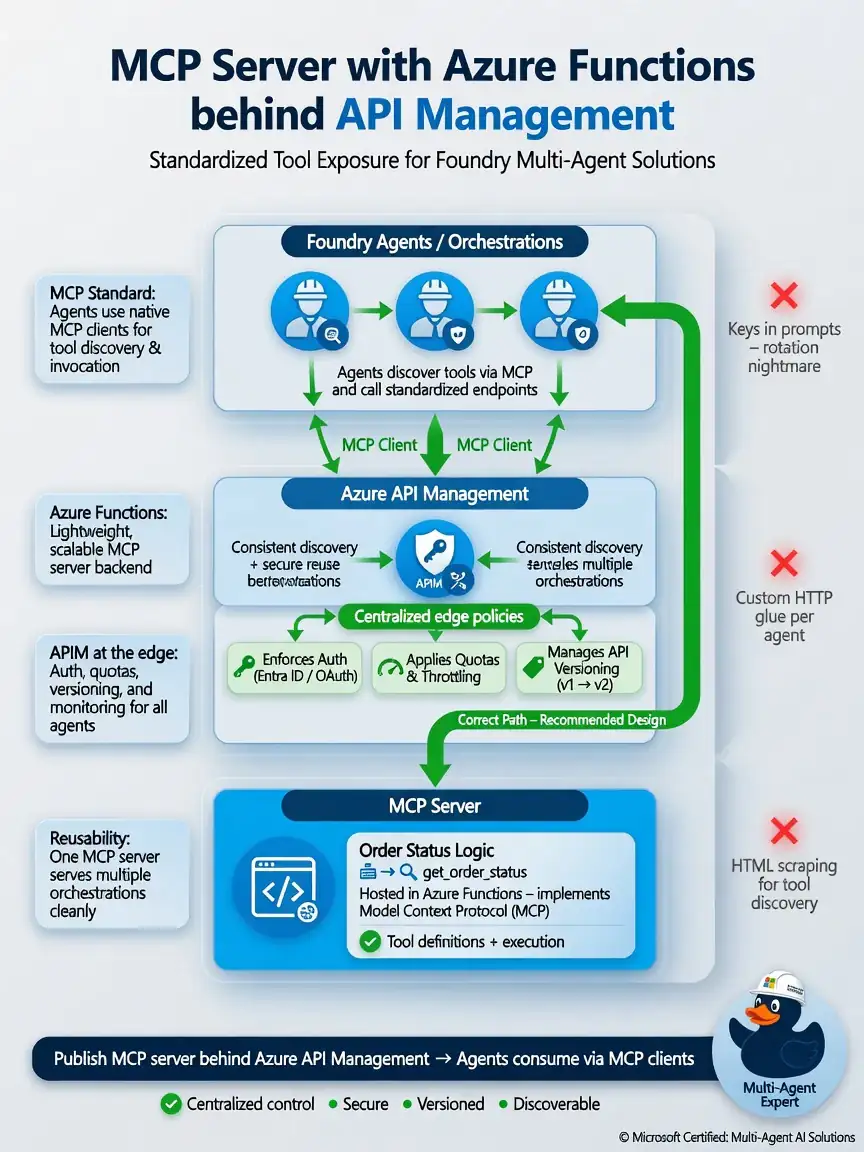
You want to publish an MCP server, often hosted by Azure Functions, behind Azure API Management. That gives agents a standard way to discover and call the order-status tool while APIM handles auth, throttling, and versioning. It's the clean, reusable pattern for multi-agent tool ecosystems.
Full Explanation
The best design is publishing an MCP server, for example backed by Azure Functions, behind Azure API Management so agents use MCP clients for tool discovery and calls, with APIM enforcing auth, quotas, and API versioning. Building tool ecosystems for multi-agent solutions includes MCP servers and clients, often implemented with Azure Functions, Logic Apps, and Azure API Management. Publishing an MCP server behind APIM gives reusable discovery and invocation for many agents while centralizing authentication, quotas, and versioning—exactly what platform teams need.
Embedding hard-coded REST URLs and API keys inside each agent system prompt as plain text is wrong because secrets in prompts are insecure, hard to rotate, and not a discoverable tool interface. Having every agent scrape the order-status HTML portal with browser automation instead of APIs is wrong because portal scraping is fragile and inappropriate when a stable API exists. Giving each agent a private copy of the order database connection string for direct SQL is wrong because direct database credentials expand blast radius and bypass API governance.
Exam tip: MCP for tool standards; APIM for edge auth/throttle/version; Functions or Logic Apps for server implementation.