
You design a multi-agent RAG solution where a Research agent retrieves policy documents and a Writer agent drafts customer replies. The Research agent often returns partially relevant chunks, so the Writer invents policy details. Product owners require higher retrieval precision without forcing the Writer to search itself. What should you implement?
Select an answer to reveal the explanation.
Short Explanation
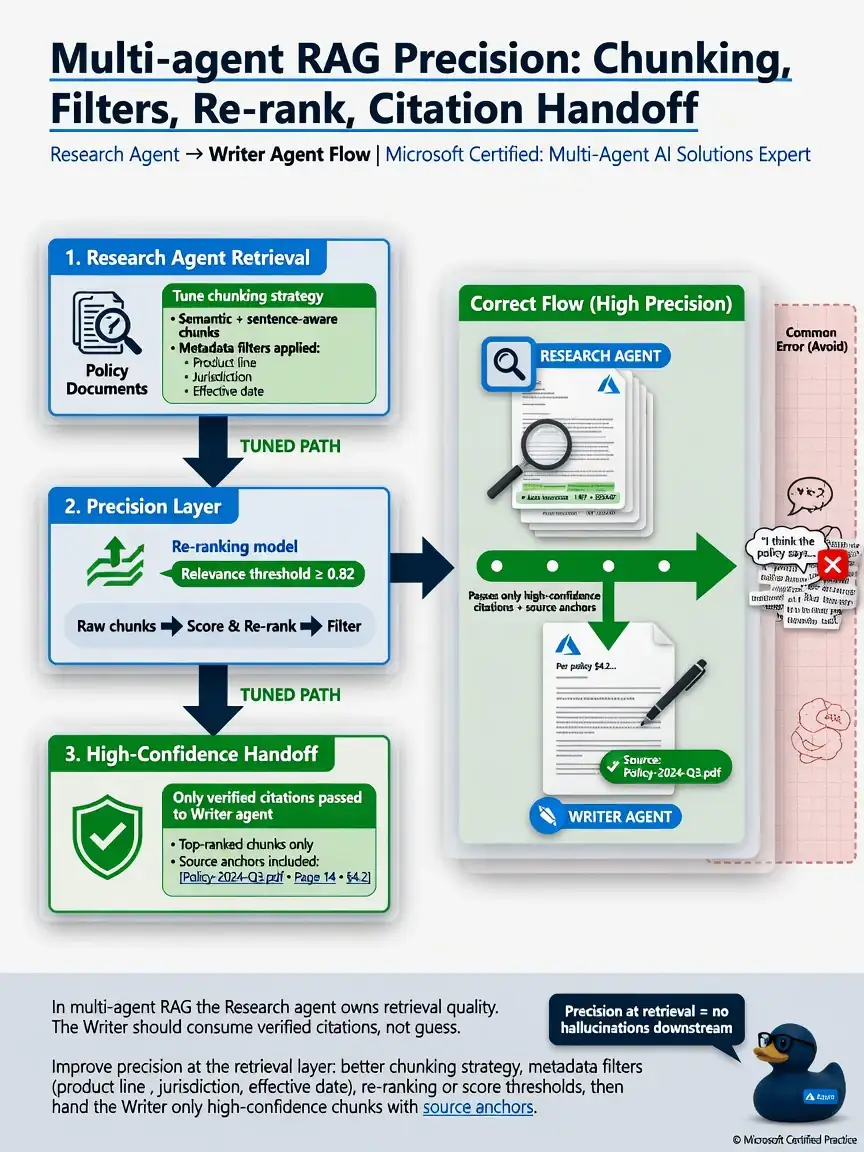
You need to fix retrieval before generation. Tune chunking, metadata filters, and re-ranking or relevance thresholds, then pass only high-confidence citations with source anchors to the Writer. That keeps the Research agent responsible for precision and stops the Writer from inventing policy details.
Full Explanation
Correct approach
Multi-agent RAG architecture emphasizes chunking quality, embedding effectiveness, and retrieval precision for the agent that consumes knowledge. The Research agent should apply tuned chunking, metadata filters, and re-ranking or confidence thresholds, then pass only high-quality citations with source anchors to the Writer. That separation of retrieval and drafting roles is a core multi-agent development pattern.
Why increasing embedding dimensions only is wrong: Embedding size alone does not fix poor chunk boundaries, missing filters, or weak relevance ranking.
Why storing full unchunked PDFs as single vectors is wrong: Whole-document vectors reduce precision, waste context, and still do not guarantee the right passage is used.
Why disabling RAG and fine-tuning the Writer on every policy PDF is wrong: Fine-tuning every policy PDF is operationally heavy, lags document updates, and is not a substitute for grounded retrieval in regulated content.
Exam tip: Multi-agent RAG = specialist retrieval quality + citation handoff, not writer self-search or pure fine-tune.