
You are implementing a multi-step research workflow on Azure that needs explicit graph control: conditional branches, cycles for refinement, and checkpointed state between nodes. The team is proficient in Python and open-source agent stacks used with Microsoft Foundry model deployments. Which approach best matches the orchestration requirement?
Select an answer to reveal the explanation.
Short Explanation
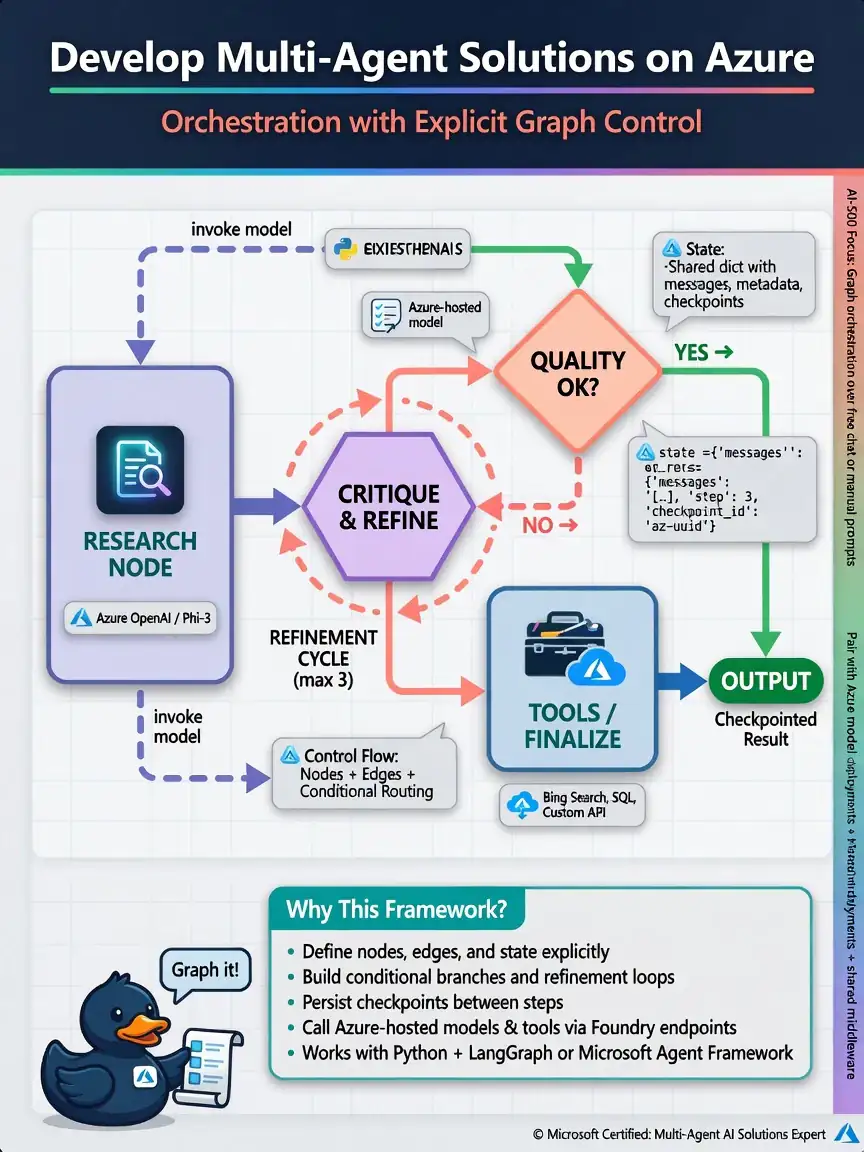
You want explicit graph control, so you use a multi-agent orchestration framework such as Microsoft Agent Framework or LangGraph to define nodes, edges, state, and control flow while calling Azure-hosted models and tools. That gives you branches, loops, and checkpointed state instead of free chat, prompt-only control, or manual tabs.
Full Explanation
Complex multi-agent workflows need durable control flow, not only clever prompts. A multi-agent orchestration framework such as Microsoft Agent Framework or LangGraph provides primitives for nodes (agents/tools), conditional edges, cycles for critique/refine loops, and state passing. This supports testing, visualization, and HITL interrupts. The unstructured free-chat loop option lacks determinism and testability. The option that encodes business branching only in natural language inside one prompt overloads the model with governance that belongs in code. The manual copy-paste between three browser chat tabs option is not production engineering. Integrate middleware for logging, authorization, and exception handling across nodes, and keep model calls pointed at governed Azure deployments.