
Your team must expose internal order-status and inventory operations to several Foundry agents through a standard tool protocol. Operations should run as scalable Azure compute with existing API backends. Which approach best builds the tool ecosystem?
Select an answer to reveal the explanation.
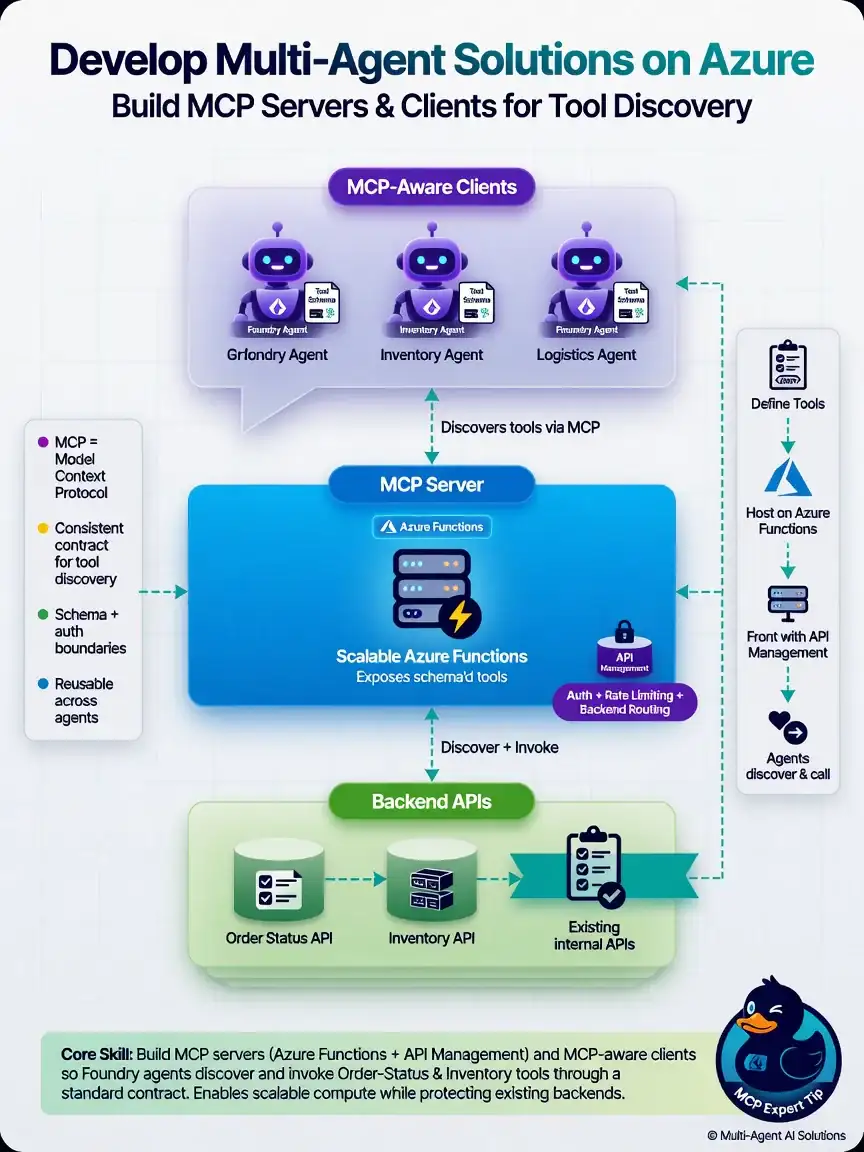
Short Explanation
You want MCP servers and MCP-aware clients so your agents can discover and call order and inventory tools through one clean contract. You can host the servers on Azure Functions and put API Management in front as needed. That gives you schemas, auth boundaries, and reusable integrations instead of brittle hacks.
Full Explanation
The exam expects candidates to design and build MCP servers and clients, including Azure Functions, Logic Apps, and Azure API Management. MCP standardizes tool discovery and invocation for multi-agent hosts. Implement authenticated, least-privilege backends; validate inputs; return structured results. The approach of asking agents to scrape an internal HTML intranet page without authentication is brittle and unsafe. The approach of emailing a human operator for every tool need and pasting results back into chat reintroduces manual latency. The approach of embedding database connection strings in prompts so agents write raw SQL directly exposes data planes and invites injection. Front existing order APIs with MCP tool definitions, apply API Management policies where appropriate, and document tool scopes for each agent’s allowlist.