
You are implementing knowledge access for a multi-agent product-support solution. A retrieval agent must supply precise passages to a resolution agent and a citation agent. Documents are long, mixed-quality PDFs. Which RAG implementation focus is most important?
Select an answer to reveal the explanation.
Short Explanation
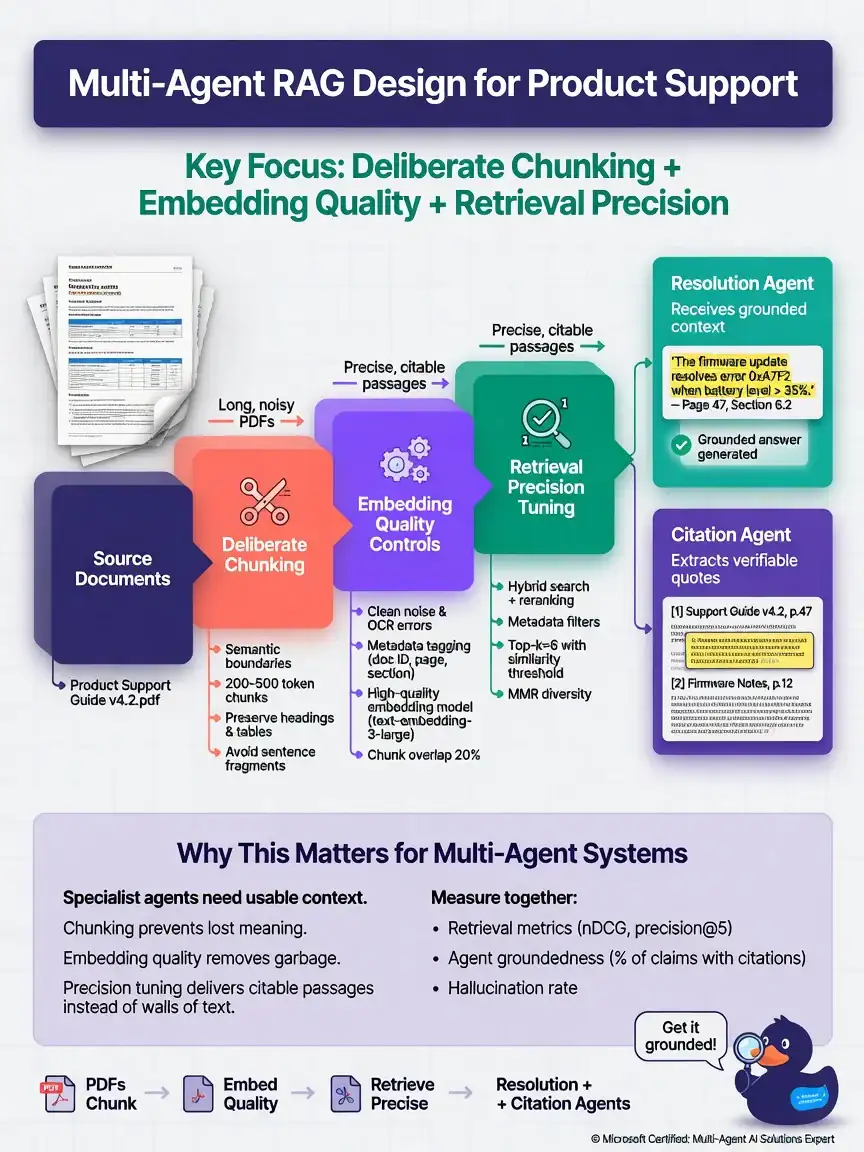
You need deliberate chunking, embedding quality controls, and retrieval precision tuning so each specialist agent gets grounded, citable passages. Whole-document vectors, random substrings, or pasting the whole corpus won't give precise answers at scale. Measure retrieval metrics and agent answer groundedness together.
Full Explanation
Multi-agent RAG needs chunking that preserves semantic units, high-quality embeddings, and retrieval precision, often with hybrid search. Agents may use the same knowledge plane with different filters, such as troubleshooting versus policy citations. The right focus is deliberate chunking, embedding quality controls, and retrieval precision tuning so downstream agents receive grounded, citable passages. Embedding each 200-page PDF as a single vector while ignoring chunking yields coarse vectors that rarely match specific issues. Using random substrings without embeddings and hoping keyword search is unnecessary abandons modern retrieval. Skipping retrieval and pasting the entire corpus into every agent prompt is not viable for large corpora or multi-tenant data. Implement metadata filters, re-ranking if needed, and pass structured citations to the citation agent. Evaluate retrieval separately from generation, and measure retrieval metrics and agent answer groundedness together.