
A retailer wants an autonomous system that, for each new product launch, researches competitors, drafts marketing copy, checks brand compliance, and schedules social posts. Stakeholders describe this as one mega-agent that “does everything.” As the solution architect, what is the most appropriate first logical-architecture step?
Select an answer to reveal the explanation.
Short Explanation
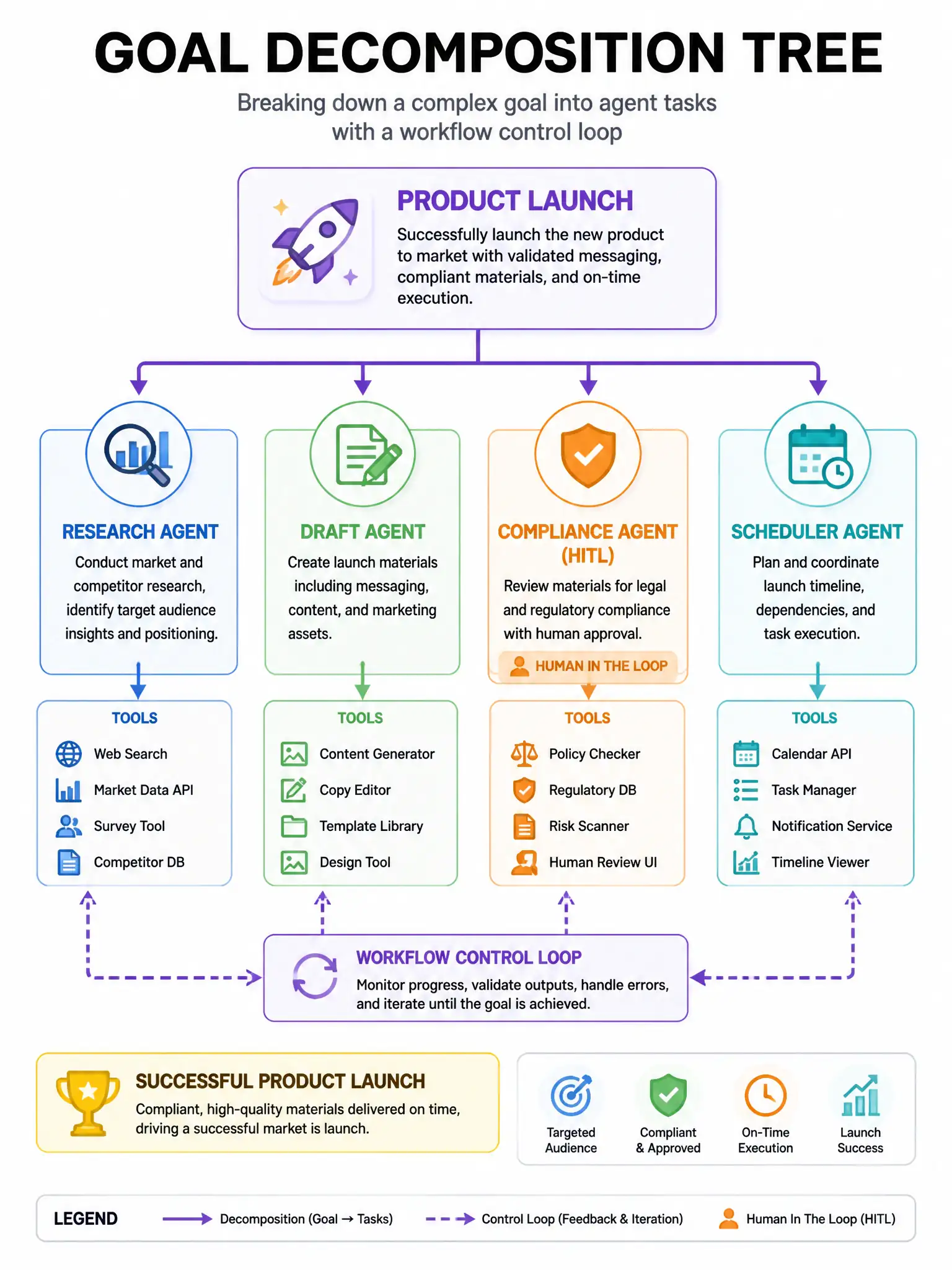
A 'mega-agent' is like hiring one person to be researcher, copywriter, lawyer and scheduler all at once, and it never works. You start by breaking the goal into scoped workflows, agents, subagents and tools, then decide where the control loops and human checkpoints sit, especially around brand risk. Once that map exists, you can pick models and frameworks with confidence.
Full Explanation
The AI-500 skills outline starts logical architecture with decomposing goals and objectives into workflows, agents, and tools, and then designing those workflows with subagents, control loops, and human-in-the-loop checkpoints. A product launch mixes very different tasks: competitor research, copywriting, brand-compliance review, and publishing. Each has its own data sources, tools, and risk level, so each deserves a defined scope and autonomy level. Mapping control loops shows where an agent retries or hands work back, and human checkpoints belong where a mistake is public and costly, such as approving brand-sensitive copy before it is scheduled. A single orchestrator with every tool and full autonomy concentrates permissions and failure modes in one place, and adding scopes and review only after production reverses the order responsible AI requires. Fine-tuning one model on historical marketing documents optimizes a model before any workflow contract exists, so it answers the wrong question first. Deploying unrelated chatbots with no shared workflow leaves coordination, memory, and observability to users, which is the opposite of an architecture. On the exam, the first step is design, not model selection or deployment. As a check, confirm that every agent in the design has a named scope, inputs and outputs, allowed tools, an autonomy level, and an escalation path.