
After implementing multi-stage guardrails for a multi-agent procurement assistant, the security team needs evidence that the controls block known attack classes before each release. Production traffic is sparse for rare jailbreaks. What is the best validation approach?
Select an answer to reveal the explanation.
Short Explanation
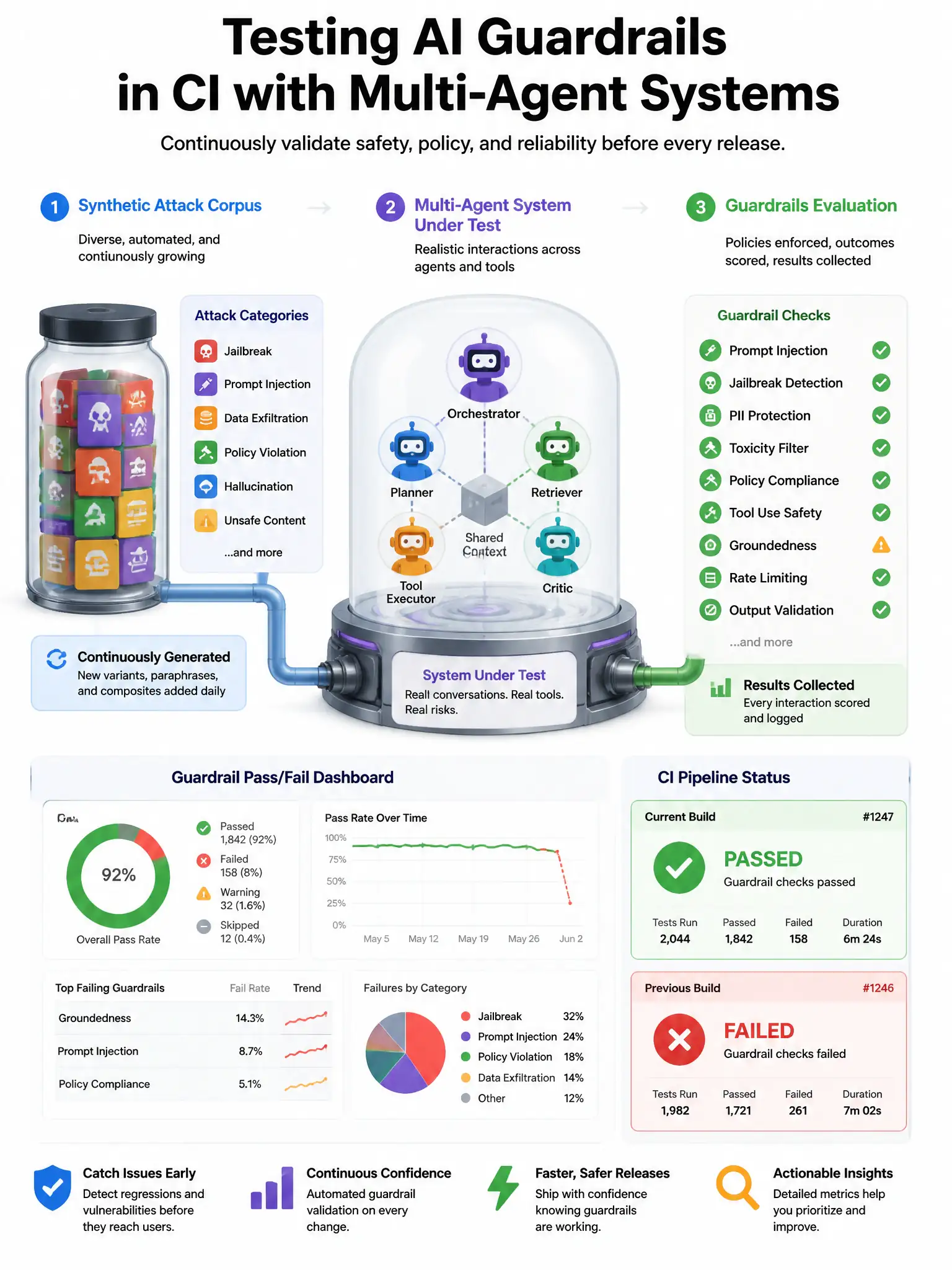
You need synthetic adversarial datasets covering prompt injection, tool-parameter tampering, and policy violations, then run automated guardrail evaluation in continuous integration against pass thresholds. Rare jailbreaks won't show up reliably in sparse production traffic, so you need curated adversarial suites every release. Waiting for incidents, one-off manual checks, or latency metrics won't prove the controls block known attack classes.
Full Explanation
Designing guardrails is incomplete without continuous validation. The best approach is to build and maintain synthetic adversarial datasets covering prompt injection, tool-parameter tampering, and policy violations, then run automated guardrail evaluation in continuous integration against pass thresholds. Synthetic datasets let you encode known jailbreak patterns, cross-agent injection, disallowed tool arguments (for example, shipping to unapproved vendors), and personal-data leakage cases. Automate evaluation so regressions fail the build when block rates drop below policy. Include benign cases to control over-blocking. Skipping pre-release testing and waiting for incidents is purely reactive. One-off manual checks by a single developer do not scale or detect drift after prompt or tool changes. Measuring only average token latency optimizes performance, not policy adherence. Combine synthetic suites with red-teaming agents and sampled human review for high-severity classes. Store results as release evidence for governance and regulated audits.