
You must roll out a major change to a multi-agent orchestration graph (new planner prompt, updated tool schemas, and a new subagent). Leadership wants limited user blast radius, fast rollback, and production traffic validation—not only lab evaluations. Which release methodology best fits?
Select an answer to reveal the explanation.
Short Explanation
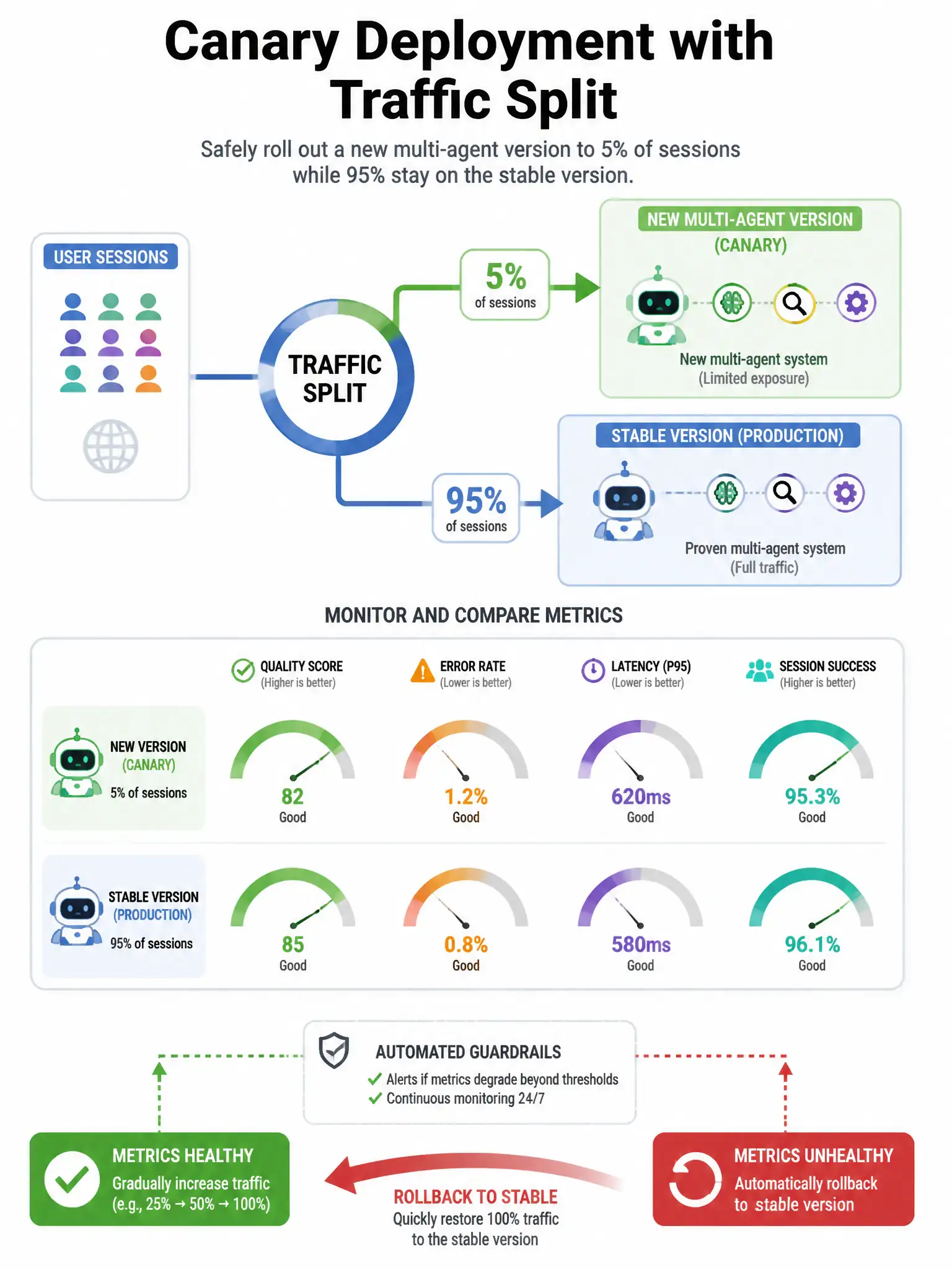
You need a canary release that sends a small percentage of production sessions to the new multi-agent version, monitors quality and error signals, then progressively increases traffic or rolls back. It gives leadership limited blast radius, fast rollback, and real production validation instead of lab-only proof.
Full Explanation
AI-500 covers release methodologies including DTAP, blue/green, and canary for multi-agent deployments. Agent changes are not purely binary code swaps—prompt, tool, and subagent interactions can fail only under live distributions. Canary routing (by percentage, cohort, or region) limits impact while capturing production traces and quality scores. Define success criteria: tool error rate, human override rate, groundedness, latency, and cost. Replacing all production agents at once during a weekend maintenance window with no partial traffic split is high risk for agentic systems. Shipping directly from a developer laptop to the production Foundry project when local demos look good violates multi-environment strategy. Keeping two permanent production forks forever and letting users choose which agent stack to use in the UI without observability becomes dual-running chaos without governance. Blue/green remains valid when you need instant environment swap; canary is preferred when you specifically need progressive production validation. Codify promotion and rollback in CI/CD rather than manual portal clicks.