
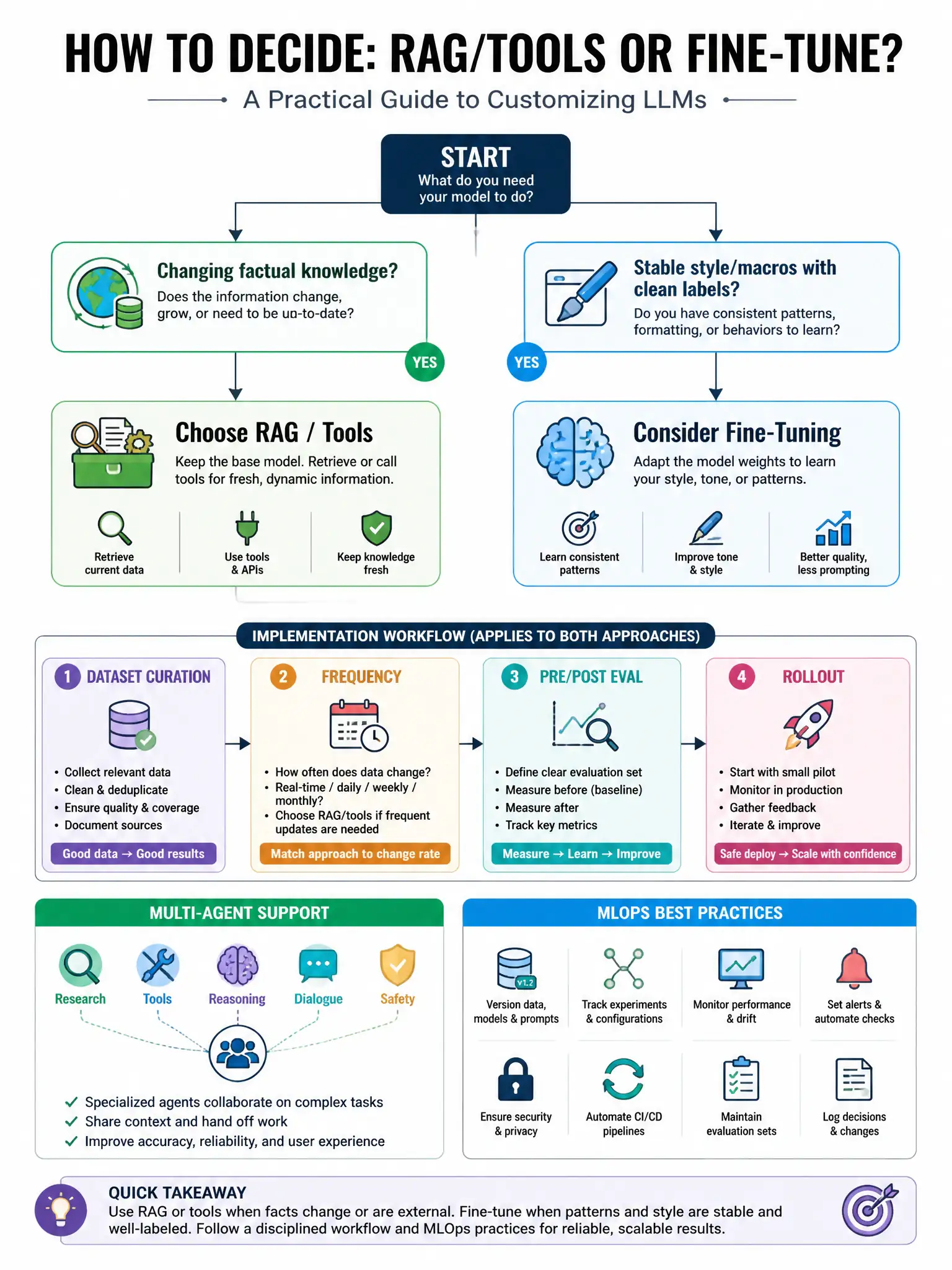
A support multi-agent system underperforms on company-specific resolution macros. Leaders ask about fine-tuning. Which strategy best aligns with multi-agent development guidance?
Select an answer to reveal the explanation.
Short Explanation
You don't fine-tune just because someone asks. You do it when the data and task fit: curate high-quality task-specific examples, set update frequency, evaluate specialists before and after, and keep retrieval-augmented generation and tools for fast-changing knowledge.
Full Explanation
The data-justified fine-tuning strategy is correct because developers may design fine-tuning strategies for agents/models, including data selection and update frequency, while recognizing retrieval-augmented generation and tools often handle enterprise knowledge better when content changes quickly. Ungoverned daily fine-tuning on unreviewed production logs including personal data is incorrect: it creates compliance risk. Fine-tuning a single model on unrelated images to improve text tool calling is incorrect: unrelated image fine-tunes do not address text resolution macros. Avoiding evaluation and shipping fine-tunes directly to production agents on Fridays is incorrect: shipping without evaluation risks regressions across the agent mesh. Measure specialist task success, not only generic loss curves.