
A bank is designing a Zero Trust multi-agent investment-research platform on Azure. Compliance demands that a compromised research agent must not be able to invoke trade-execution tools used by a separate trading agent. Which architectural specification best implements this requirement?
Select an answer to reveal the explanation.
Short Explanation
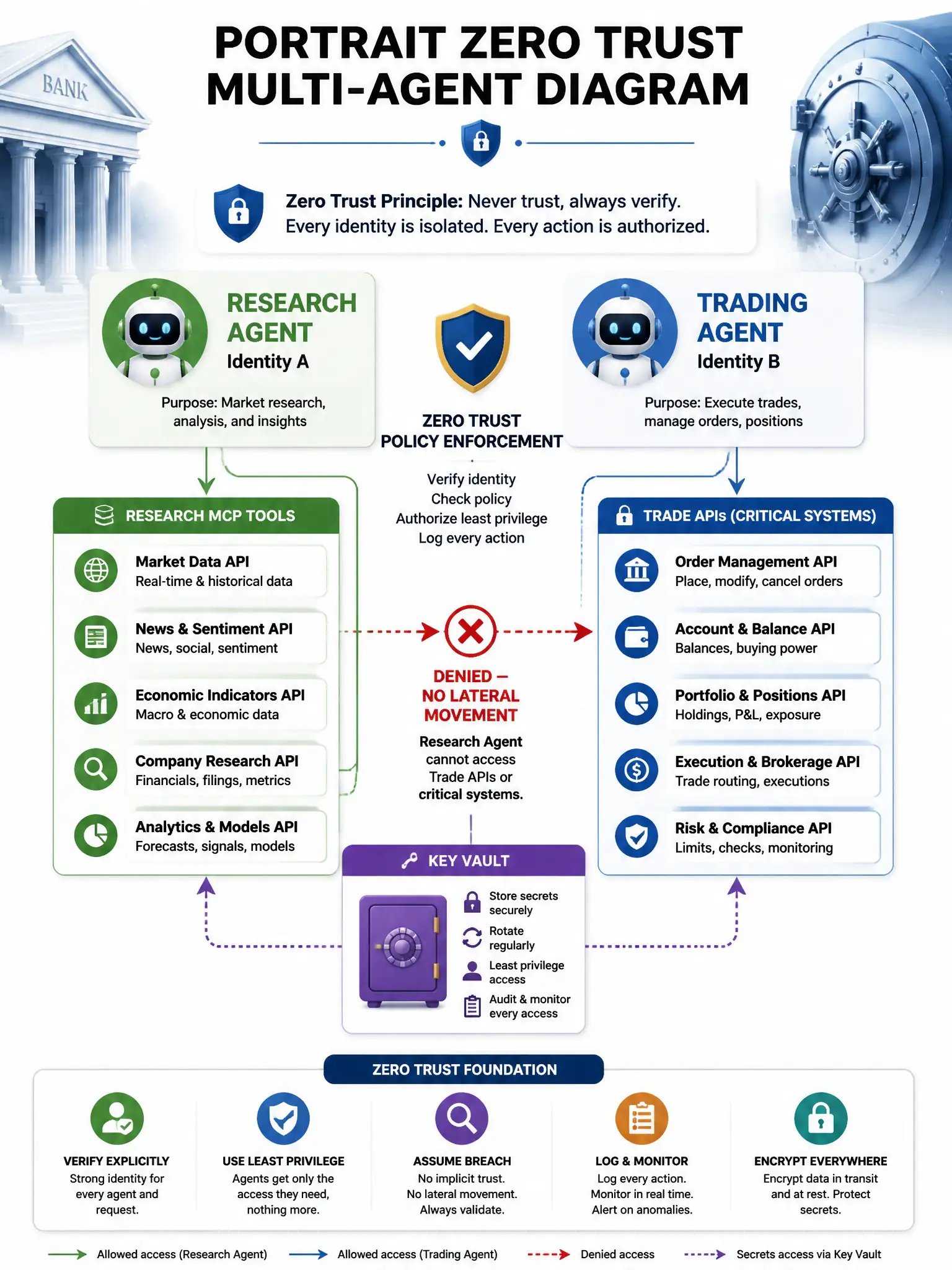
You want each agent to have its own identity and only the tools it needs. That stops a compromised research agent from reaching trade-execution tools because authorization is enforced at the tool gateway. Don't use shared identities, prompt secrets, or disabled logging; that's not Zero Trust.
Full Explanation
Distinct identities with role-scoped tool and data access, authorization at the tool/API boundary, and lateral-movement prevention are correct. This lets a compromised research agent call only research tools and knowledge sources, not trade-execution tools used by trading, because it lacks credentials and role-based access control for trading. The shared managed identity with Contributor access for operational simplicity is wrong because one fat identity maximizes blast radius. The shared API key stored in prompts, even with annual rotation, is wrong because it violates secrets management, such as Key Vault-backed retrieval, and prevents fine-grained attribution. Disabling tool-call logging is wrong because it undermines observability, forensics, and incident response. Specify unique identities, least-privilege tool scopes, network/API boundaries, and compliance mapping; pair identity scoping with structured authorization middleware and audited tool gateways.