
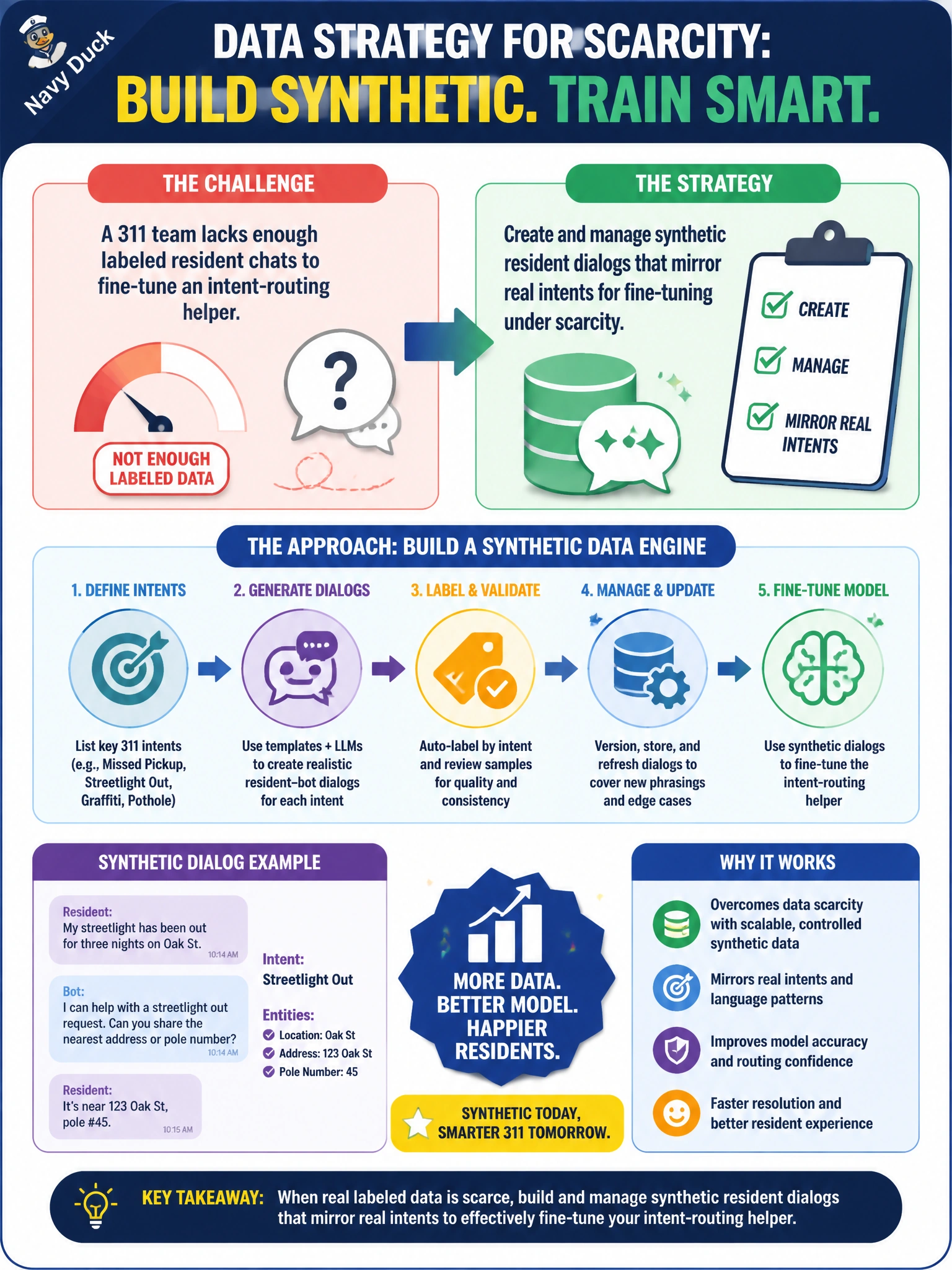
A 311 team lacks enough labeled resident chats to fine-tune an intent-routing helper. What data strategy should they use?
Select an answer to reveal the explanation.
Short Explanation
When real labeled chats are scarce, you grow a practice squad—synthetic dialogs that look like real 311 intents. Managed synthetic data fills the fine-tune set without waiting years for perfect labels. Generic templates, high-volume-only coverage, or FAQ-style wording won't teach you real routing — you'll miss how residents actually ask.
Full Explanation
Creating and managing synthetic resident dialogs that mirror real intents for fine-tuning under scarcity is the data strategy a 311 team should use when labeled resident chats are insufficient for an intent-routing helper. Synthetic dialogs can cover rare intents, balance classes, and avoid exposing raw PII while still teaching routing behavior. Managed synthetic data is a standard GenAIOps response to labeled-data scarcity in civic contact centers.
Creating and managing synthetic resident dialogs that reuse generic templates for fine-tuning under scarcity still leaves real resident phrasing variation uncovered; reusing the same generic structures reinforces templated patterns without mirroring the diverse intents and language synthetic generation must provide. Creating and managing synthetic resident dialogs that favor high-volume intents for fine-tuning under scarcity reproduces class imbalance and leaves rare and underrepresented intents uncovered instead of balancing coverage across the real intent taxonomy. Creating and managing synthetic resident dialogs that mirror FAQ wording patterns for fine-tuning under scarcity does not give the model real resident dialog patterns; FAQ wording is one-way informational text, not two-way chats, so it cannot teach intent routing between resident messages and city responses.
Exam caveat: synthetic data must still be versioned, quality-checked, and aligned to real intent taxonomies; scarcity justifies synthesis, not ungoverned scraping. Prefer synthetic generation when stems cite lack of labeled civic chats.
Operational check: generate synthetic 311 dialogs mapped to the official intent schema, validate a sample with human reviewers for realism and PII absence, version the dataset, fine-tune, and compare intent-routing F1 on a held-out real (redacted) eval set before promotion.
Prefer to study offline? Printable PDF study book + test engine ($7.50, unofficial). These questions stay free here.