
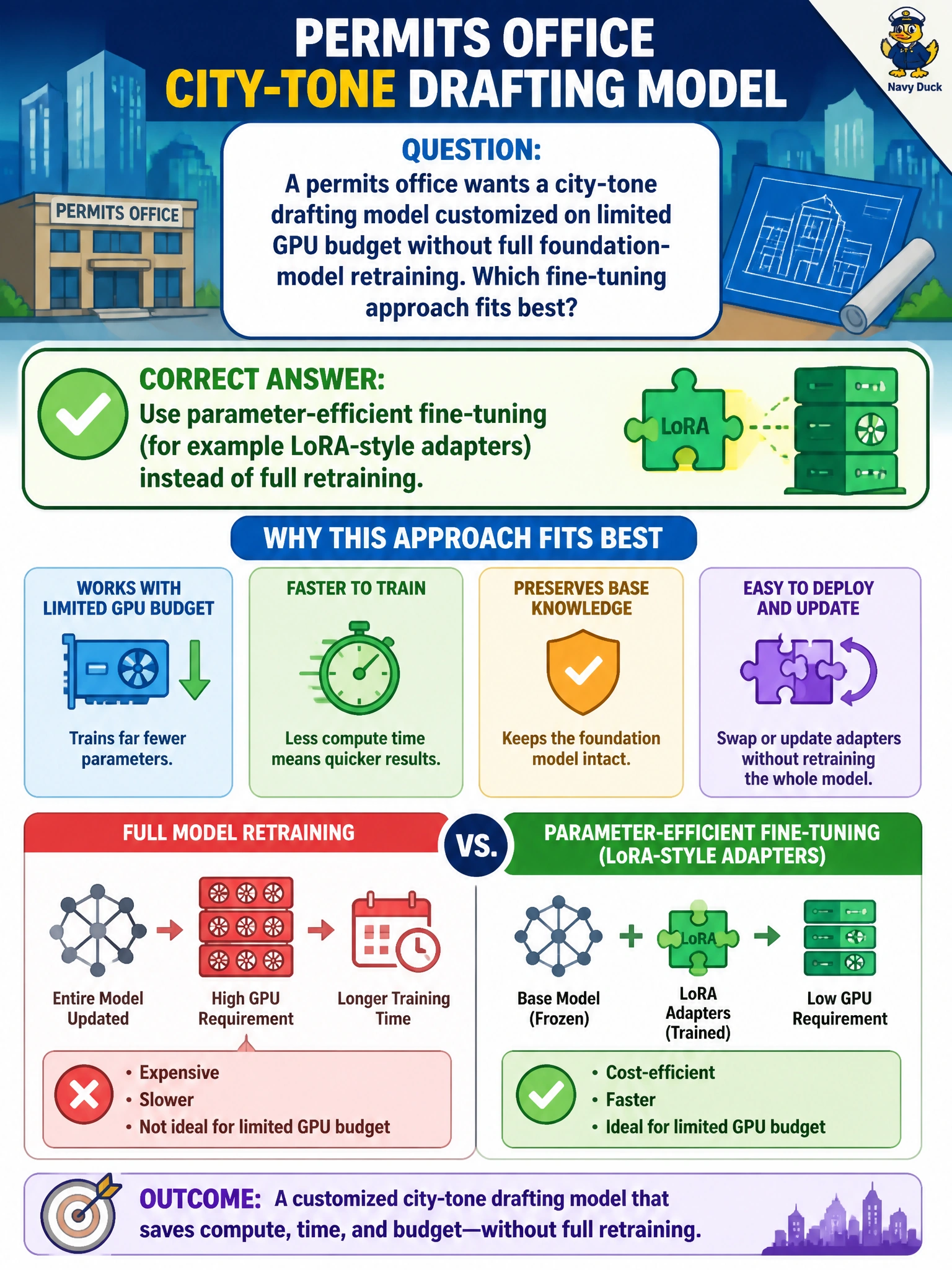
A permits office wants a city-tone drafting model customized on limited GPU budget without full foundation-model retraining. Which fine-tuning approach fits best?
Select an answer to reveal the explanation.
Short Explanation
You don't need to rebuild city hall to change the lobby paint. Parameter-efficient fine-tuning—LoRA-style adapters—tweaks a small adapter for city tone without retraining every weight. That fits limited municipal GPU budgets.
Full Explanation
Using parameter-efficient fine-tuning such as LoRA-style adapters instead of full retraining best fits a permits office that wants a city-tone drafting model customized on a limited GPU budget without full foundation-model retraining. PEFT updates a small set of adapter parameters while freezing most base weights, delivering municipal voice customization at far lower compute and storage cost than training every parameter. That matches the stem’s budget and scope constraints for city-tone drafting.
Using prompt-tuning with trainable soft prompts while updating pretrained backbone weights jointly defeats the purpose of prompt-tuning, because jointly updating the backbone reintroduces full-model compute and memory costs that exceed the permits office’s limited GPU budget—exactly the full-retraining cost the stem says to avoid. Using adapter-based instruction tuning with full-rank updates across core transformer layers requires training dense full-rank matrices through the core layers, which costs nearly as much compute and memory as a full fine-tune and breaks the limited-budget constraint that low-rank adapters are designed to solve. Using direct preference optimization with large-scale rollout sampling for tone adaptation adds expensive large-scale sampling and preference-optimization overhead that far exceeds a limited GPU budget, and it misapplies heavy alignment machinery to a straightforward municipal-tone customization that lightweight adapters handle more efficiently.
Exam caveat: PEFT/LoRA is the go-to answer when stems stress limited GPU budget or avoiding full retraining while still customizing behavior. Distinguish PEFT from prompt-tuning with joint backbone updates, from adapter tuning with full-rank updates across core layers, and from direct preference optimization with large-scale rollout sampling, all of which reintroduce heavy compute that violates the limited-budget constraint.
Operational check: train LoRA adapters on approved permits-office drafting examples, evaluate tone and factual groundedness against a city style rubric, measure GPU hours versus a full fine-tune baseline, and deploy adapters through a registered model path rather than laptop copies.
Prefer to study offline? Printable PDF study book + test engine ($7.50, unofficial). These questions stay free here.