
A municipal open-data narrator must reliably retrieve ward names and local toponyms in resident questions. How should the team choose among embedding models?
Select an answer to reveal the explanation.
Short Explanation
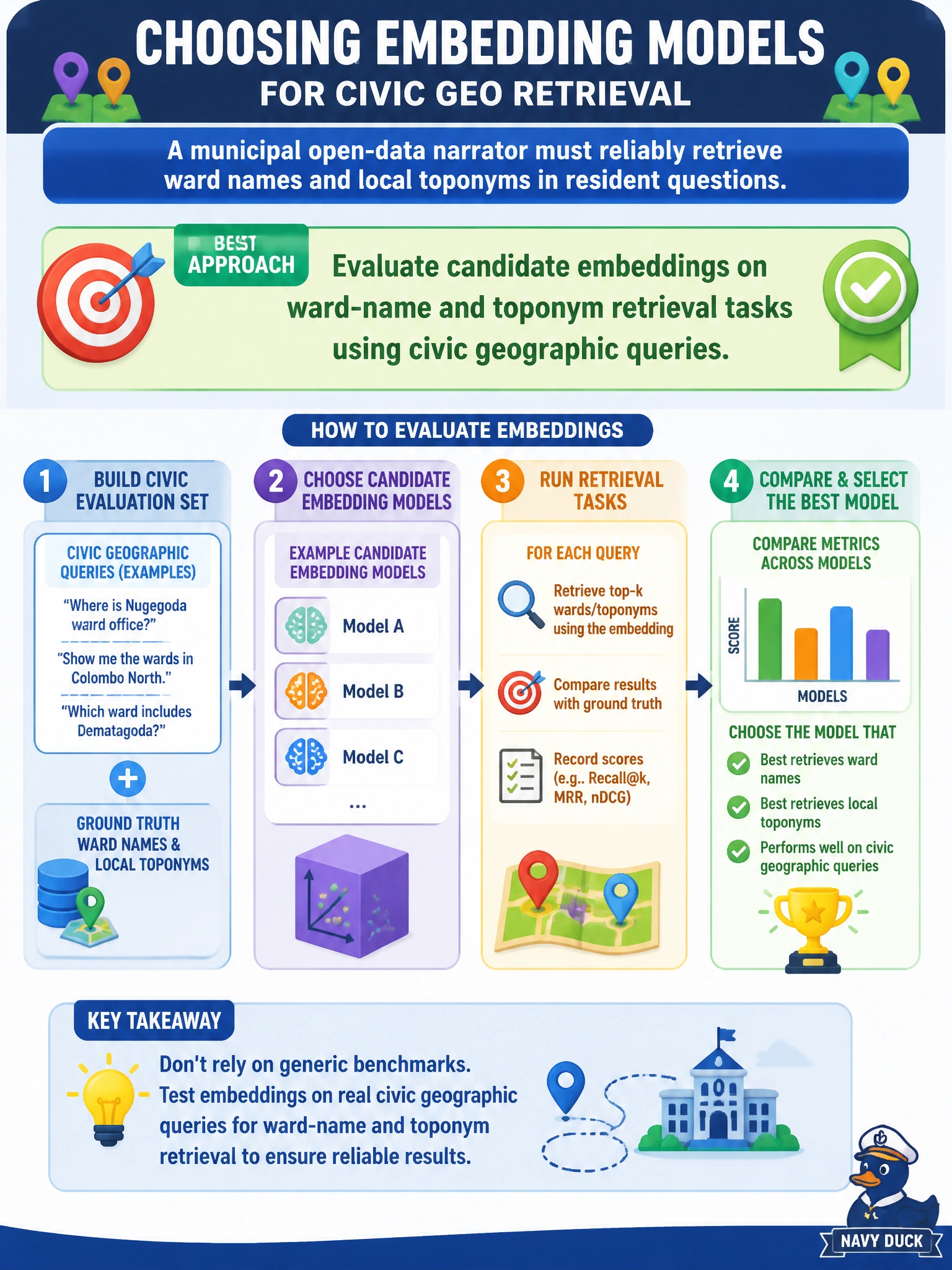
Ward names and local nicknames are picky—test embeddings on those exact retrieval tasks. A model that aces generic English may still flub “Ward 7” versus a park alias. Generic academic semantic-similarity benchmarks won’t tell you if it retrieves the right ward.
Full Explanation
Evaluating candidate embeddings on ward-name and toponym retrieval tasks using civic geographic queries is how the team should choose among embedding models for a municipal open-data narrator. Local place names, ward labels, and neighborhood toponyms are high-value civic entities; models differ in how well they encode them. Task-specific retrieval tests on real resident geographic phrasing select the embedding that actually ranks the right open-data slices, not the one that scores highest on generic academic semantic-similarity benchmarks.
Comparing candidates on generic semantic similarity benchmarks using standard academic datasets substitutes leaderboard performance for evidence on ward and toponym retrieval. Selecting embeddings by vector dimension and indexing throughput using production latency profiles confuses engineering metrics with geographic retrieval fitness. Prioritizing embeddings with broad multilingual coverage using national language identification benchmarks ignores local place-name matching and fails the civic narration task.
Exam caveat: embedding selection should be driven by the retrieval tasks that matter for the civic corpus—here toponyms and wards—not by generic leaderboard fame. Geographic entity handling can diverge from general English MTEB scores.
Operational check: assemble a ward/toponym query set with graded open-data documents, score each candidate embedding on recall@k and nDCG, include paraphrases and informal neighborhood names, and promote the checkpoint that wins on civic geo queries while remaining acceptable on broader FAQ retrieval.
Prefer to study offline? Printable PDF study book + test engine ($7.50, unofficial). These questions stay free here.