
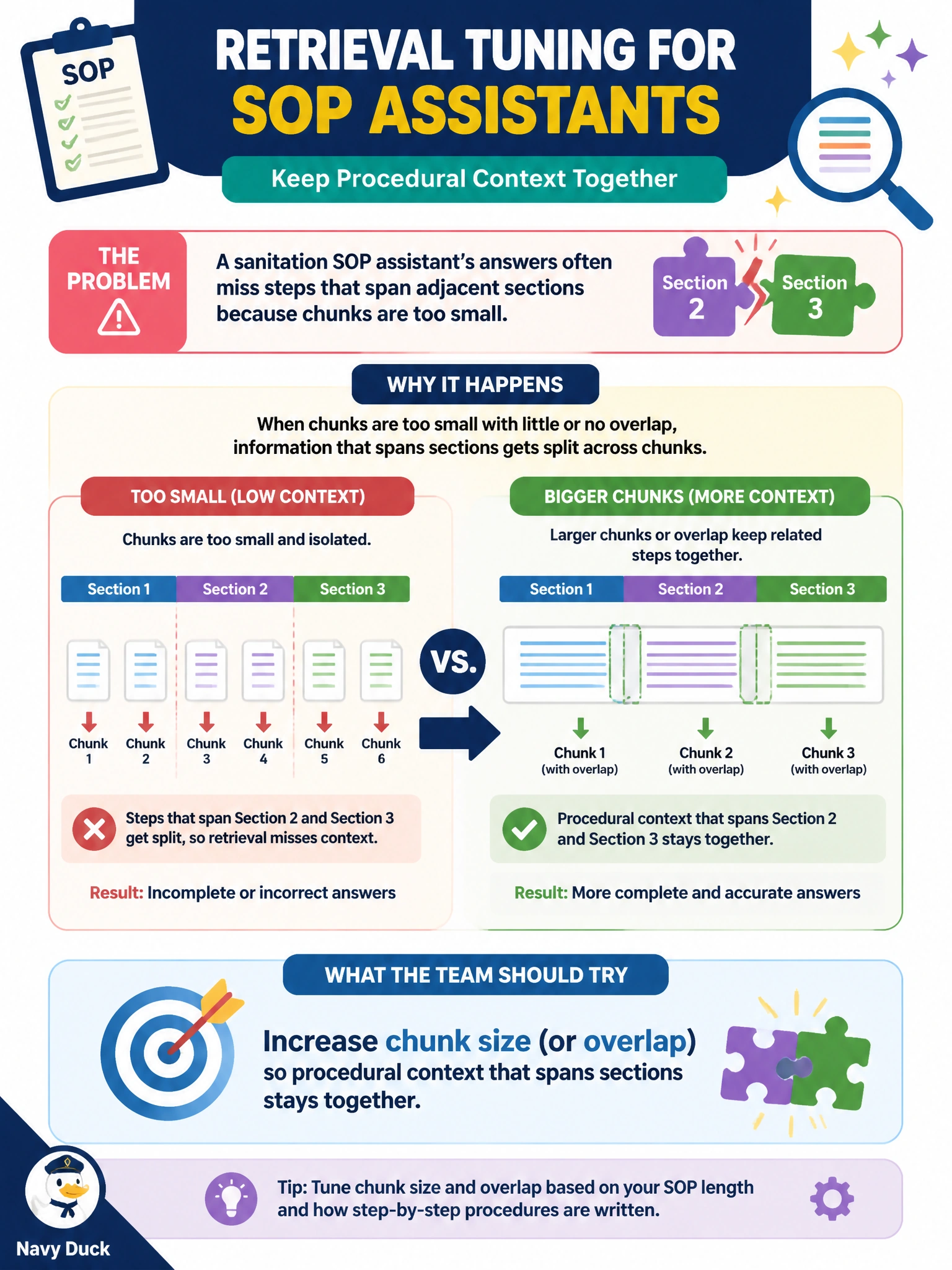
A sanitation SOP assistant’s answers often miss steps that span adjacent sections because chunks are too small. What retrieval tuning should the team try?
Select an answer to reveal the explanation.
Short Explanation
Tiny chunks are like tearing a recipe into single lines—you lose the “then do this” flow, and shrinking chunks further, cutting overlap, or keeping overlap minimal will just split steps more so it won't fix it for you. Bumping chunk size or overlap keeps multi-step sanitation procedures in one retrieveable bite, which is the real fix for cross-section steps.
Full Explanation
Increasing chunk size or overlap so procedural context that spans sections stays together is the retrieval tuning a sanitation SOP assistant should try when answers miss steps that cross adjacent sections because chunks are too small. Small fragments sever numbered procedures mid-sequence; larger windows or overlapping windows keep predecessor and successor steps in the same retrieved context so the generator can narrate complete municipal SOPs. That directly targets the stated failure mode without discarding structure.
The option to decrease chunk size (and overlap) so SOP section steps stay isolated for precise lookup would make the missing cross-section steps worse, as smaller isolated fragments further sever the sequential procedural context that spans adjacent sections instead of keeping predecessor and successor steps together. Keeping chunk size the same but reducing overlap to limit redundant text across sections fails to fix the missing cross-section steps, because less overlap means boundaries are more likely to split predecessor and successor steps into different fragments instead of keeping them together in the generator’s context. The option to increase chunk size with minimal overlap so sections stay separate for concise retrieval does not solve the missing cross-section steps, because minimal overlap still lets section breaks sever the sequence and deliberately keeping sections separate prevents predecessor and successor steps from landing together in the same retrieved context.
Exam caveat: chunk size and overlap are complementary levers—overlap helps boundary straddling even when average chunk size is moderate. Prefer size/overlap tuning when stems cite steps spanning adjacent sections; avoid the option to decrease chunk size (and overlap) so SOP section steps stay isolated for precise lookup or the option to increase chunk size with minimal overlap so sections stay separate for concise retrieval when the need is contiguous procedure span rather than concise isolated lookup.
Operational check: sample sanitation procedures known to cross section breaks, compare step completeness and groundedness before and after larger/overlapping chunks, watch context-window and cost growth, and ensure headings or section IDs remain in chunk metadata for citation.
Prefer to study offline? Printable PDF study book + test engine ($7.50, unofficial). These questions stay free here.