
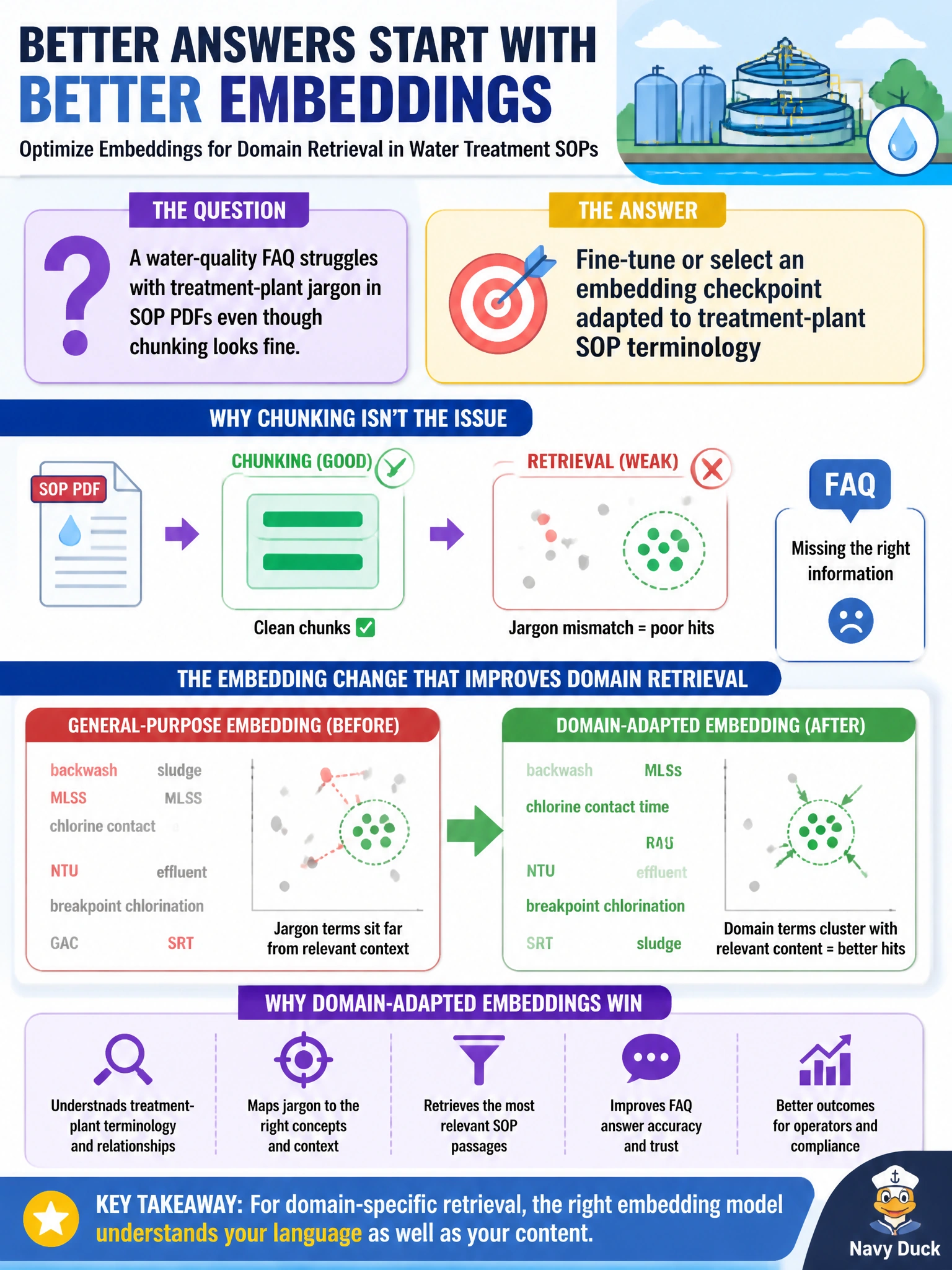
A water-quality FAQ struggles with treatment-plant jargon in SOP PDFs even though chunking looks fine. What embedding change best improves domain retrieval?
Select an answer to reveal the explanation.
Short Explanation
Plant SOPs speak their own dialect—SCADA tags, residual ranges, the whole alphabet soup. A domain-adapted embedding checkpoint learns that dialect so retrieval stops missing the right sections. Deploying a larger embedding checkpoint trained on broad web text for SOP terminology still won’t catch how you actually write as operators.
Full Explanation
Fine-tuning or selecting an embedding checkpoint adapted to treatment-plant SOP terminology is the embedding change that best improves domain retrieval for a water-quality FAQ. Chunking may already be sound, yet generic embeddings often under-represent plant jargon—SCADA tags, residual ranges, chemical names, and utility-specific abbreviations—so semantically correct SOP sections rank poorly. A domain-adapted embedding moves those specialized terms into a vector space that better matches how operators phrase FAQ questions, raising retrieval quality without abandoning vector search.
Deploying a larger embedding checkpoint trained on broad web text for SOP terminology fails because it still under-represents treatment-plant jargon—SCADA tags, residual ranges, and utility abbreviations—so semantically correct SOP sections rank poorly. Raising vector dimensions of the general embedding checkpoint for SOP terminology coverage addresses vector size, which the stem already says is not the issue, and leaves the actual cause—an embedding space that under-represents plant jargon—completely untouched. Tuning embedding normalization and dot-product scoring for treatment-plant SOP terminology addresses scoring mechanics, which the stem already says are not the issue, and leaves the actual cause—an embedding space that under-represents plant jargon—completely untouched.
Exam caveat: domain embedding adaptation addresses vocabulary mismatch; it does not fix under-represented jargon by simply raising vector dimensions of the general embedding checkpoint for SOP terminology coverage, missing metadata filters, or absent keyword fusion for exact chemical codes. Choose embedding adaptation when the stem says chunking looks fine but specialized municipal jargon still hurts retrieval.
Operational check: build a small set of water-utility queries rich in plant terms, compare recall@k and nDCG for the larger embedding checkpoint trained on broad web text for SOP terminology versus adapted checkpoint on the same SOP chunks, and promote only if domain retrieval gains hold without regressing general FAQ topics.
Prefer to study offline? Printable PDF study book + test engine ($7.50, unofficial). These questions stay free here.