
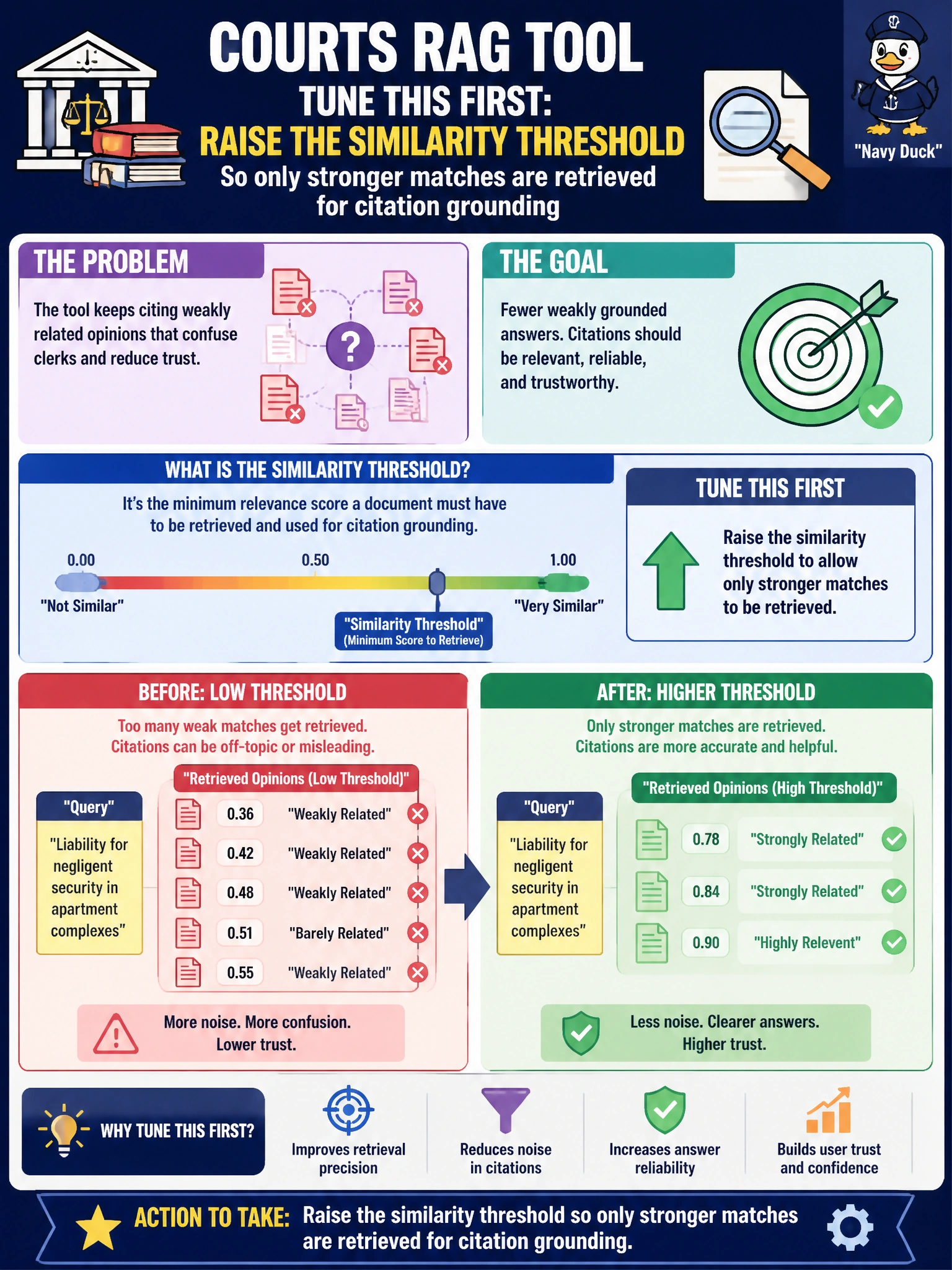
A courts RAG tool keeps citing weakly related opinions that confuse clerks. Engineers want fewer weakly grounded answers without rewriting the whole index. What should they tune first?
Select an answer to reveal the explanation.
Short Explanation
Think of the similarity threshold like a bouncer at the clerk's door—only strong matches get in. Raising it cuts the weakly related opinions that were feeding shaky citations. Lowering the temperature won't give you only stronger matches, since it just makes the output less random and still lets weak matches through.
Full Explanation
Raising the similarity threshold is the correct first retrieval control when a courts RAG tool cites weakly related opinions that confuse clerks. Similarity thresholds gate which chunks enter the grounding context: increasing the bar keeps only stronger vector matches and shrinks the set of loosely related opinions that the generator can treat as citation-worthy. That change improves groundedness unlike lowering the generation temperature, which does not generate only stronger matches because temperature controls sampling randomness, not retrieval filtering, and does not stop weakly related opinions from being retrieved—exactly the scoped fix the stem asks for when engineers want fewer weakly grounded answers without rewriting the whole index.
Lowering the generation temperature does not generate only stronger matches; it only controls generation randomness and leaves the similarity gate untouched, so weakly related opinions are still retrieved and cited just as before. Expanding queries with synonyms does not retrieve only stronger matches; it broadens recall, which pulls in even more loosely related opinions and worsens the weakly grounded citation problem the clerks already see. Increasing top-k modestly does not retrieve only stronger matches; it still keeps the same loose similarity gate, so it just gives the model more weakly related candidates to cite from instead of fixing the grounding problem.
Exam caveat: threshold tuning is a precision–recall trade-off, not a substitute for bad chunking, wrong embedding domains, or missing hybrid keyword paths for exact case identifiers. On AI-300-style items, prefer the least-disruptive retrieval control that matches the stated failure mode—here, weak matches—before scorched-earth redesigns.
Operational check: after raising the threshold, re-score a fixed courts eval set for citation relevance and groundedness, sample clerk-facing answers for over-filtering of legitimate nearby opinions, and confirm top-k still returns enough strong passages to support multi-issue clerk questions.
Prefer to study offline? Printable PDF study book + test engine ($7.50, unofficial). These questions stay free here.