
A grants chatbot SLO pack must reflect both resident wait time and spend efficiency. Which combination belongs in the pack?
Select an answer to reveal the explanation.
Short Explanation
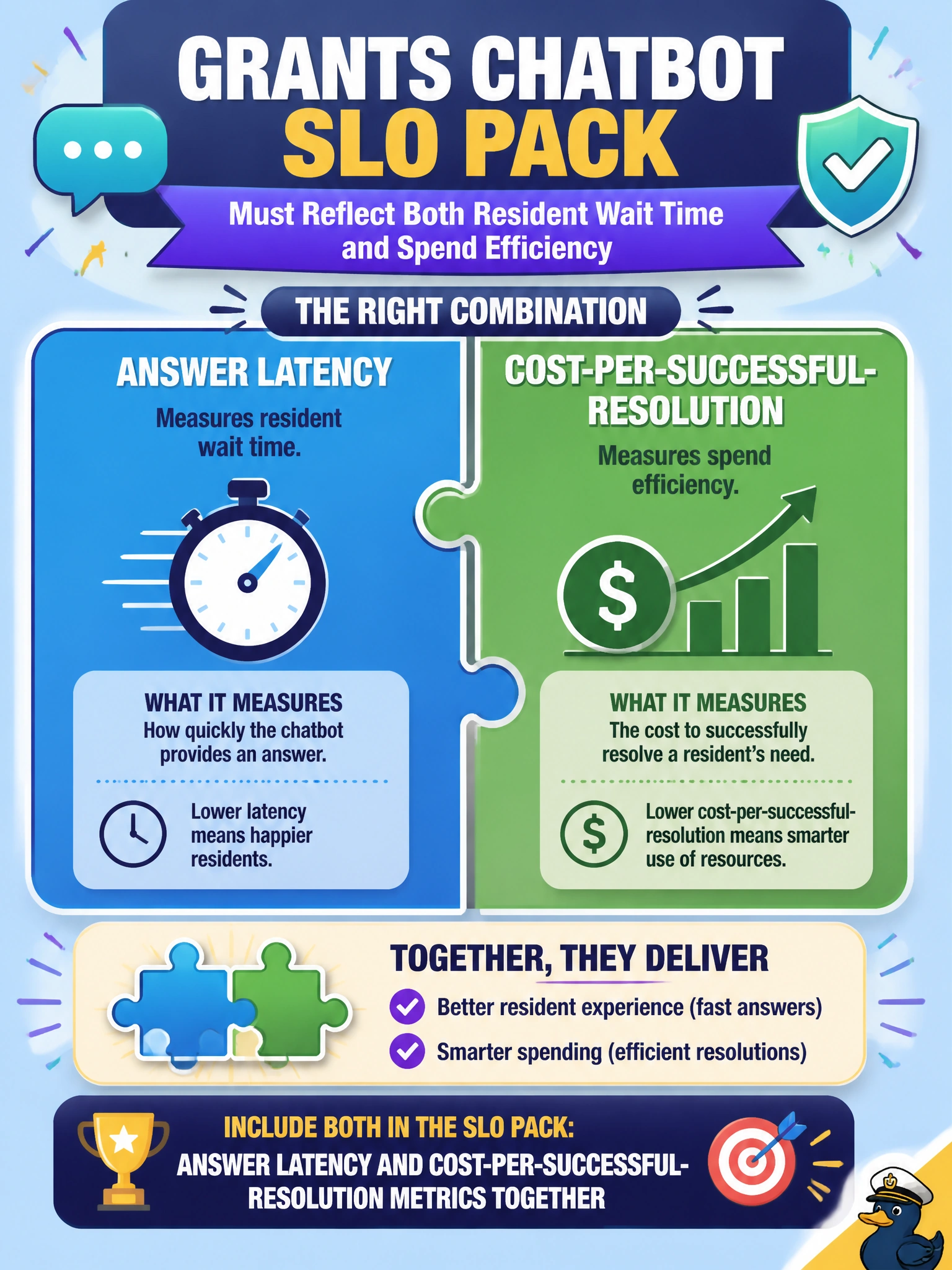
Residents care about speed; finance cares about cost per win. Put both answer latency and cost-per-successful-resolution in the SLO pack. You'll still miss the mark with P95 answer latency and average GPU cost per hour because it's an hourly infrastructure rate, not what you spend per successful win.
Full Explanation
Including answer latency and cost-per-successful-resolution metrics together is correct because civic GenAI SLOs often balance resident experience with appropriation stewardship. A grants chatbot must answer quickly enough for applicants and resolve intents efficiently enough that spend per successful resolution stays sustainable. Packaging both latency and cost-per-successful-resolution into the SLO pack gives product owners dual targets that reflect wait time and spend efficiency named in the stem.
Time to first token and cost-per-thousand-tokens metrics together track a partial latency signal and aggregate token pricing, but they do not measure whether applicants get a complete answer quickly or what each successful resolution actually costs, so they miss both the resident wait-time and per-resolution efficiency the stem requires.
Answer latency and total monthly token consumption metrics together show how long applicants wait and how many tokens are used overall, but total token consumption is not spend efficiency per successful resolution, so the pack still lacks the cost-per-outcome view the stem requires.
P95 answer latency and average GPU cost per hour metrics together cover wait time with a strong latency percentile, but average GPU cost per hour tracks infrastructure hourly rate rather than spend efficiency per successful resolution, so they do not form the latency-and-efficiency pack the stem requires.
Exam caveat: SLO packs can combine performance and cost. When the stem asks for resident wait time and spend efficiency, choose latency plus cost-per-successful-resolution—not aggregate token metrics or average GPU cost per hour.
Operational check: define numeric targets for answer latency (for example p95) and cost per successful grants resolution, instrument both in production monitoring, review them in the grants ops cadence alongside quality metrics, and trigger capacity or prompt-efficiency work when either SLO trends toward breach.
Prefer to study offline? Printable PDF study book + test engine ($7.50, unofficial). These questions stay free here.