
A housing agent fails eligibility checks when tool calls break, and support needs to debug production. What observability capability helps most?
Select an answer to reveal the explanation.
Short Explanation
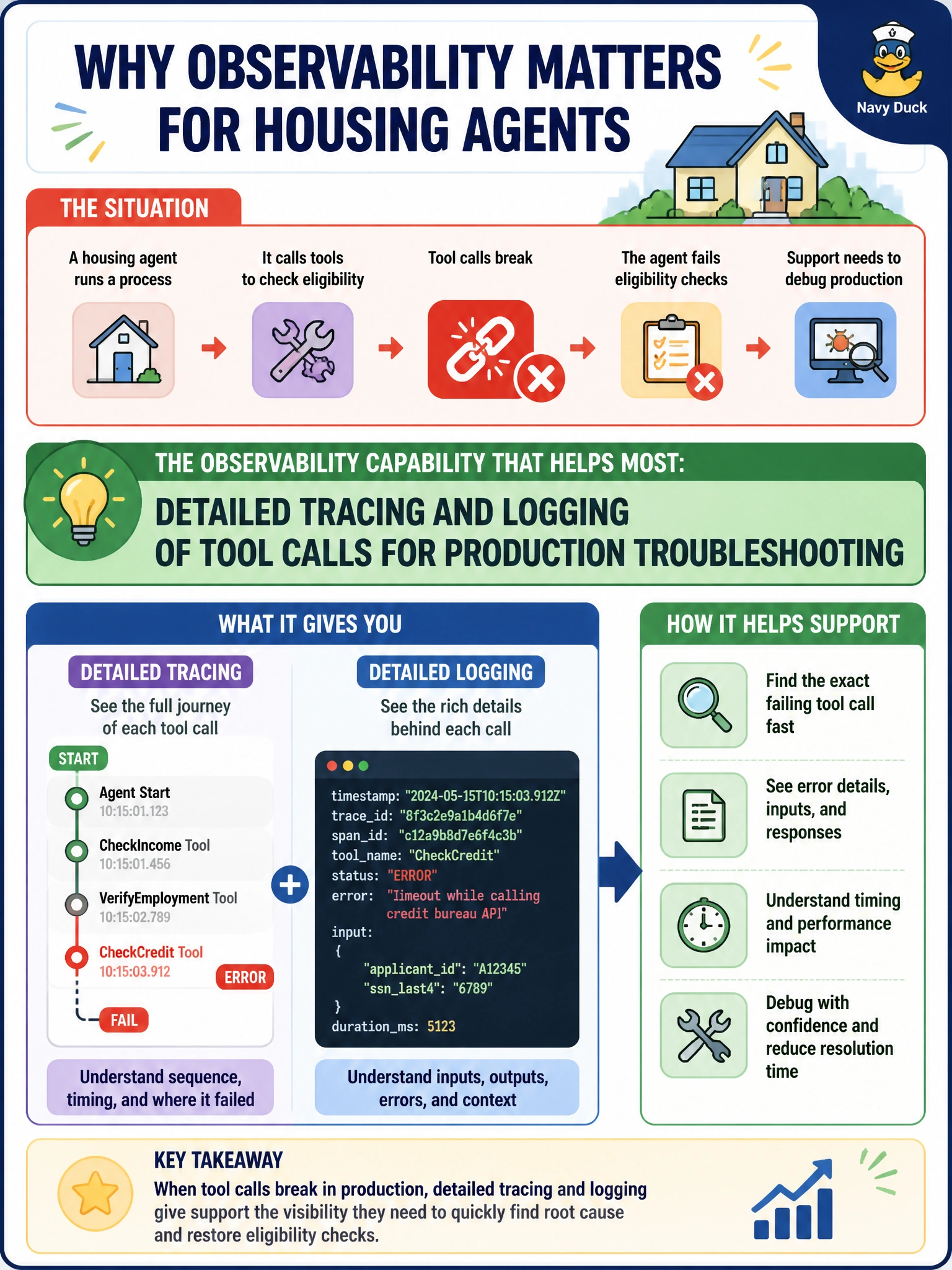
When eligibility tools fail, you need a breadcrumb trail. Detailed tracing of tool calls lets support see where the agent tripped.
Full Explanation
Detailed tracing and logging of tool calls for production troubleshooting is correct because agent failures often occur at tool boundaries—authentication, schema mismatch, timeout, or bad tool results—not only inside the foundation model. A housing agent that fails eligibility checks when tool calls break needs traces that show which tool ran, with what arguments, what response or error returned, and how the agent continued. That observability lets municipal support debug production eligibility failures instead of relying on cached response summaries of tool calls for production troubleshooting, which reuse old outputs and hide the live arguments and errors. Aggregated success counts of tool calls for production troubleshooting summarize overall health but omit the per-tool-call detail support needs to investigate a specific eligibility failure, so they trade debuggability for high-level trend visibility. Sampled latency averages of tool calls for production troubleshooting track average timing from a subset of calls, not the specific arguments, responses, and errors support needs to investigate a specific eligibility failure. Cached response summaries of tool calls for production troubleshooting yield reused, incomplete, and non-reproducible signals for GenAIOps triage of a live eligibility failure. Exam caveat: agent observability emphasizes traces across model, retrieval, and tool-call spans. When the stem cites tool-call breakage, detailed tool tracing—not aggregated success counts of tool calls for production troubleshooting or sampled latency averages of tool calls for production troubleshooting—is the answer. Operational check: enable end-to-end traces with tool-call spans and structured logs, retain correlation IDs, reproduce a failed eligibility check in staging from a production trace, fix the tool contract or timeout, and verify success rate recovery in continuous monitoring before closing the incident.
Prefer to study offline? Printable PDF study book + test engine ($7.50, unofficial). These questions stay free here.