
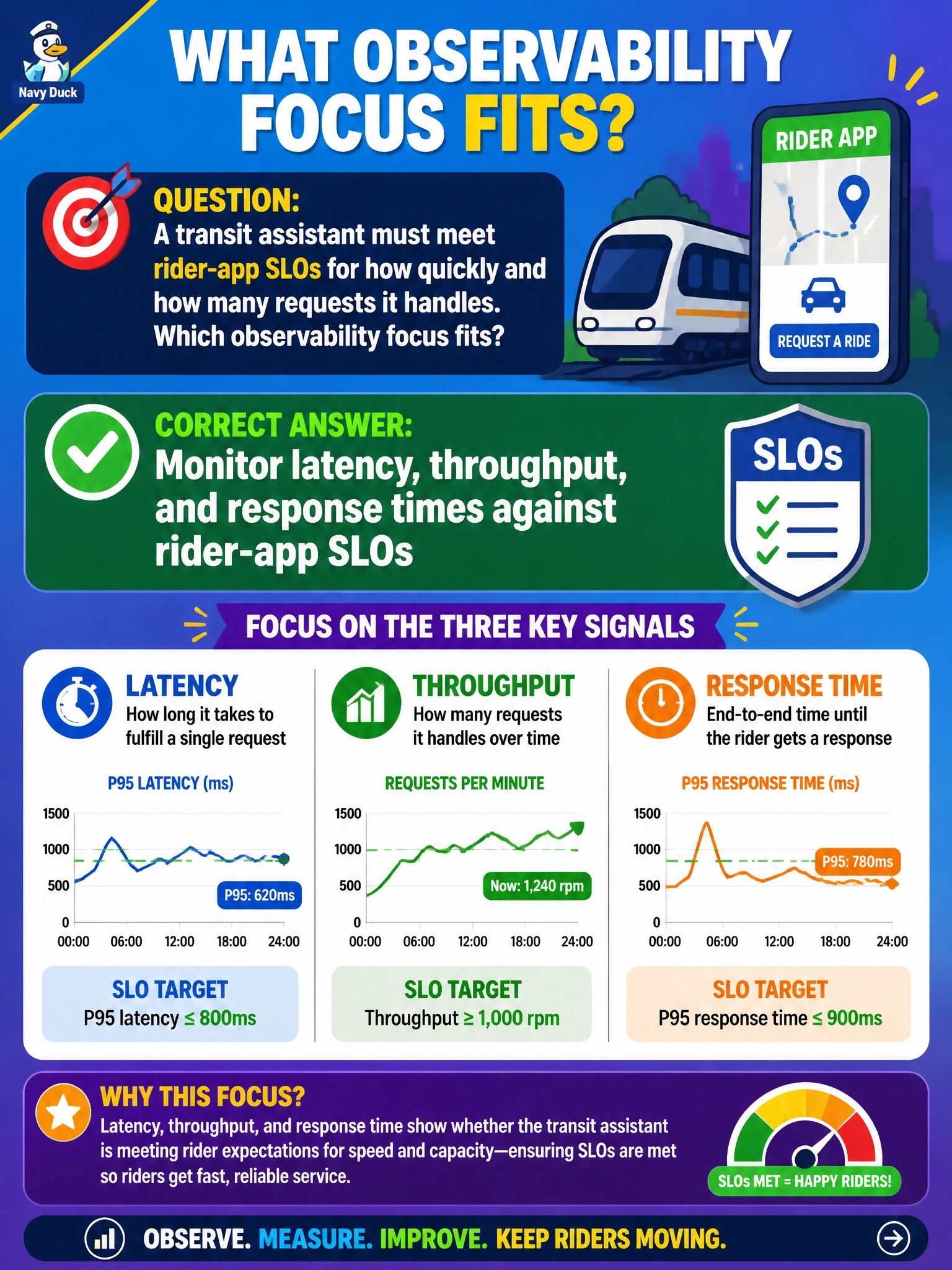
A transit assistant must meet rider-app SLOs for how quickly and how many requests it handles. Which observability focus fits?
Select an answer to reveal the explanation.
Short Explanation
You won't meet live rider SLOs by watching batch scoring, training, or offline eval SLOs since those don't reflect live serving. Watch latency, throughput, and response times against the app's SLOs.
Full Explanation
Monitoring latency, throughput, and response times against rider-app SLOs is correct because GenAI observability for customer-facing assistants must include performance signals that residents feel. A transit assistant embedded in a rider app succeeds only if it answers quickly enough and handles the expected request volume under peak commute load. Tracking latency, throughput, and response times against published rider-app SLOs makes degradations visible before they breach municipal service targets and drive app-store complaints or missed transfer decisions.
Monitoring latency, throughput, and timing against batch scoring SLOs fails because those batch metrics describe offline scheduled jobs, not inference-time speed or request volume for a deployed assistant. Monitoring latency, throughput, and response times against training SLOs can show healthy training jobs while the assistant itself answers slowly, so it misses exactly the request-level delay and throughput riders feel. Monitoring latency, throughput, and response times against offline eval SLOs assumes strong offline test performance equals sustained capacity under real transit demand patterns, but it says nothing about whether the assistant meets rider latency and throughput SLOs.
Exam caveat: GenAI observability spans quality (relevance/groundedness/safety) and performance (latency/throughput/response time). When the stem emphasizes rider-app SLOs for speed and request volume, performance monitoring against those SLOs is the fit.
Operational check: instrument p50/p95 latency, throughput, and error rates for the transit assistant endpoints, compare them to rider-app SLO budgets during peak windows, alert on breach, and capacity-plan (scale, caching, PTU/quota) before known ridership events.
Prefer to study offline? Printable PDF study book + test engine ($7.50, unofficial). These questions stay free here.