
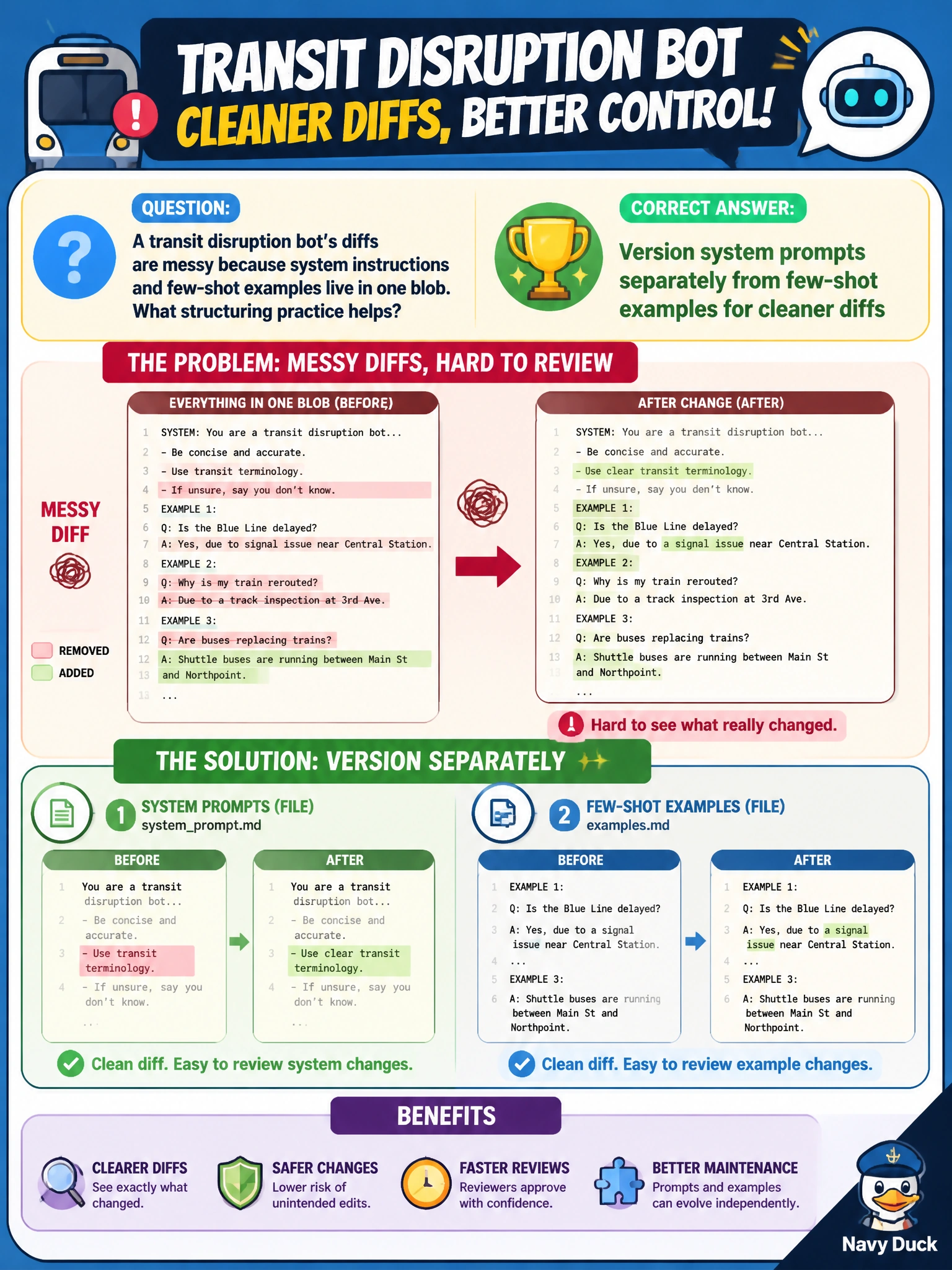
A transit disruption bot’s diffs are messy because system instructions and few-shot examples live in one blob. What structuring practice helps?
Select an answer to reveal the explanation.
Short Explanation
Versioning user queries separately won't help you because they're runtime inputs, so your system prompt and examples stay tangled. Split system prompts from few-shot examples so transit changes show up as clean diffs.
Full Explanation
Versioning system prompts separately from few-shot examples produces cleaner diffs for a transit disruption bot and makes GenAIOps reviews tractable. System instructions encode role, safety, and channel policy; few-shot examples encode style and edge-case behavior. Versioning user queries separately from few-shot examples misses the real blob because user queries are transient runtime inputs, not versioned prompt assets, so reviewers still cannot approve examples without also parsing core instructions that govern rider messaging during outages. Versioning user queries separately from few-shot examples fails maintainability—diffs of the system-prompt and example blob stay noisy, blame is unclear, and high-risk instruction changes hide beside innocuous example tweaks. Versioning conversation logs separately from few-shot examples for cleaner diffs fails knowledge transfer and regression analysis because logs are append-only runtime history, not structured prompt assets, and cannot show which instruction or example edit caused a behavior change when rider complaints spike after a release. Versioning tool schemas separately from release notes for cleaner diffs fails version control for this issue: it separates an unrelated pair, release notes are not diffable, not deployable, and not a reliable source of truth for Foundry configuration, while the system-prompt and few-shot blob stays tangled.
Exam caveat: Separation of assets still requires a packaging convention so production loads the matching system prompt and example set as one release. Do not confuse separate files with unreviewed experimental examples in the production slot.
Operational check: Check the repo layout for distinct system-prompt and few-shot paths (or modules) with independent version tags; review a recent PR diff and confirm reviewers can isolate instruction versus example changes; ensure the deployment manifest pins both artifacts together; and run a smoke eval after example-only edits to catch unintended tone or policy drift in disruption messaging.
Prefer to study offline? Printable PDF study book + test engine ($7.50, unofficial). These questions stay free here.