
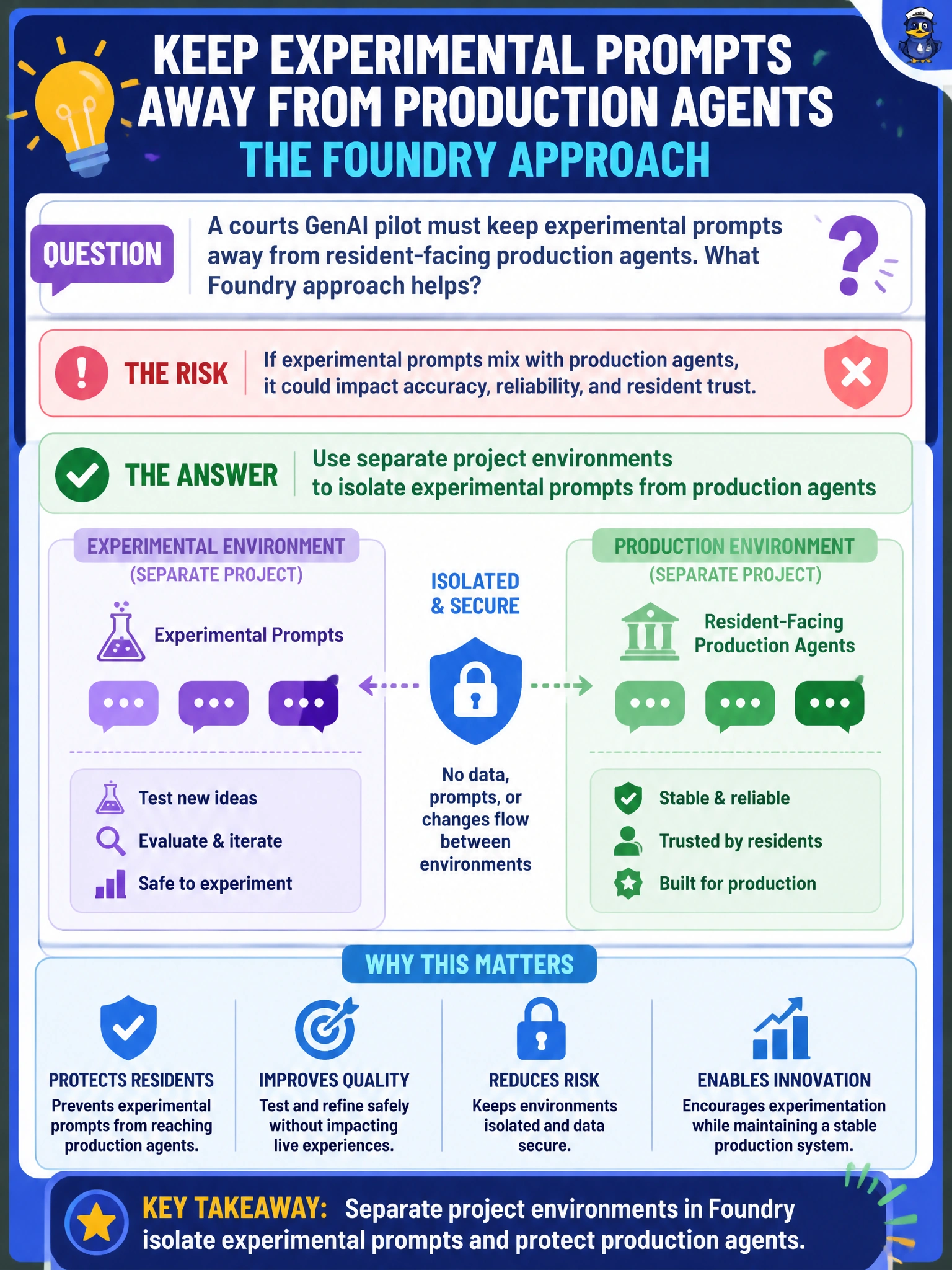
A courts GenAI pilot must keep experimental prompts away from resident-facing production agents. What Foundry approach helps?
Select an answer to reveal the explanation.
Short Explanation
Lab prompts and live court assistants should not share the same blast radius. Give experiments their own Foundry environment so residents only meet the approved agents.
Full Explanation
Separate Foundry project environments are the correct control for a courts GenAI pilot that must keep experimental prompts away from resident-facing production agents. Azure AI Foundry (and related Azure AI project structures) let municipal GenAIOps teams create isolated environments so draft system prompts, tools, and agent configurations can be iterated without sharing the same deployment slot, connection set, or change blast radius as the live court assistant. That separation preserves production stability for resident-facing interactions while still giving lab teams a governed place to experiment under the same civic platform.
Using separate deployment names to isolate experimental prompts from production agents fails because names alone do not create an environment boundary; experimental and production prompts still share the same project connections, access scope, and change blast radius, so a misrouted call can still expose residents to untested behavior. Using separate trace retention rules to isolate experimental prompts from production agents fails because retention controls how long telemetry is kept, not where prompts run; it leaves experimental prompts in the same project as live agents with no barrier to affecting resident-facing interactions. Using separate evaluation schedules to isolate experimental prompts from production agents fails because scheduling determines when checks run, not environment isolation; it keeps experimentation and production in the same project without preventing untested prompts from reaching resident-facing agents.
Exam caveat: environment separation is a GenAIOps infrastructure control, not a substitute for content safety, evaluation gates, or RBAC. On AI-300-style scenario items, choose separate project environments when the stem emphasizes isolating experimental prompts or agents from production—not when the stem is only about model choice or networking.
Operational check: confirm the courts pilot has distinct Foundry environments (or projects) for experiment versus production, production agents are not editable from the lab path, and promotion to the resident-facing slot requires an explicit governed change rather than direct lab overwrite.
Prefer to study offline? Printable PDF study book + test engine ($7.50, unofficial). These questions stay free here.