
A school-district enrollment forecaster only learns true fall headcount months later. How should production quality be monitored?
Select an answer to reveal the explanation.
Short Explanation
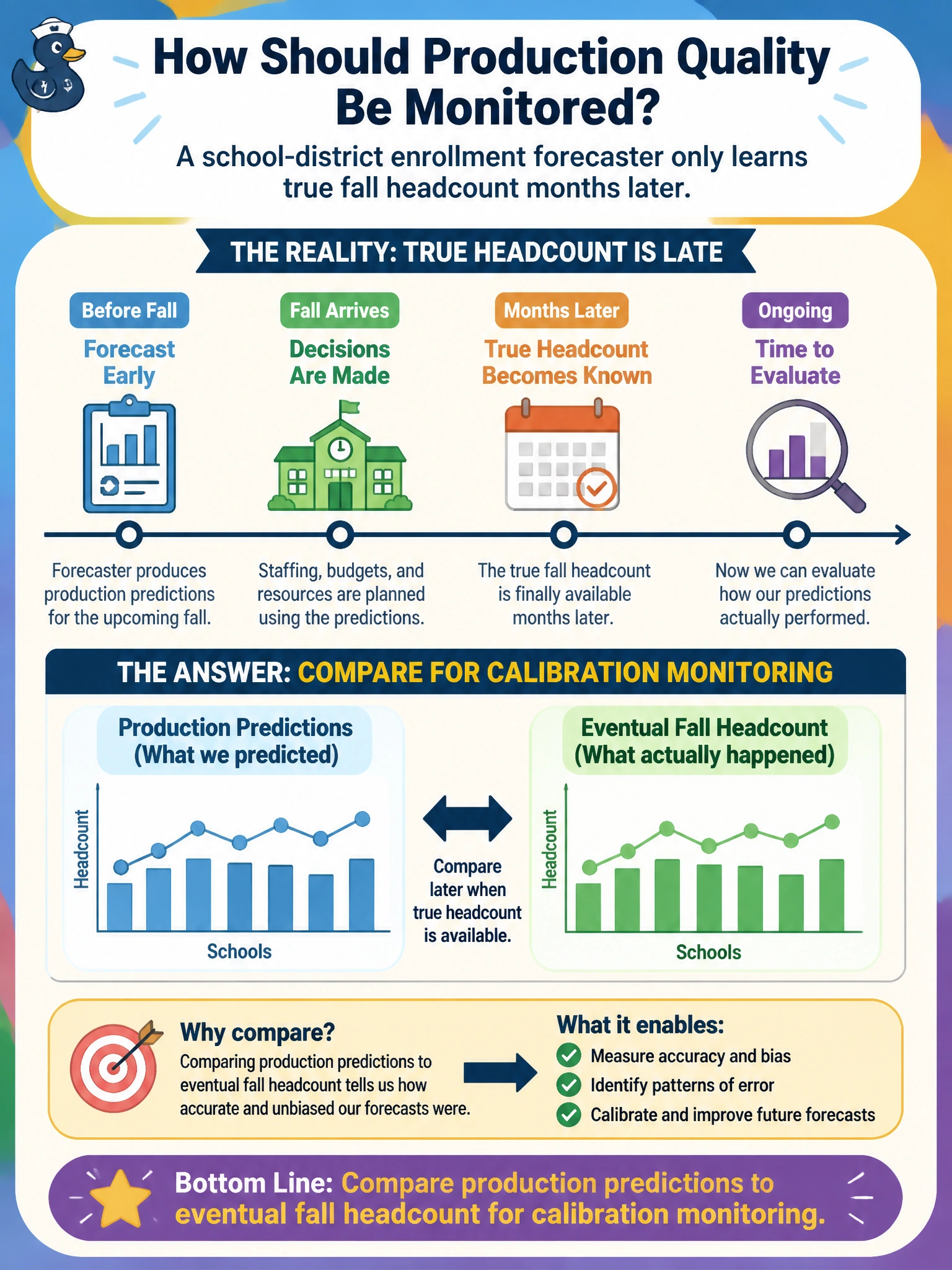
Enrollment truth shows up in the fall — so park the predictions and check them when headcount lands. Delayed labels still deserve calibration monitoring.
Full Explanation
Comparing production predictions to eventual fall headcount for calibration monitoring is correct because school-district enrollment forecasts often receive true labels months later. Delayed-label monitoring stores or freezes earlier production predictions and evaluates them when fall headcount arrives, measuring calibration and error rather than pretending labels are real-time. That practice keeps municipal forecasters honest about quality despite the natural lag in education data.
Assuming every spring prediction was perfect without checking fall counts fails accountability and hides systematic bias. Comparing forecasts only to other forecasts and never to outcomes fails because peer prediction agreement is not ground truth. Disabling monitoring until labels are real-time for every student fails practical MLOps: many civic outcomes are delayed, and monitoring must accommodate that lag rather than wait forever.
Exam caveat: delayed-label stems want outcome comparison when labels arrive—not disabling monitoring or validating only against other predictions.
Operational check: archive spring enrollment forecasts with timestamps and cohort keys, join them to official fall headcount when available, compute calibration and error metrics, and report them to district stakeholders before the next forecasting cycle.
Prefer to study offline? Printable PDF study book + test engine ($7.50, unofficial). These questions stay free here.