
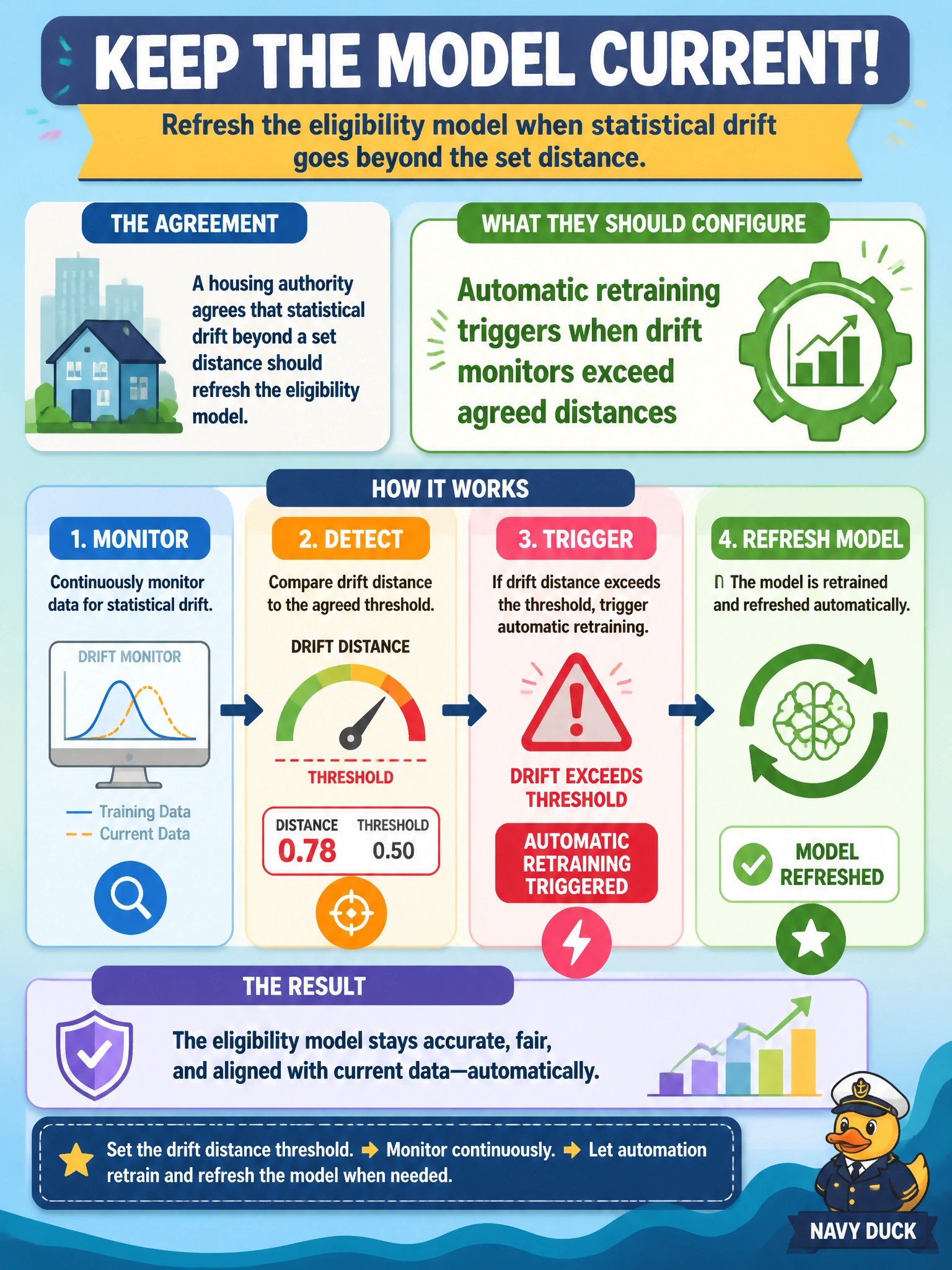
A housing authority agrees that statistical drift beyond a set distance should refresh the eligibility model. What should they configure?
Select an answer to reveal the explanation.
Short Explanation
If drift crosses the line the housing authority already agreed on, don't wait for an alert to sit for analyst review. Wire retraining to that drift trigger.
Full Explanation
Configuring automatic retraining triggers when drift monitors exceed agreed distances is correct because the housing authority already negotiated a statistical drift policy for the eligibility model. Wiring lifecycle action to those monitors turns detection into refresh: when feature or prediction drift exceeds the agreed distance, a scheduled or automated retrain (still subject to validation gates) keeps scores aligned with current resident data instead of waiting for informal notice. Policy-driven triggers are the intended MLOps link between monitoring and model refresh.
Periodic retraining schedules linked to quarterly data refresh cycles fail the agreed refresh policy because they refresh on a calendar cadence rather than when drift actually crosses the agreed distance, leaving scores stale between cycles. Drift detection monitors that raise alerts for analyst review workflows fail the agreed refresh policy because an alert that waits for human review does not automatically refresh eligibility scores when drift crosses the threshold, allowing drift to persist until an analyst acts. Model performance dashboards tracking accuracy trends across eligibility cohorts fail the agreed refresh policy because a dashboard only displays trends; it does not trigger a retrain when drift exceeds the agreed distance, so scores can stay out of date while reviewers look at charts.
Exam caveat: when the stem states an agreed drift distance should refresh the model, choose automatic (or scheduled) retrain triggers tied to those monitors—not monitor deletion or permanent freeze.
Operational check: confirm drift distance thresholds match the housing policy, attach a retrain pipeline trigger, run a dry-run that exceeds the distance in a non-prod slot, verify the retrain job starts, and ensure promotion still requires evaluation gates before the eligibility endpoint updates.
Prefer to study offline? Printable PDF study book + test engine ($7.50, unofficial). These questions stay free here.