
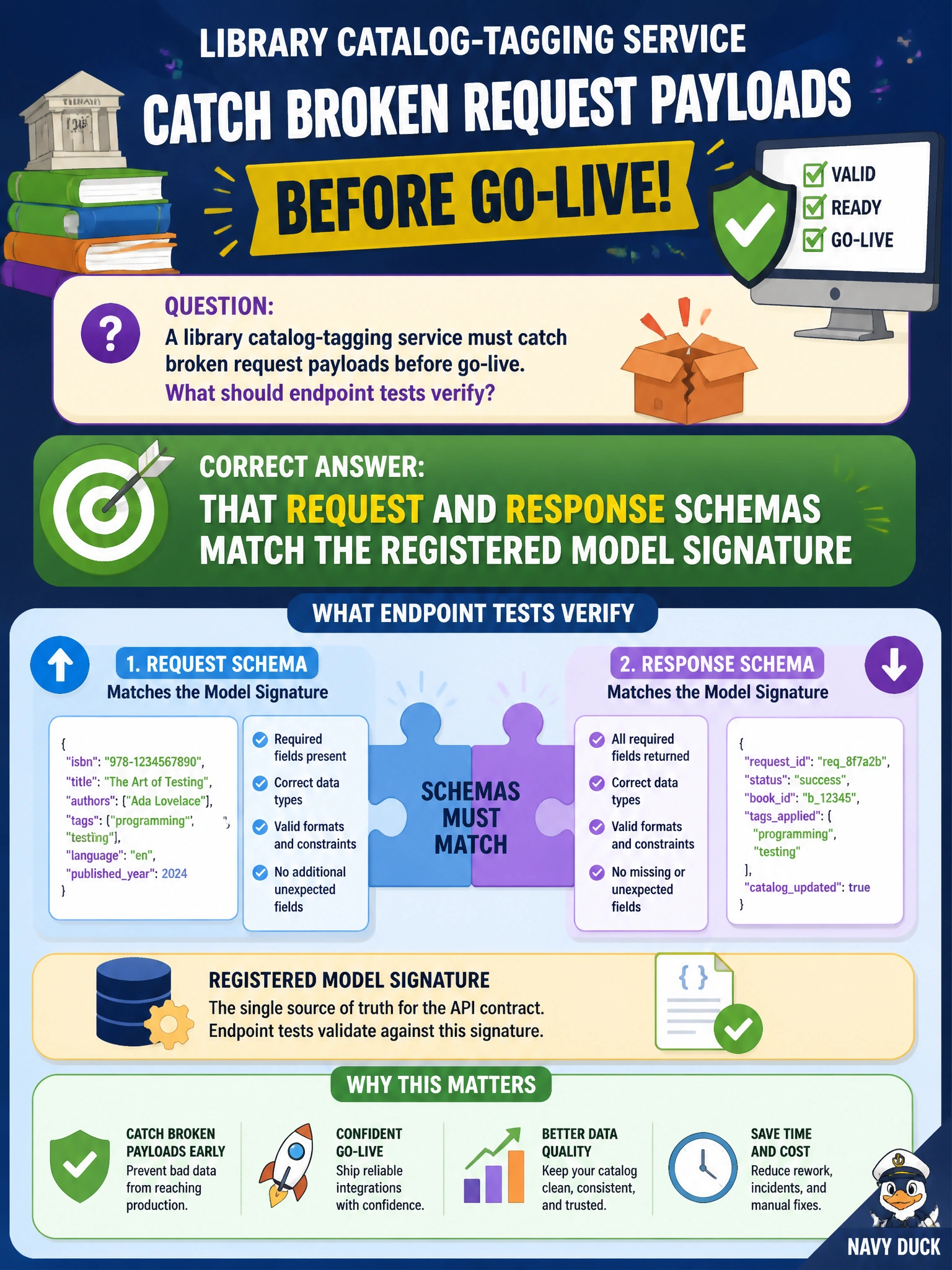
A library catalog-tagging service must catch broken request payloads before go-live. What should endpoint tests verify?
Select an answer to reveal the explanation.
Short Explanation
Catalog tagging is picky about columns — treat the model signature like a contract. Endpoint tests should confirm request and response shapes match what was registered.
Full Explanation
Verifying that request and response schemas match the registered model signature is correct because endpoint tests for a library catalog-tagging service must catch broken payloads before go-live. The registered signature is the contract: field names, types, and shapes the model expects in and returns out. Smoke and contract tests that assert valid and invalid payloads against that signature prevent schema drift from reaching resident-facing catalog flows and make failures explicit during CI or pre-promotion checks rather than in production. Verifying that request and response schemas match the training pipeline log format fails because log records reflect training bookkeeping, not the registered model signature contract, so payloads can match logs yet still break against what the endpoint expects in and returns out. Verifying that request and response schemas match the batch scoring output template fails because a batch file layout is not the live endpoint's registered signature, so conformance to the batch template leaves malformed online request and response shapes undetected. Verifying that request and response schemas match the monitoring dashboard metrics fails because dashboard metrics describe aggregated observability, not the registered signature's field names, types, and shapes, so broken payloads can pass while metrics look correct. Exam caveat: model signature / schema contract language is the cue. Prefer tests that validate request and response against the registered signature over training pipeline log formats, batch scoring output templates, or monitoring dashboard metrics. Operational check: pull the registered signature for the catalog-tagging model, run endpoint tests with a golden valid payload and known invalid payloads, confirm 2xx with correctly shaped responses for valid input and clear client errors for schema violations, and gate promotion on those results.
Prefer to study offline? Printable PDF study book + test engine ($7.50, unofficial). These questions stay free here.