
A fire-district dispatch aid model must stay responsive during incident spikes. Which online endpoint capability should they configure?
Select an answer to reveal the explanation.
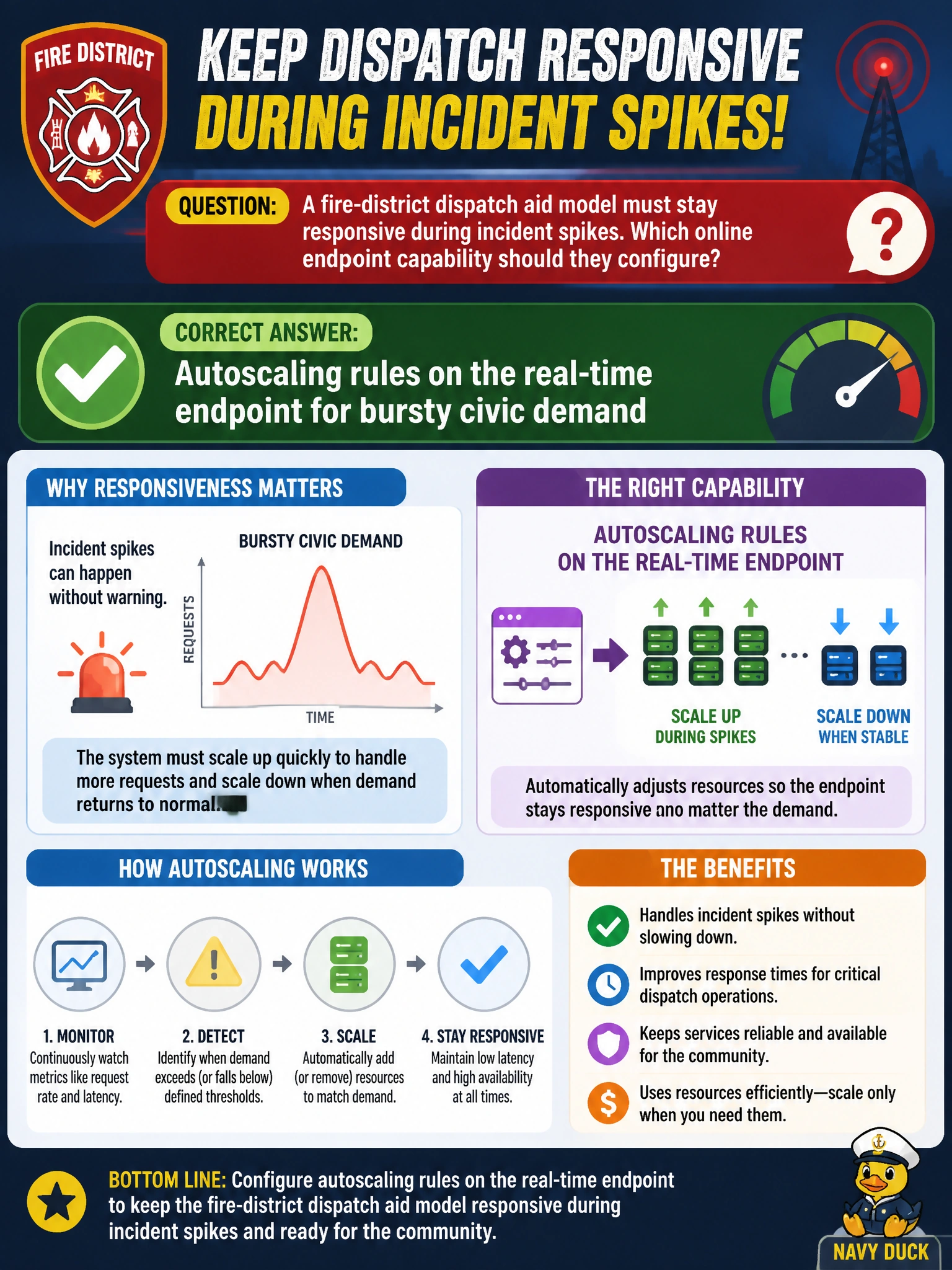
Short Explanation
Incident spikes are not polite — they arrive together. Put autoscaling on the real-time endpoint so dispatch aid keeps up when the toners go off.
Full Explanation
Configuring autoscaling rules on the real-time endpoint for bursty civic demand is correct because fire-district dispatch aid must stay responsive when incident volume spikes. Managed online endpoints can scale out (and in) based on traffic or utilization so concurrent scoring requests during multi-alarm periods do not queue behind a fixed tiny footprint. Autoscaling preserves latency budgets without permanently over-provisioning for peak load that occurs only during spikes—matching both operational and budget realities for emergency-adjacent municipal ML.
Autoscaling rules on the batch endpoint for bursty civic demand fail because batch endpoints serve queued, asynchronous bulk scoring jobs, not low-latency real-time requests, so scaling them adds no concurrent online capacity to keep dispatch aid responsive during a live incident spike. Larger instance types on the real-time endpoint for bursty civic demand fail because a bigger fixed footprint only increases per-instance resources without adding elastic concurrent capacity, so simultaneous dispatch requests during a burst will still queue while you pay for peak capacity even when idle. Scheduled scale rules on the real-time endpoint for bursty civic demand fail because scheduled scaling only adds capacity at preset times for predictable patterns and cannot react to unpredictable incident-driven bursts, so a sudden multi-alarm spike will still overwhelm the endpoint.
Exam caveat: when stems stress spikes, bursts, or staying responsive on an online endpoint, choose autoscaling (or equivalent elastic capacity)—not autoscaling rules on the batch endpoint for bursty civic demand, larger instance types on the real-time endpoint for bursty civic demand, or scheduled scale rules on the real-time endpoint for bursty civic demand.
Operational check: set scale rules (min/max instances, target utilization or request metrics) on the dispatch aid online endpoint, load-test with a simulated alarm spike, confirm latency and error rate stay within SLO, and ensure scale-in does not drop below a safe minimum for standby readiness.
Prefer to study offline? Printable PDF study book + test engine ($7.50, unofficial). These questions stay free here.