
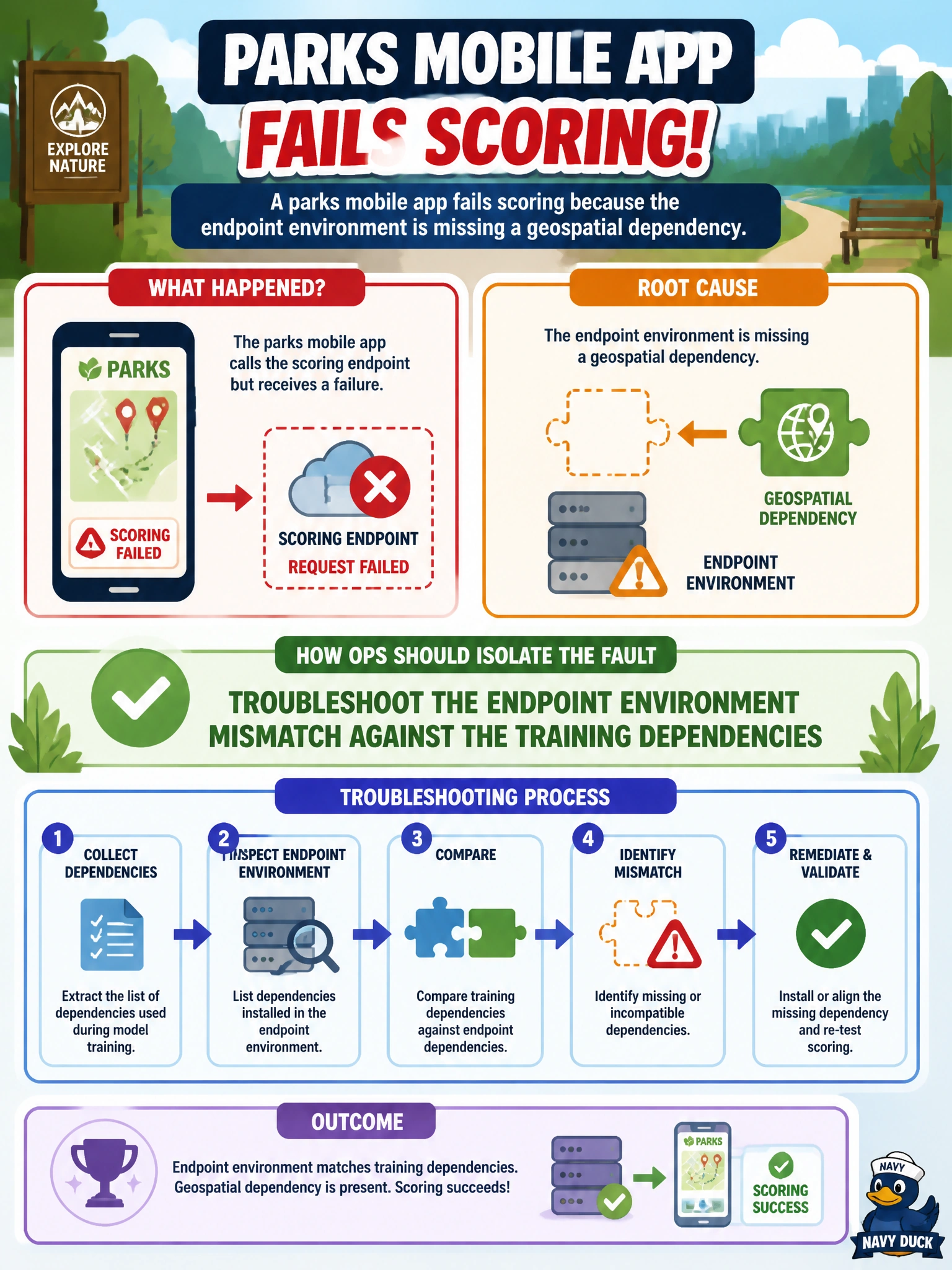
A parks mobile app fails scoring because the endpoint environment is missing a geospatial dependency. How should ops isolate the fault?
Select an answer to reveal the explanation.
Short Explanation
If parks scoring dies and the map libraries are missing, that is an environment mismatch — not a mystery algorithm bug. Compare the endpoint packages to what training used and fix the gap.
Full Explanation
Troubleshooting the endpoint environment mismatch against the training dependencies is correct because parks scoring failures that cite missing geospatial packages are classic environment parity bugs, not mysterious model-weight defects. Municipal ops should compare the endpoint's conda/pip/environment definition to the registered training environment, restore the missing geospatial libraries (and matching versions), redeploy or refresh the scoring container, and only then revisit the canopy model itself. Isolating the fault this way prevents wasted troubleshooting of the training pipeline image against the endpoint scoring dependencies when the training image is fine but the serving image is incomplete.
Troubleshooting the training pipeline image against the endpoint scoring dependencies fails because auditing the training image does not install the missing dependency on the live scoring endpoint; the endpoint still lacks the geospatial library needed to serve predictions. Troubleshooting the endpoint scaling configuration against the training compute target fails because scaling settings control instance count and size, not installed packages; every new instance inherits the same dependency gap and still cannot score. Troubleshooting the endpoint geospatial package against the latest public release notes fails because the correct reference is the training dependencies, not public notes; blindly aligning to the latest public version can introduce its own incompatibilities or behavior changes relative to what the canopy model was actually trained and validated against.
Exam caveat: when stems mention missing packages or environment issues on an endpoint, choose environment/dependency troubleshooting before troubleshooting the training pipeline image against the endpoint scoring dependencies, troubleshooting the endpoint scaling configuration against the training compute target, or troubleshooting the endpoint geospatial package against the latest public release notes. Training–serving skew is a first-class MLOps failure mode.
Operational check: export or open the endpoint environment spec, diff it to the training environment used to register the canopy model, add the missing geospatial dependency at a pinned version, redeploy, and run a smoke score that exercises the map-related code path.
Prefer to study offline? Printable PDF study book + test engine ($7.50, unofficial). These questions stay free here.