
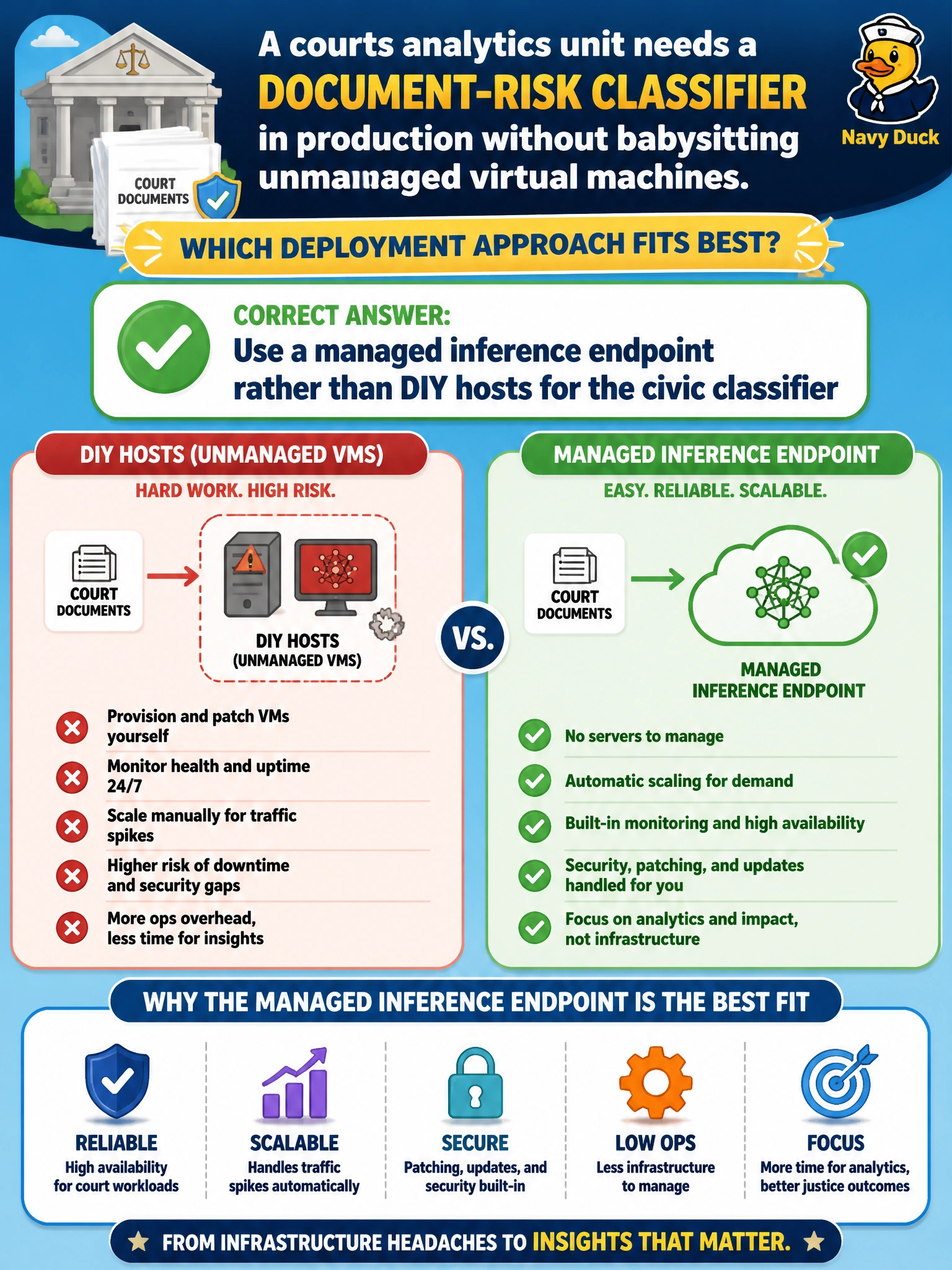
A courts analytics unit needs a document-risk classifier in production without babysitting unmanaged virtual machines. Which deployment approach fits best?
Select an answer to reveal the explanation.
Short Explanation
Courts do not need another pet VM farm for inference. Managed endpoints handle hosting, scaling, and ops so the risk classifier stays available without DIY machine babysitting.
Full Explanation
Using a managed inference endpoint rather than DIY hosts for the civic classifier is correct because courts analytics need a production scoring path without babysitting unmanaged virtual machines. Azure Machine Learning managed online or batch endpoints place the document-risk model behind platform-managed compute, scaling, health probes, and workspace governance. That keeps clerk-facing risk scores available under municipal identity, logging, and environment controls while removing the operational burden of patching, monitoring, and recovering pet VMs for inference.
Hosting the civic classifier on a Kubernetes online endpoint with self-managed nodes fails because self-managed nodes still leave the team responsible for patching, scaling, and recovering the underlying hosts: that is the DIY-host pattern the stem asks the courts unit to avoid. Publishing the civic classifier to a container registry for direct client downloads fails because it distributes the model to clients rather than providing a governed, centrally managed scoring endpoint, leaving the courts unit without operational control over inference. Scheduling the civic classifier as a nightly batch job fails the interactive scoring requirement entirely—a nightly batch job cannot serve on-demand risk requests and is not a governed, available scoring path for the courts unit.
Exam caveat: stems that contrast self-managed nodes, container-registry downloads, or nightly batch schedules with production readiness usually want managed Azure ML (or equivalent) inference endpoints. Managed hosting is the ops fit when the question emphasizes not babysitting machines.
Operational check: deploy the registered document-risk model to a managed endpoint in the courts workspace, verify scoring succeeds under a service identity, confirm autoscaling or compute SKU matches expected load, and ensure the team avoids self-managed nodes, client container downloads, or nightly batch for interactive scoring.
Prefer to study offline? Printable PDF study book + test engine ($7.50, unofficial). These questions stay free here.