
A water utility wants to release a new SCADA-derived scoring model version with limited blast radius. Which release strategy should they use?
Select an answer to reveal the explanation.
Short Explanation
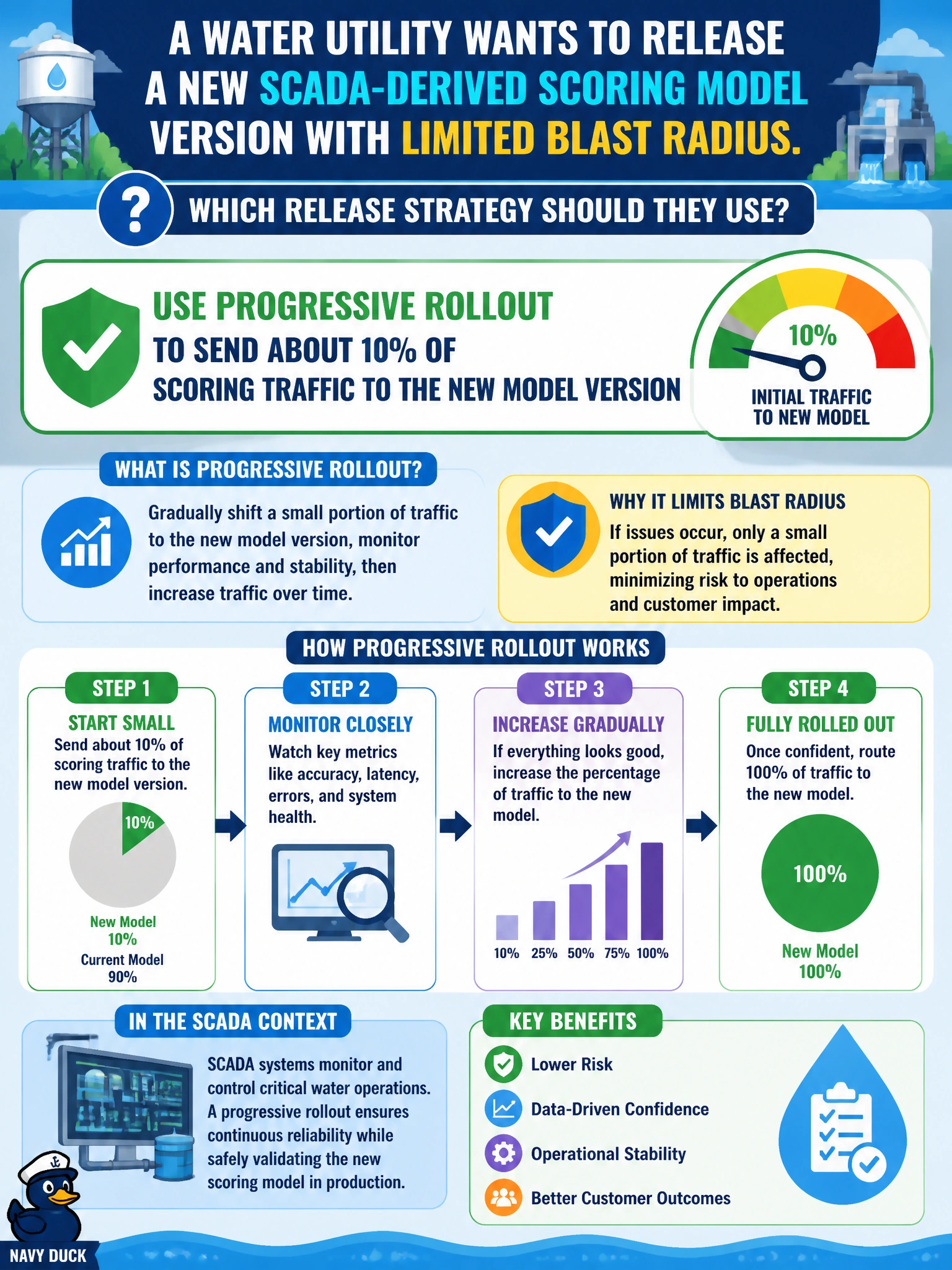
Don't count on promoting the staging slot to route 10% of traffic — you'll get a slot swap that lacks the health gates and easy rollback you'll need. Progressive rollout sends a slice — like 10% — of SCADA scoring traffic to the new version so the water utility can watch before going wide.
Full Explanation
Using progressive rollout to send about 10% of scoring traffic to the new model version is correct when a water utility wants limited blast radius for a SCADA-derived scoring release. Canary or progressive traffic splitting exposes the new version to a controlled slice of production scoring so latency, error rates, and score drift can be observed before full cutover. Promoting the staging slot to route about 10% of scoring traffic to the new model version uses the wrong control for a model release because slot promotion swaps deployment slots rather than configuring progressive traffic allocation to the new registered version on the production scoring endpoint.
Promoting the staging slot to route about 10% of scoring traffic to the new model version fails because staging-slot promotion is a deployment-slot swap construct, not the production endpoint traffic split that provides observed latency, error-rate, and score-drift gates before full cutover. Scoring about 10% of replayed SCADA batches with the new model version in development fails conceptually because offline batch scoring in development cannot surface how the new version behaves against live sensor conditions, real-time traffic patterns, or production serving paths. Sending about 10% of scoring traffic to the new model version for statistical comparison testing fails as a release strategy because it describes an experiment to compare error rates rather than a progressive rollout with health gates, expansion only if healthy, and rollback to limit blast radius.
Exam caveat: choose the canary percentage and success criteria before rollout; too small a slice may miss rare failure modes, too large increases blast radius. Ensure both versions log comparable metrics and that rollback to the prior version is one controlled action. Operational check: configure progressive traffic (for example ~10%) to the new registered version, watch error/latency/score-distribution gates, expand only if healthy, and keep an immediate rollback path for SCADA-derived scoring.
Prefer to study offline? Printable PDF study book + test engine ($7.50, unofficial). These questions stay free here.