
A housing authority online endpoint returns HTTP 429 responses during peak voucher-application hours. What is the most likely operational issue to address?
Select an answer to reveal the explanation.
Short Explanation
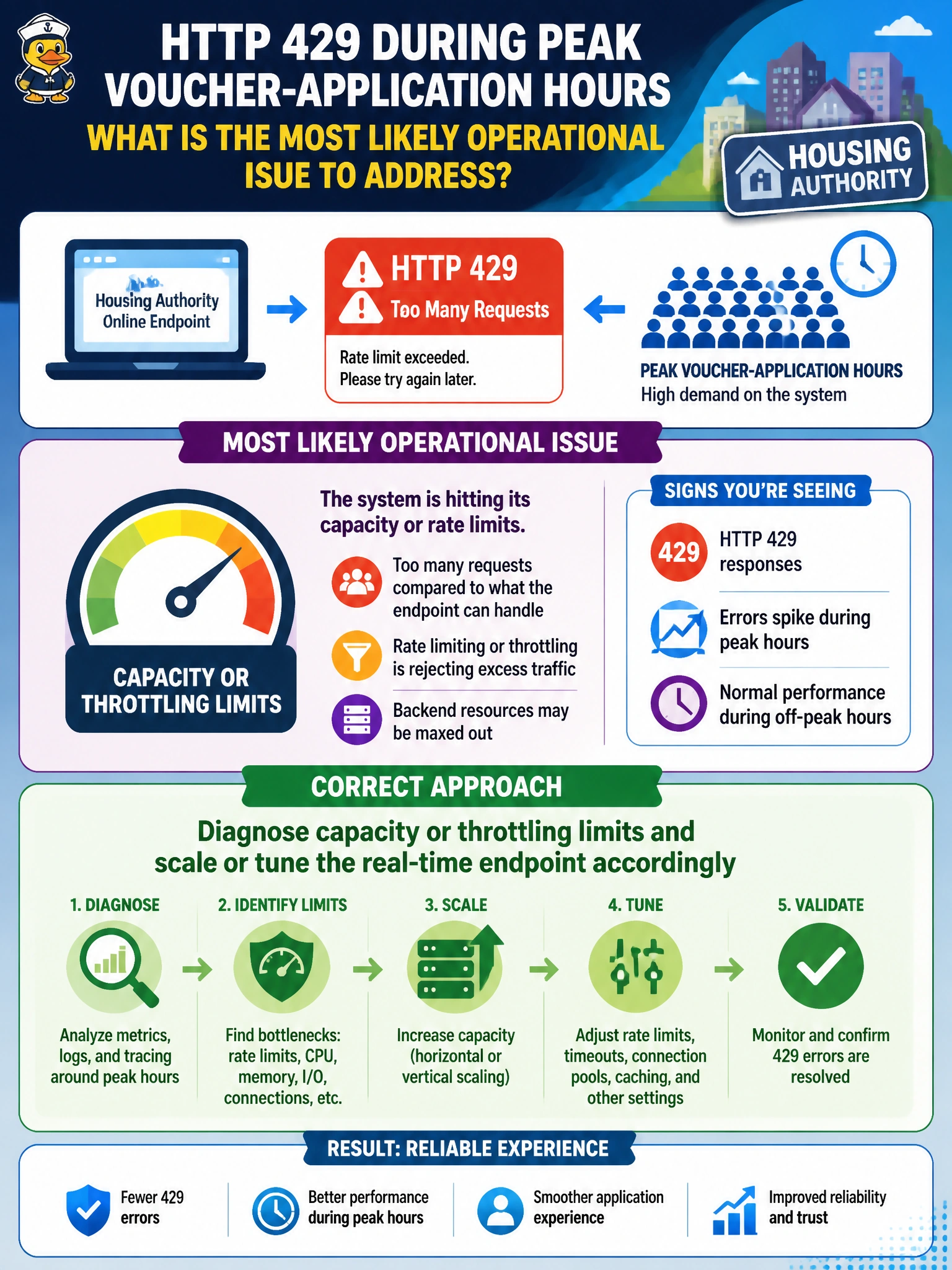
429s mean you've hit a capacity limit — the line's too long, so you'll make it worse if you retry faster. You'll want to check throttling and utilization, then scale or tune the endpoint for voucher-season peaks. Don't cut max instances or stretch timeouts when it's asking for more room.
Full Explanation
Diagnosing capacity or throttling limits and scaling or tuning the real-time endpoint accordingly is correct when a housing authority online endpoint returns HTTP 429 during peak voucher-application hours. 429 indicates the service is rate-limiting or saturated—an operational capacity problem—not a cue to shorten client retry backoff, which would add load to an already saturated endpoint. Azure ML real-time endpoints require right-sizing, autoscaling, and client retry/backoff design to absorb civic peak loads.
Analyzing request queue telemetry and shortening client retry backoff for the real-time endpoint fails because shortening backoff increases retry pressure during saturation and worsens 429s; clients need longer exponential backoff with jitter while capacity is scaled, not faster retries. Inspecting deployment logs and raising the per-request timeout for the real-time endpoint cluster fails because 429 signals admission throttling from too many concurrent requests, not requests timing out; raising the timeout holds connections longer without adding throughput and does nothing to relieve a capacity-driven rate limit. Evaluating autoscale rules and reducing the maximum instance count for the real-time endpoint fails because cutting the maximum instances lowers available capacity during voucher-application peaks and guarantees more 429s; the throttled endpoint needs a higher cap or more aggressive scale-out, not a lower ceiling.
Exam caveat: scaling helps only if the bottleneck is compute/instance count; also inspect client burst behavior, connection pools, and shared quota limits. Pair scale-out with caching or queueing where business rules allow. Operational check: review endpoint metrics for throttling and utilization, raise capacity or tune autoscaling and rate limits, retest under a peak-hour load profile, and confirm 429 rates drop for voucher applications.
Prefer to study offline? Printable PDF study book + test engine ($7.50, unofficial). These questions stay free here.