
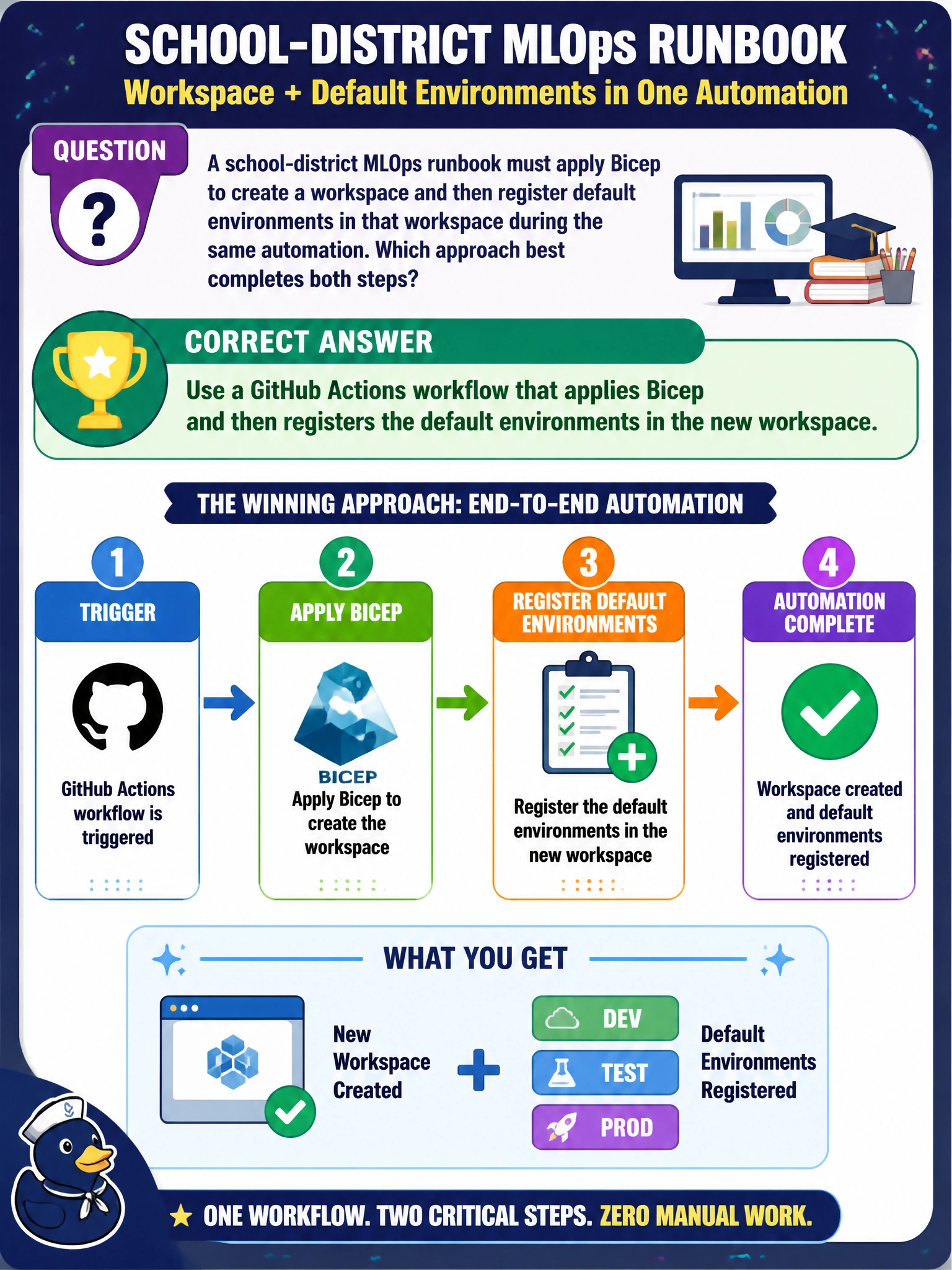
A school-district MLOps runbook must apply Bicep to create a workspace and then register default environments in that workspace during the same automation. Which approach best completes both steps?
Select an answer to reveal the explanation.
Short Explanation
One workflow, two beats: you stamp the building with Bicep, then hang the default environment keys inside. You'll still come up empty if you share them as datasets, save them as VM images, or sync them as data assets — you've got to register them as environments so your new workspace is usable on day one.
Full Explanation
A GitHub Actions workflow that applies Bicep and then registers default environments in the new workspace completes both school-district runbook steps in one automation. Bicep creates the Azure Machine Learning workspace and supporting resources; subsequent workflow steps call Azure ML CLI or SDK APIs to register the curated environment assets teachers and pipelines expect on day one. Chaining provisioning with asset registration prevents "empty workspace" handoffs and keeps environment definitions versioned next to the infrastructure that hosts them.
Use a GitHub Actions workflow that applies Bicep and then shares the default environments as datasets in the new workspace fails by asset type: datasets expose data for jobs to consume, not the conda and container definitions jobs execute in, so training jobs still cannot resolve the default environment name/version. Use a GitHub Actions workflow that applies Bicep and then saves the default environments as VM images in the new workspace fails by asset type: VM images capture compute disks, not registered Azure ML Environment assets, so the workspace still lacks the default environments teachers and pipelines expect. Use a GitHub Actions workflow that applies Bicep and then syncs the default environments as data assets in the new workspace fails by asset type: data assets register files and tables for consumption, not executable environments, so jobs in the new workspace still cannot resolve them without proper environment registration the runbook never performed.
Exam caveat: End-to-end municipal IaC questions often combine resource deployment with post-provision Azure ML asset setup; answers that share environments as datasets, save them as VM images, or sync them as data assets are incorrect.
Operational check: after the workflow succeeds, list environments in the new workspace, submit a sample job referencing the default environment name/version, and confirm the job pulls that environment without manual Studio registration.
Prefer to study offline? Printable PDF study book + test engine ($7.50, unofficial). These questions stay free here.