
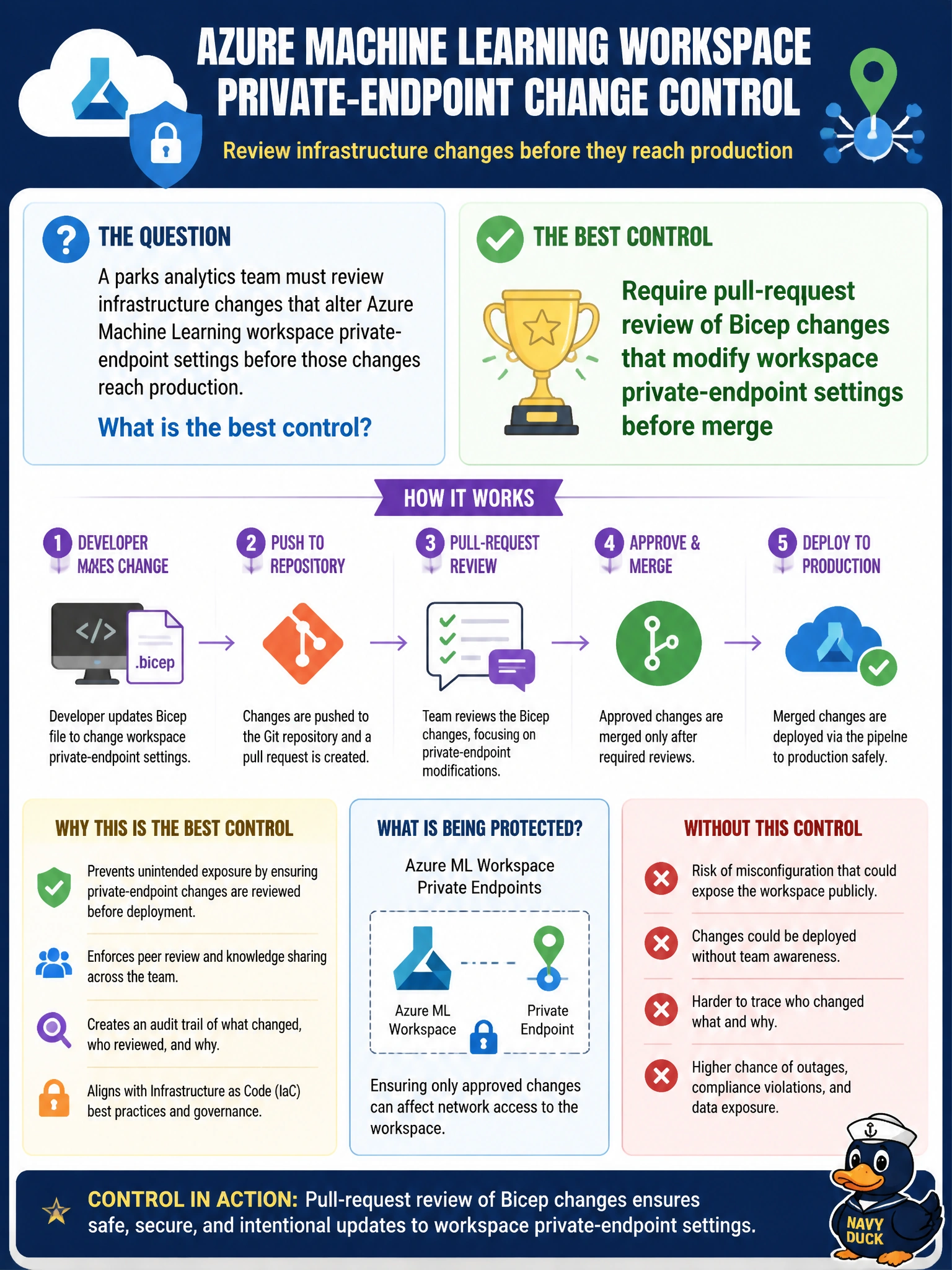
A parks analytics team must review infrastructure changes that alter Azure Machine Learning workspace private-endpoint settings before those changes reach production. What is the best control?
Select an answer to reveal the explanation.
Short Explanation
Networking posture is not a casual toggle. Put Bicep private-endpoint edits behind pull-request review so the city's security shape cannot drift on a Friday night click. Pipeline approval after deployment won't stop you merging an unreviewed change, an audit won't block your PR, and a comment won't ensure you'll get a required review.
Full Explanation
Requiring pull-request review of Bicep changes that modify Azure Machine Learning workspace private-endpoint settings before merge keeps parks-department network posture under change control. Private endpoints, DNS zones, and public-network flags are high-impact configuration: an unreviewed edit can reopen public access or break training connectivity. Treating those Bicep diffs like security-sensitive code—reviewers, required checks, limited merge rights—is the best control among the options. Require pipeline approval of Bicep changes that modify workspace private-endpoint settings after deployment fails because it acts after deployment: it does not gate the merge, so an unreviewed private-endpoint edit can still reach production. Enforce Azure Policy audit of Bicep changes that modify workspace private-endpoint settings before merge fails because audit is the wrong control type: Azure Policy audit is detective and evaluates deployed resources, it does not require human review or block a PR merge. Require pull-request comment on Bicep changes that modify workspace private-endpoint settings before merge fails because a comment is non-blocking: it does not require approval or prevent merge without review, so it does not enforce change control on networking posture. Exam caveat: Domain 1 links IaC change control to networking posture; when the stem asks what gates private-endpoint Bicep changes, pull-request review is the answer—after-deployment pipeline approvals, Policy audit effects, and non-blocking pull-request comments are distractors. Operational check: open a PR that alters private-endpoint Bicep, confirm merge is blocked without review, apply only after approval, then validate that workspace private connectivity still works and publicNetworkAccess remains as intended.
Prefer to study offline? Printable PDF study book + test engine ($7.50, unofficial). These questions stay free here.