
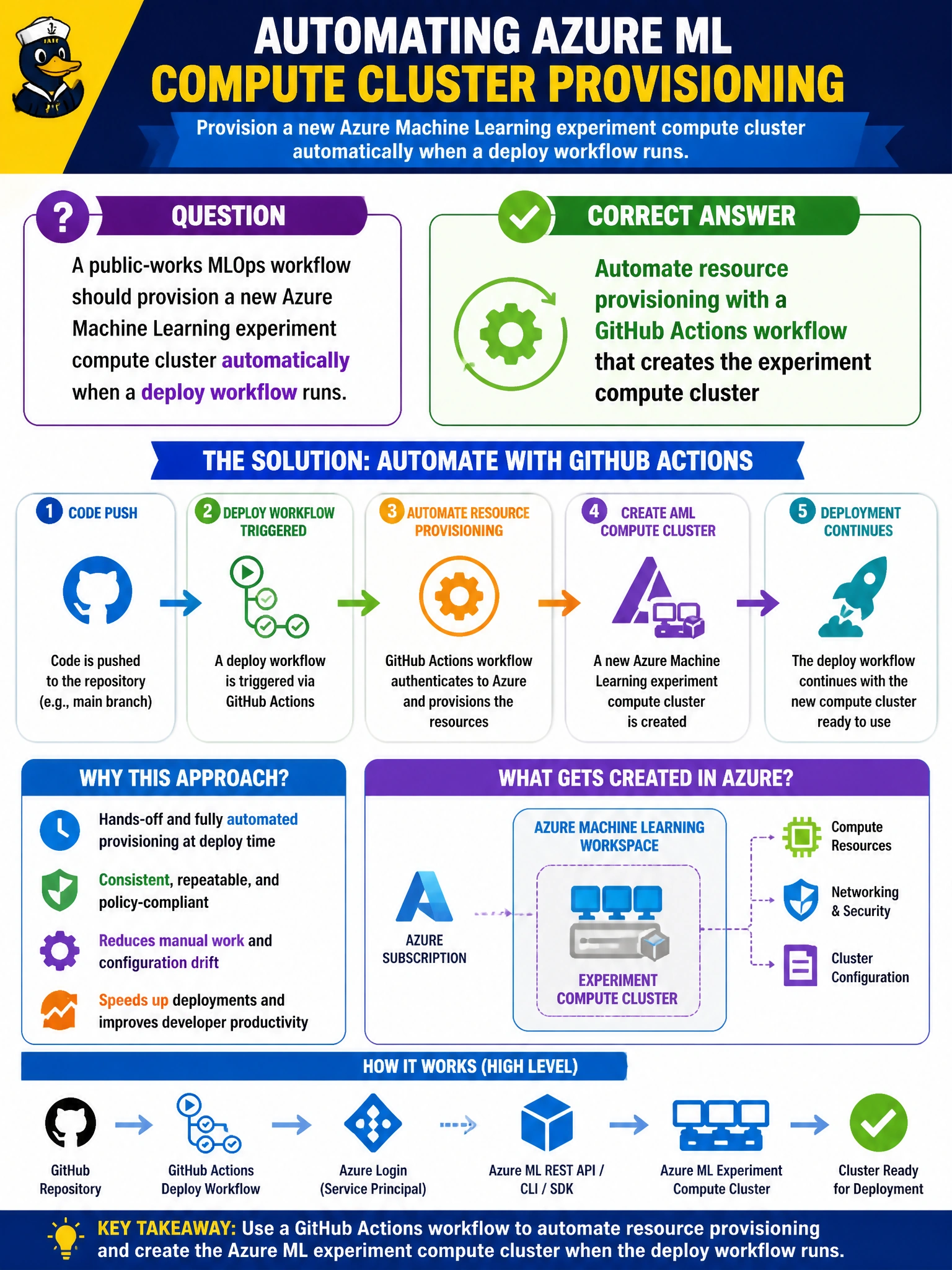
A public-works MLOps workflow should provision a new Azure Machine Learning experiment compute cluster automatically when a deploy workflow runs. Which capability should they use?
Select an answer to reveal the explanation.
Short Explanation
GitHub Actions is the night shift that builds the compute when the deploy hits — not a scheduled pipeline creating it on a nightly interval. Creating it after the training job completes won't align it with your deploy run, and creating it for online endpoint scaling won't tie it to the deploy workflow you need. Let the workflow provision what the experiment needs.
Full Explanation
A GitHub Actions workflow that creates the experiment compute cluster when the deploy workflow runs aligns Azure Machine Learning capacity with actual municipal demand. Automation provisions the cluster with the SKU, max nodes, and identity bindings declared in code, then can scale or tear down when the experiment ends. Public-works teams avoid scheduled nightly creation that ignores deploy triggers and keep cost tied to active MLOps events rather than creating for online-endpoint scaling that doesn't tie experiment compute to the deploy workflow. Configuring a scheduled Azure ML pipeline that creates the experiment compute cluster on a nightly interval fails because it runs on a timer independent of the deploy workflow, does not create the experiment cluster at deploy time, and leaves no machine-readable audit tied to the deployment event. Running a GitHub Actions workflow that creates the experiment compute cluster after training job completes fails because it triggers on training completion rather than the deploy workflow run the stem requires; the deploy workflow needs cluster creation as part of deployment, not as a post-training step. Deploying an Azure DevOps pipeline that creates the experiment compute cluster for online endpoint scaling fails because it ties creation to inference scaling needs, not the automatic provisioning of an experiment compute cluster when the deploy workflow runs. Exam caveat: Domain 1 pairs resource provisioning automation (often GitHub Actions) with Azure ML compute lifecycle; nightly-interval creation, post-training-job creation, and online-endpoint-scaling creation are distractors when the stem emphasizes automatic creation of experiment compute at deploy time. Operational check: run the deploy workflow in a pilot project, confirm the cluster appears via az ml compute show with expected properties, measure idle cost after the job completes, and ensure teardown or scale-to-zero steps exist so temporary experiment capacity does not linger.
Prefer to study offline? Printable PDF study book + test engine ($7.50, unofficial). These questions stay free here.