
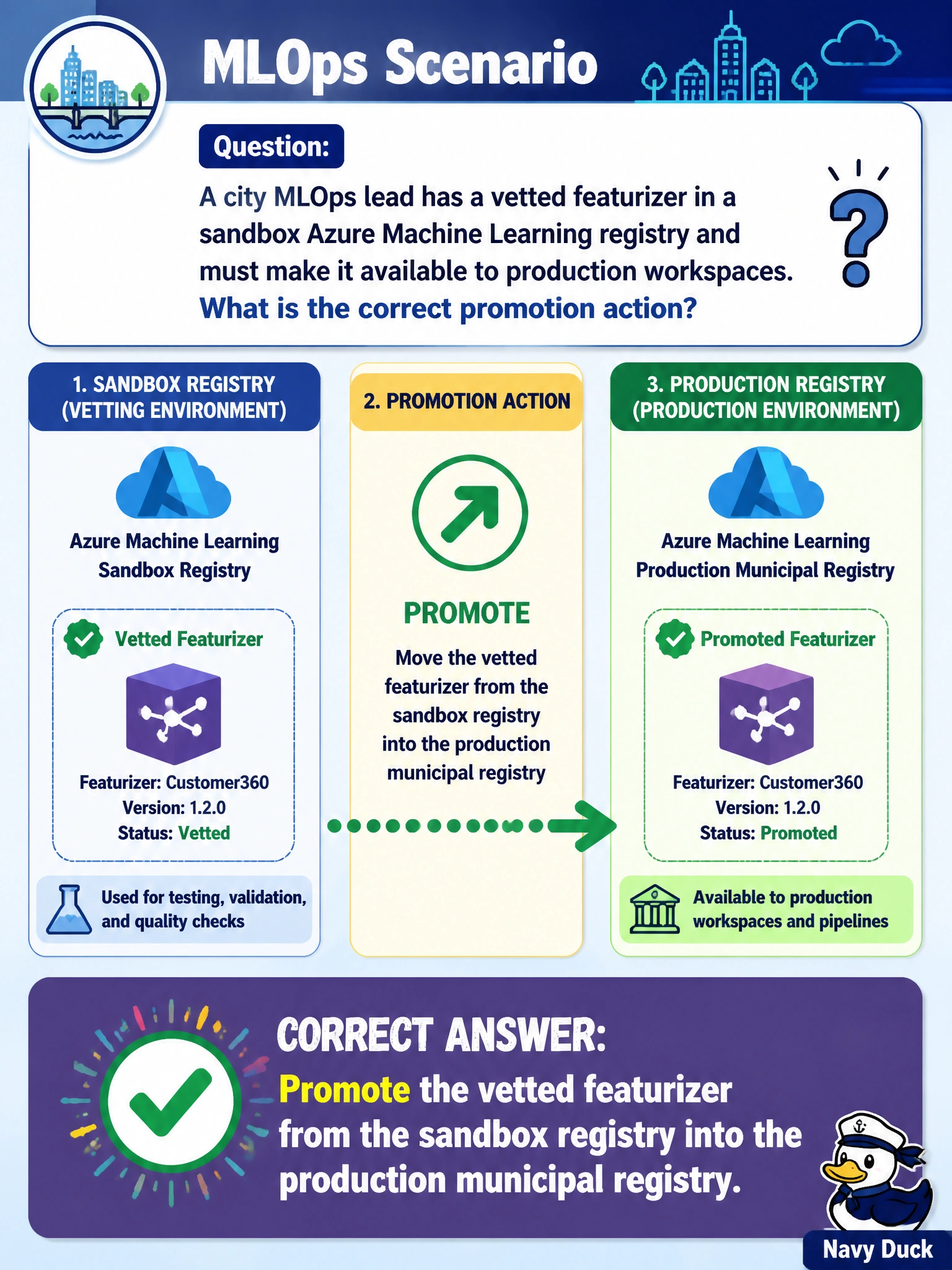
A city MLOps lead has a vetted featurizer in a sandbox Azure Machine Learning registry and must make it available to production workspaces. What is the correct promotion action?
Select an answer to reveal the explanation.
Short Explanation
Sandbox is the tryout league; production is opening day. You promote the vetted featurizer into the production registry so every workspace pulls the same governed copy. Just letting workspaces reference sandbox, dropping it in as a local copy, or promoting only its environment won't give you that governed registry copy you'll actually need.
Full Explanation
Promoting the vetted featurizer from the sandbox registry into the production municipal registry is the correct action because production workspaces should consume governed assets through a deliberate promotion path, not through informal copy-paste. Sandbox registries are for validation; production registries hold approved components for city MLOps. Promotion preserves lineage and version identity so production Azure ML workspaces pull the same vetted featurizer the lead approved.
Promoting the vetted featurizer from the sandbox registry for direct reference by production workspaces fails because it leaves production pointed at the sandbox registry instead of a deliberately promoted copy in the production municipal registry — any later sandbox change or deletion reaches production with no gate in between. Promoting the vetted featurizer from the sandbox registry to production workspaces as a local component fails because a workspace-local component is visible only to that one workspace, not shared across production the way a true registry-to-registry promotion is, and it substitutes scattered local copies for the actual vetted artifact. Promoting the vetted featurizer environment from the sandbox registry to production municipal registry fails because promoting the environment moves only the runtime dependencies rather than reusing the exact vetted component the lead already approved, which can drift from what was actually validated in sandbox.
Exam caveat: sandbox → production promotion via registry is the governance pattern. Distinguish a true promoted copy into the production municipal registry from a promotion for direct reference, a promotion to workspaces as a local component, or a promotion of only the environment. Do not delete the source until production has a governed copy.
Operational check: promote the featurizer version into the production municipal registry, grant production workspaces pull access, verify a production pipeline resolves that version, and only then consider sandbox cleanup policies that retain required audit history.
Prefer to study offline? Printable PDF study book + test engine ($7.50, unofficial). These questions stay free here.