
A city fraud-detection effort needs the same feature-engineering logic reused across several Azure Machine Learning pipelines. What asset type should they publish?
Select an answer to reveal the explanation.
Short Explanation
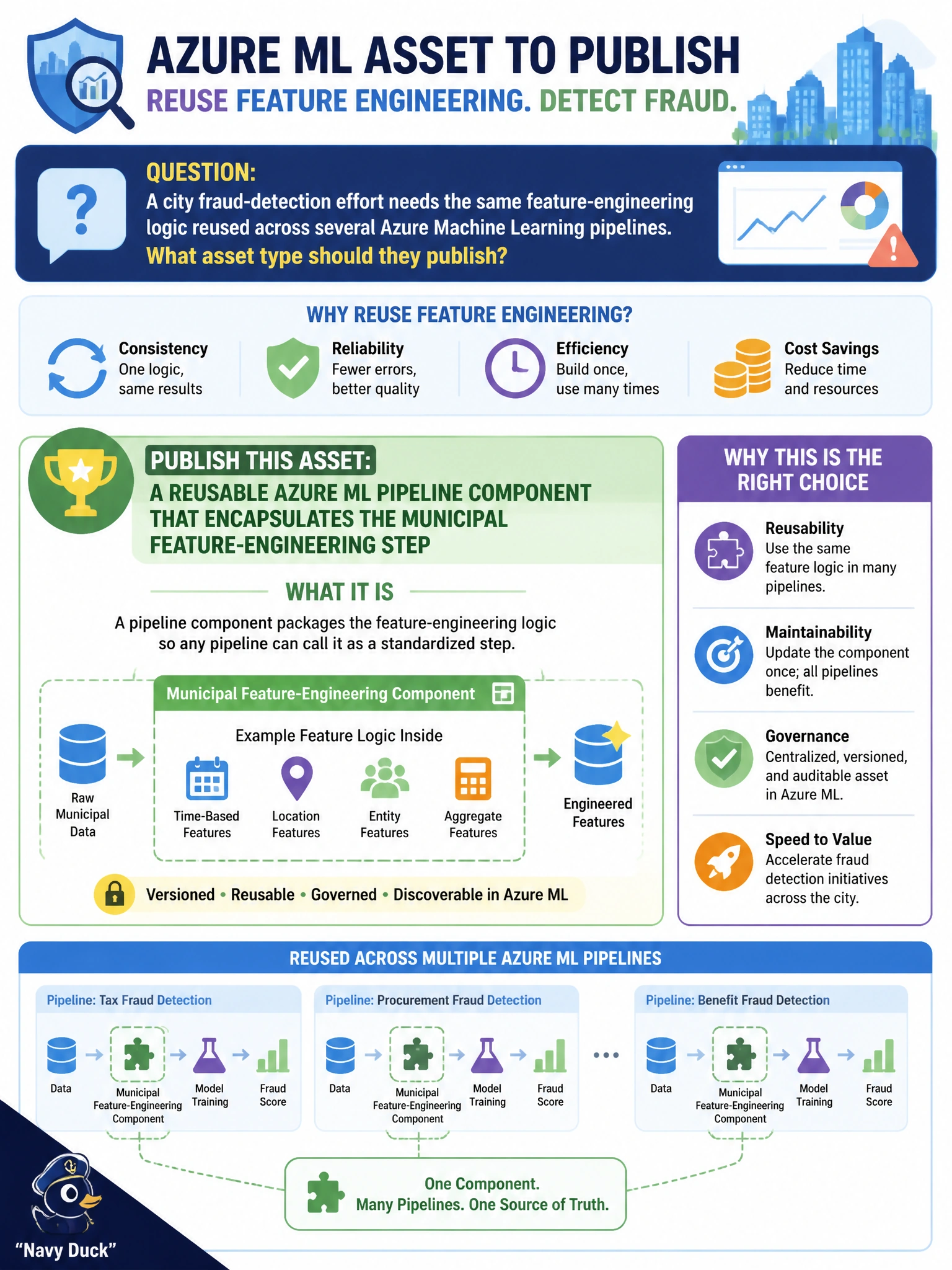
Don't photocopy the recipe into twelve kitchens—publish one reusable component. Wrap the fraud feature-engineering step as an Azure ML component and compose it into each pipeline. A reusable environment only holds dependencies—it won't stop your feature logic from drifting when someone "improves" a paste.
Full Explanation
Publishing a reusable Azure ML pipeline component that encapsulates the municipal feature-engineering step is correct because shared logic across several fraud-detection pipelines should be versioned, typed, and composable. Components package inputs, outputs, and code so city teams reuse one featurizer definition instead of treating a reusable environment that holds pipeline dependencies as the reusable step. That improves consistency of fraud features across departments and simplifies testing when the engineering logic changes.
A reusable Azure ML environment that holds the municipal feature-engineering pipeline dependencies fails maintainability for shared logic: it holds dependencies but leaves the featurizer code uncaptured, so copies drift and bugs must be fixed in many places. A reusable Azure ML dataset that caches the municipal feature-engineering pipeline output prevents composition and creates incompatible feature contracts: it caches pipeline output but exposes no versioned, typed featurizer step for pipelines to call. A reusable Azure ML online endpoint that hosts the municipal feature-engineering pipeline code fails for pipeline reuse: it hosts code for real-time serving but cannot run inside Azure ML pipelines as a reusable featurizer step.
Exam caveat: components are the reusable building blocks of Azure ML pipelines; environments, datasets, and online endpoints are not reusable pipeline steps. When stems ask what to publish for reuse across pipelines, choose a component—not an environment, dataset, or endpoint.
Operational check: package the fraud feature-engineering step as a component with explicit typed inputs/outputs, register a version, reference it from at least two pipelines, and confirm both produce compatible feature schemas for downstream model steps.
Prefer to study offline? Printable PDF study book + test engine ($7.50, unofficial). These questions stay free here.