
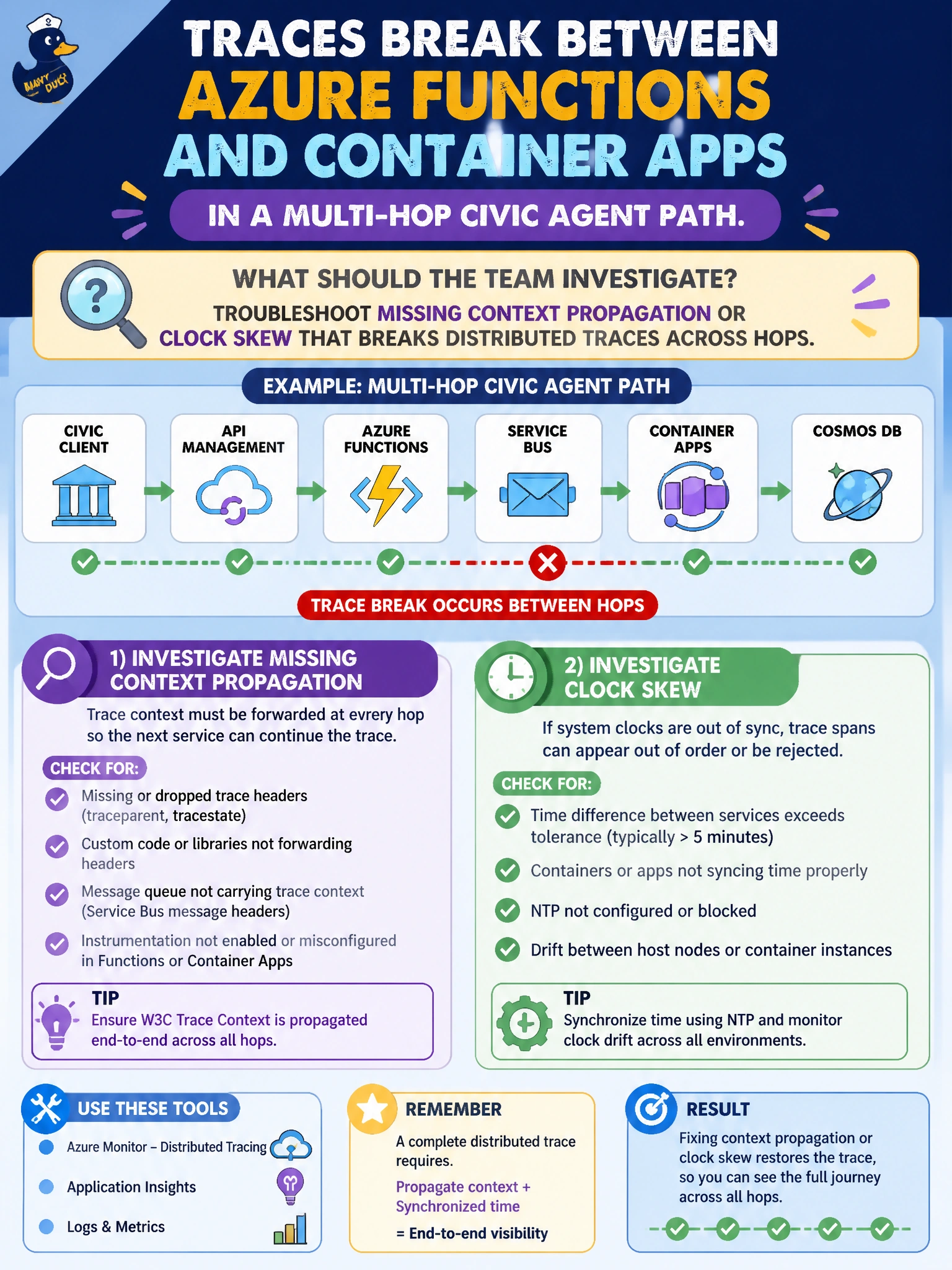
Traces break between Azure Functions and Container Apps in a multi-hop civic agent path. What should the team investigate?
Select an answer to reveal the explanation.
Short Explanation
Broken traces are like a relay where the baton never changes hands—fix context (or clock skew) across Functions and containers.
Full Explanation
When traces break between Azure Functions and Container Apps in a multi-hop civic agent path, investigate missing context propagation or clock skew that breaks distributed traces across hops. Parent/child linking depends on trace context headers (and compatible exporters) flowing with each call; if Functions do not forward context into Container Apps (or clocks diverge badly), the municipal agent path appears as disconnected fragments instead of one timeline.
Increasing Function memory only and ignoring trace context headers may change performance but does not repair broken distributed correlation. Deleting parent spans so children stand alone in the UI destroys topology rather than fixing it. Turning off OpenTelemetry in Functions permanently removes visibility from a critical hop in the civic agent path.
Exam caveat: W3C tracecontext propagation must be supported on both sides; HTTP, Service Bus, and Event Grid hops each need the right instrumentation. Sampling decisions should be consistent or parent-based so child spans are not dropped asymmetrically. Severe clock skew can disorder timings even when IDs propagate—NTP/time sync on hosts still matters for analysis.
Operational check: Send a synthetic multi-hop request through Functions into Container Apps, confirm one shared trace ID across spans, inspect outbound headers for traceparent, verify both services export to the same backend, and check host time sync. Fix missing middleware/propagation first; only then tune sampling and dashboards for the repaired traces.