
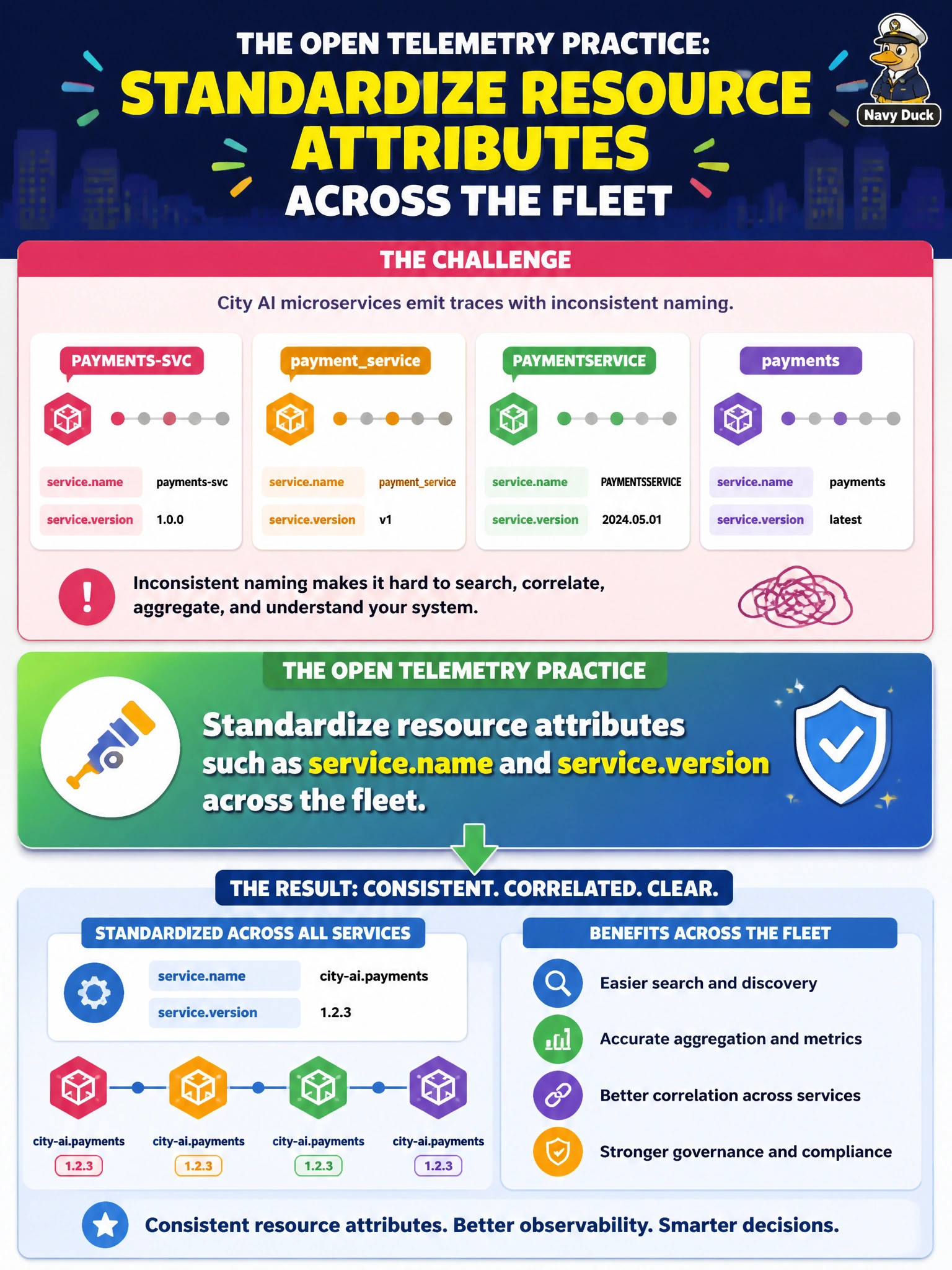
City AI microservices emit traces with inconsistent naming. What OpenTelemetry practice should leadership standardize?
Select an answer to reveal the explanation.
Short Explanation
Consistent service.name and version are like uniform building plaques—ops can find the right wing every time.
Full Explanation
When city AI microservices emit traces with inconsistent naming, leadership should standardize resource attributes such as service.name and service.version across the fleet. Consistent resource attributes make Azure Monitor / OpenTelemetry backends group, filter, and alert on the correct municipal service instead of fracturing one logical system into many accidental identities. Stable naming is foundational for SLOs, incident routing, and cross-service civic agent traces.
Leaving service.name blank so backends invent random labels produces chaotic service maps and unreliable alerts. Changing service.version on every request to maximize uniqueness destroys release attribution and makes regressions impossible to tie to a deploy. Dropping resource attributes entirely to shrink payloads only saves little bandwidth while erasing the metadata ops needs for fleet-wide analysis.
Exam caveat: Resource attributes describe the process/service; they are not a substitute for span names or trace context propagation. Agree on a naming convention (for example department-system-component) and set version from build/release metadata, not per-request randomness. Too-high cardinality custom resource attributes can pressure backends—standardize a small required set first.
Operational check: Publish an OpenTelemetry resource attribute standard for city AI services, update collectors/SDKs accordingly, verify service maps show stable names/versions after deploy, and spot-check that alerts and workbooks filter on the new conventions. Reject CI builds that omit required resource attributes for production microservices.