
Dead-letter count on the summarization queue must page on-call when it exceeds a threshold. How should that be implemented?
Select an answer to reveal the explanation.
Short Explanation
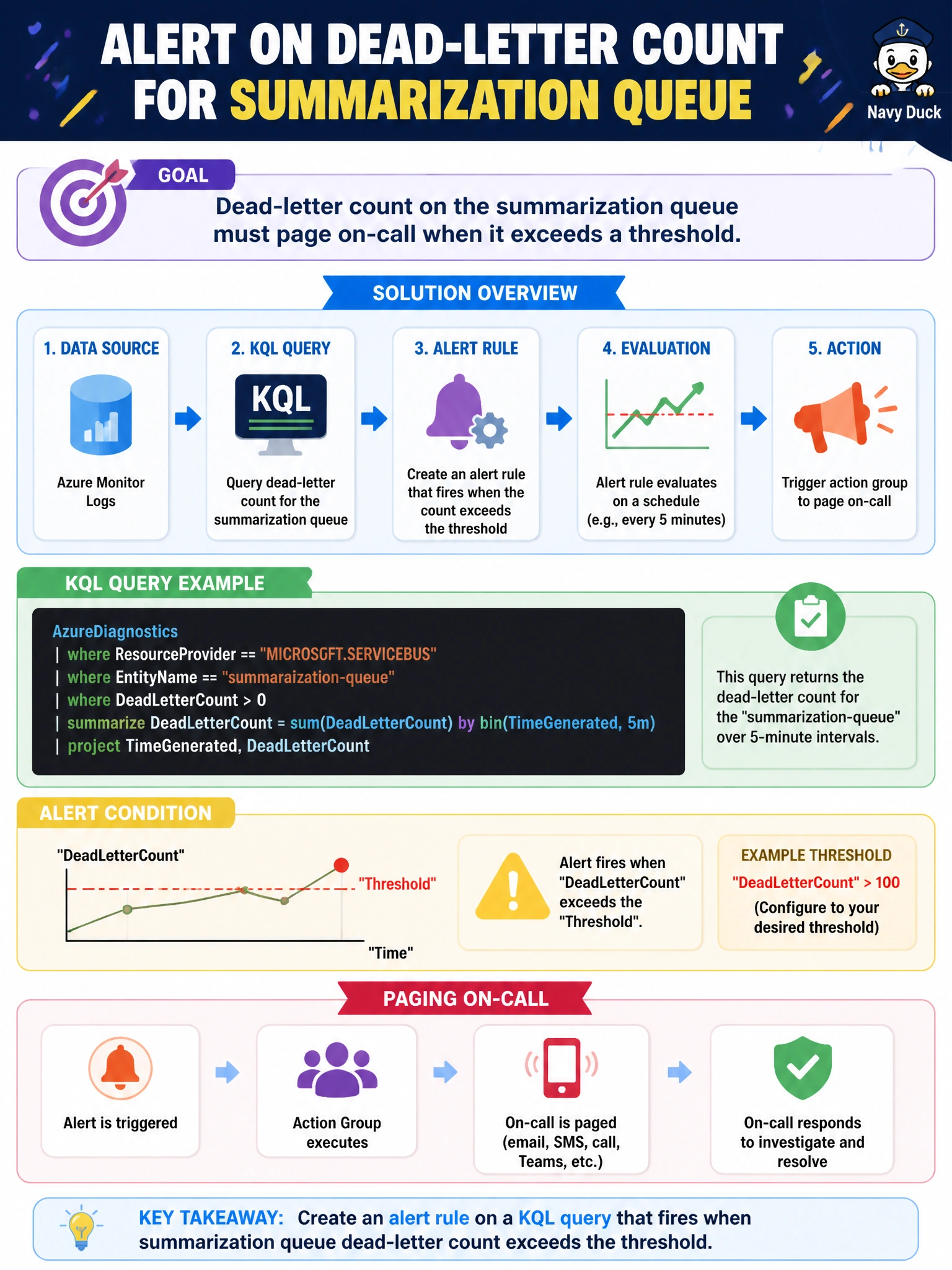
You can make this reliable with a KQL alert that pages on-call when the summarization queue’s dead-letter count exceeds the threshold. That way, you catch the backlog before residents notice summaries have stopped arriving.
Full Explanation
Create an alert rule on a KQL query that fires when the summarization queue’s dead-letter count exceeds the threshold. Azure Monitor evaluates the query and can notify an action group—through SMS, voice, or ITSM—so municipal operators learn about poison summarization messages before residents notice a silent backlog. Automated threshold alerting is a standard reliability control for asynchronous civic AI pipelines. Relying on residents to email when summaries stop arriving is late and incomplete: residents are not instrumentation, and their reports do not provide dependable detection. Scheduling an annual review and notifying the team only then cannot meet an operational paging requirement; a growing queue could go unnoticed for months. Disabling dead-lettering so messages vanish without counts removes both the safety net and the signal needed to alert on failures. Exam caveat: target the summarization queue or subscription, choose a threshold that avoids noise while catching sustained growth, and include investigation of dead-letter reasons—such as poison payloads, model authentication, or schema breaks—in the runbook. Practical check: deliberately dead-letter test summarization messages until the threshold is exceeded, confirm the alert reaches the on-call action group, then verify the queue depth falls below threshold after remediation and document the KQL criteria in the municipal AI ops runbook.