
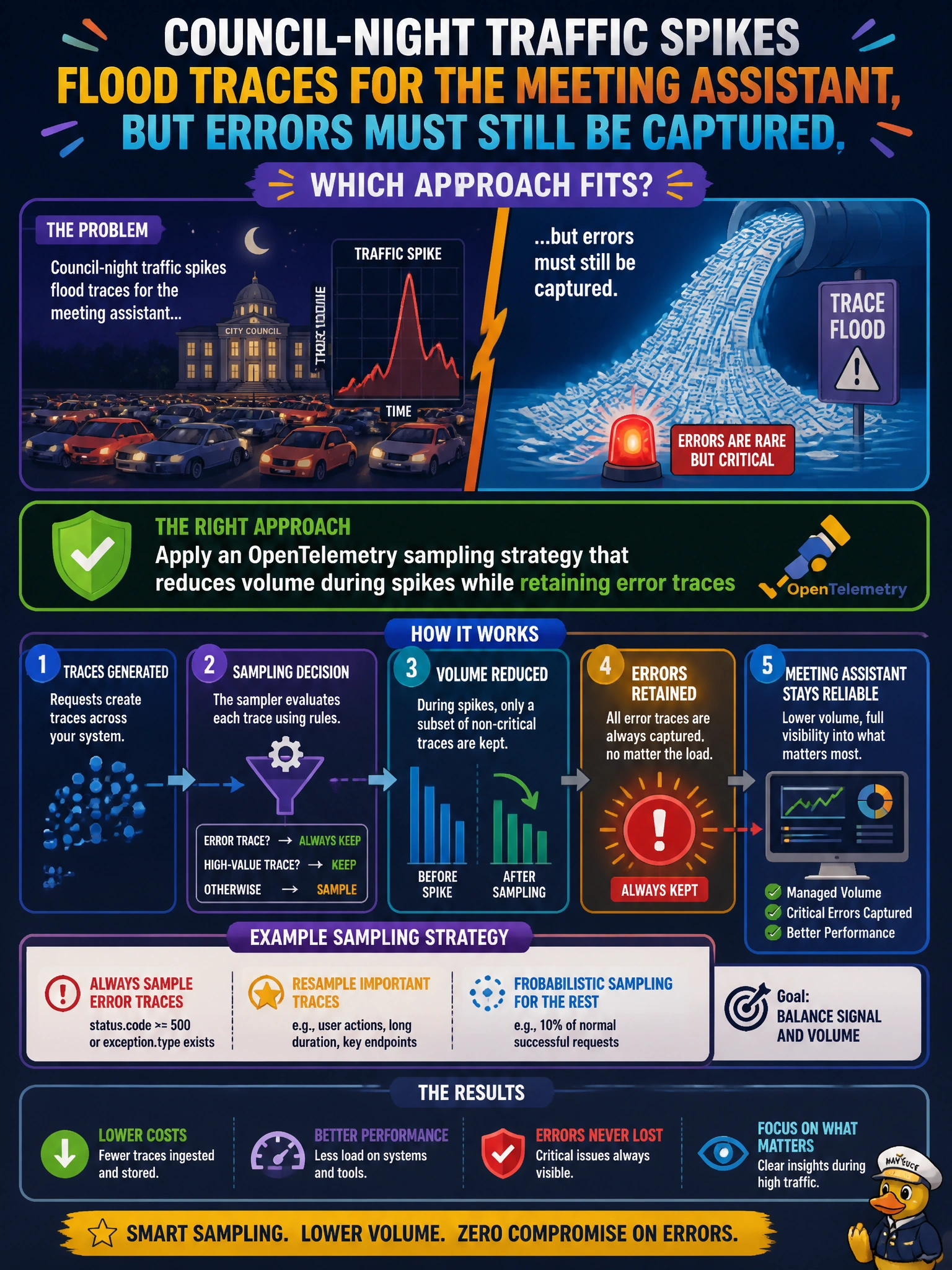
Council-night traffic spikes flood traces for the meeting assistant, but errors must still be captured. Which approach fits?
Select an answer to reveal the explanation.
Short Explanation
Sampling is keeping every crashed bus report but only a fraction of the smooth rides—spikes stay cheap without hiding failures.
Full Explanation
Council-night traffic spikes flood traces for the meeting assistant, yet errors must still be captured. Apply an OpenTelemetry sampling strategy that reduces volume during spikes while retaining error traces (for example head/tail sampling that keeps failures and a fraction of successful quiet calls). That preserves diagnostically valuable failure telemetry for municipal ops without paying full-fidelity cost on every routine successful span when council traffic surges.
Sampling at 100% forever regardless of cost or volume fails sustainability—council spikes can overwhelm ingestion, storage, and analysts without improving signal. Dropping all traces including failures whenever traffic rises fails the ‘errors must still be captured’ constraint and blinds on-call during the exact window incidents appear. Disabling Application Insights for the entire council week fails observability for a predictable peak and removes both successes and failures from the record.
Exam caveat: not all samplers behave the same—ensure error retention is explicit in the chosen strategy, and that sampling decisions propagate consistently so child spans are not orphaned incorrectly. Sampling is not a substitute for fixing chatty custom events or high-cardinality attributes that inflate costs. Metrics may remain higher fidelity than traces during peaks.
Operational check: configure sampling with error retention, load-test a council-night profile, verify successful-trace volume drops, confirm injected exceptions still appear in Application Insights, and compare cost/ingestion against a 100% baseline without losing failure visibility.