
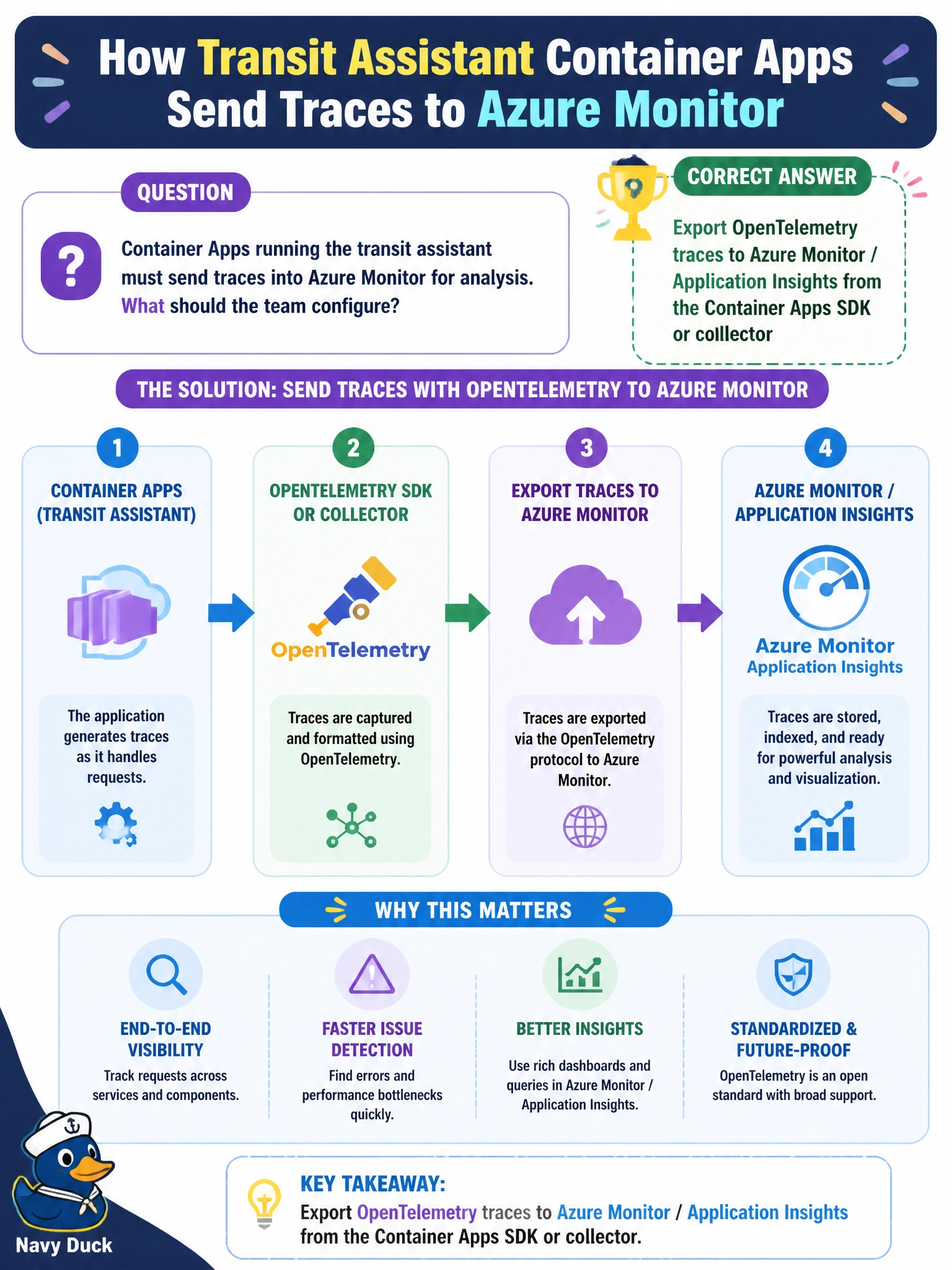
Container Apps running the transit assistant must send traces into Azure Monitor for analysis. What should the team configure?
Select an answer to reveal the explanation.
Short Explanation
Exporting to Azure Monitor is mailing the trip log to city HQ—Container Apps stop hugging traces in local memory and ops can query them.
Full Explanation
Container Apps running the transit assistant must send traces into Azure Monitor for analysis by exporting OpenTelemetry telemetry to Azure Monitor / Application Insights via the Azure Monitor OpenTelemetry Distro, Application Insights SDK, or an OpenTelemetry Collector pipeline configured for that destination. Export moves spans out of the container’s memory into a queryable municipal backend where Kusto (KQL), failures, and dependency maps can be used during transit incidents. Without export, traces cannot support cross-team operations.
Keeping traces only in container memory and never exporting them fails analysis: restart, scale-in, or crash loses evidence, and other operators cannot query what they cannot see. Writing traces exclusively to sticky notes attached to the rack fails automation and durability—humor aside, local non-exported records are not an Azure Monitor strategy. Exporting traces only to an unsupported personal laptop syslog with no Azure destination fails enterprise operations: laptops are not the city’s system of record and break shared on-call workflows.
Exam caveat: enabling an SDK without a valid connection string/instrumentation key or managed-identity-based exporter configuration still results in ‘no data.’ Container Apps may also use built-in integrations—know that the destination should be Azure Monitor/Application Insights for the scenario. Sampling and filtering still apply after export is configured.
Operational check: deploy the exporter on a transit assistant revision, generate traffic, confirm Application Insights receives requests/dependencies/traces with the expected cloud role name, and run a simple KQL query joining request duration to dependency calls for a known test ride-status query.