
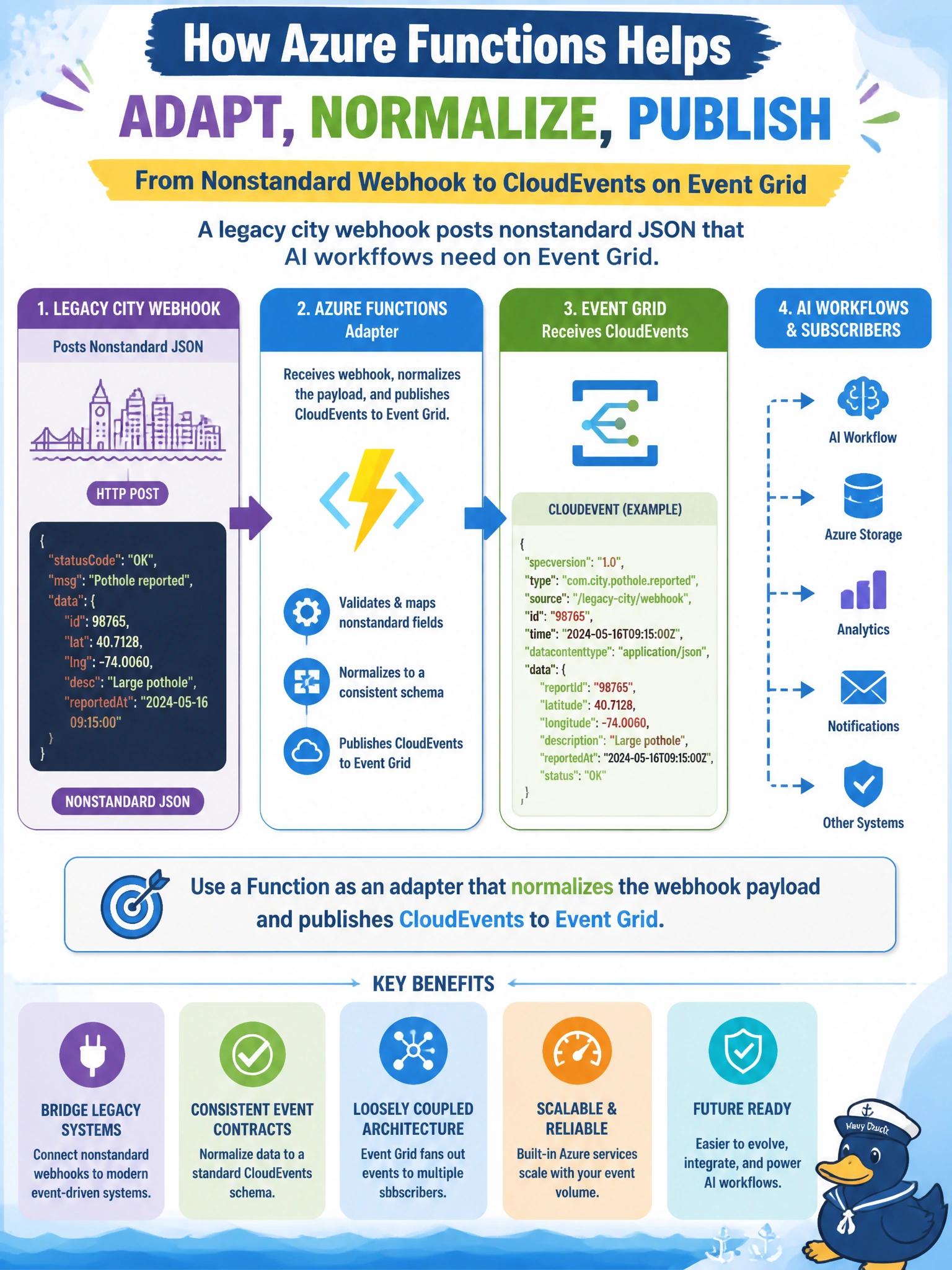
A legacy city webhook posts nonstandard JSON that AI workflows need on Event Grid. How should Azure Functions help?
Select an answer to reveal the explanation.
Short Explanation
Think of the Azure Function as your translator at the permit counter: it turns a legacy webhook’s nonstandard JSON into a clean CloudEvent for Event Grid. This adapter lets your AI workflows consume consistent events without requiring every legacy system to change.
Full Explanation
Legacy city webhooks may post nonstandard JSON, while AI workflows need consistent events on Event Grid. An Azure Function can receive each webhook, validate and normalize its payload into CloudEvents or the city’s canonical schema, then publish it to an Event Grid custom topic. Downstream summarizers, classifiers, and agents can then consume a predictable event shape. Requiring every legacy system to speak Event Grid natively without an adapter may be impractical, especially when vendor systems cannot be rewritten; it also leaves the payload mismatch unresolved. Retiring the webhook and asking residents to re-enter events in spreadsheets discards automation and adds avoidable effort and service delays. Keeping raw webhook bodies only in email inboxes provides no reliable Event Grid publishing path for AI workflows. Exam caveat: Functions commonly serve as protocol adapters in event-driven architectures, but the Function should validate and normalize data at ingress rather than pass proprietary payloads downstream for every subscriber to interpret. Practical check: send a legacy test webhook to the Function, verify malformed bodies are rejected, confirm a valid CloudEvent reaches the custom topic with a stable subject and type, and check that the AI subscriber processes it without one-off parsing.