
Thousands of 311 events flood Event Grid during a storm surge into AI triage. What capacity planning concern matters most?
Select an answer to reveal the explanation.
Short Explanation
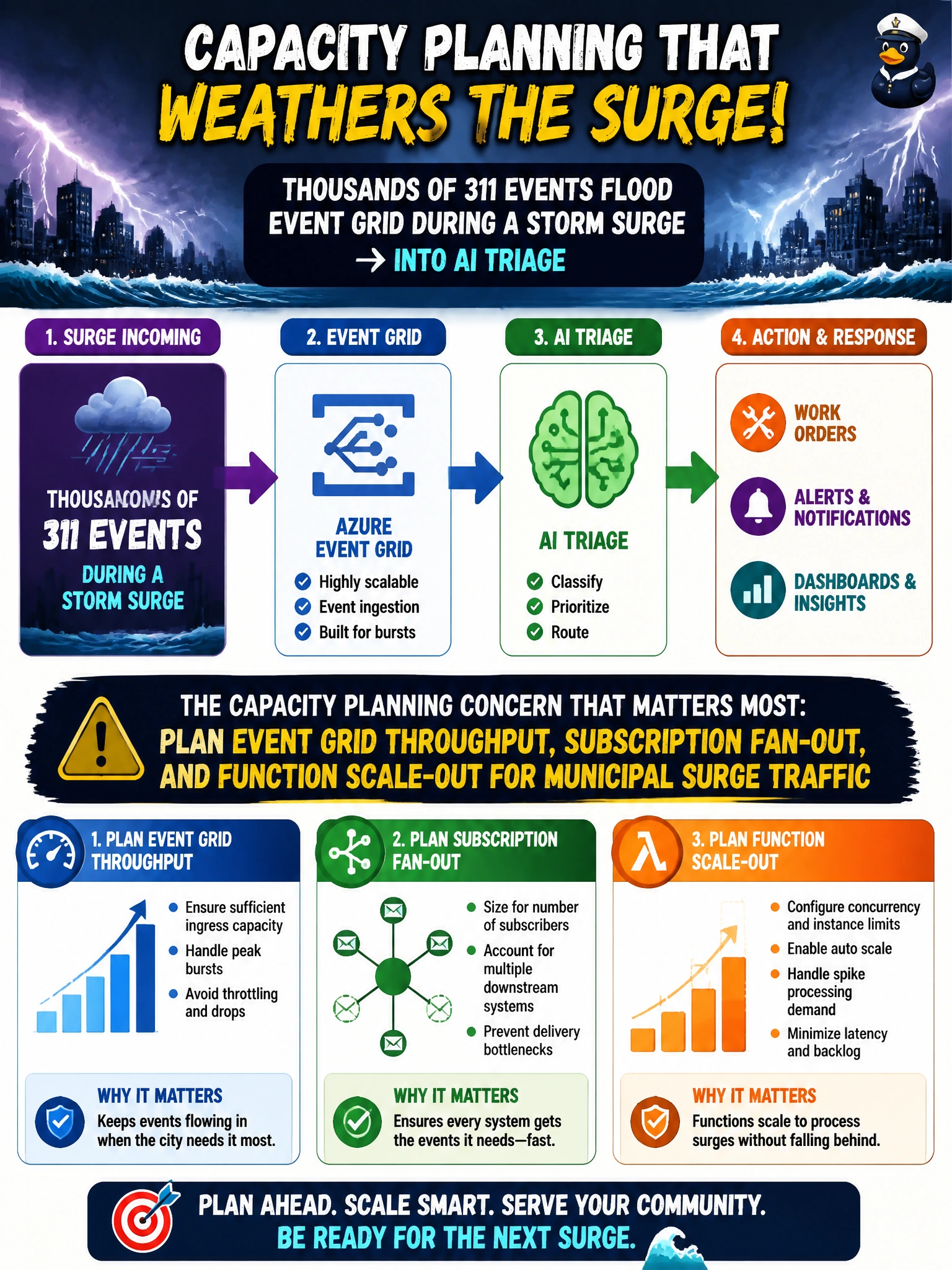
Storm night is when the call center floods—Event Grid and the triage Functions need a surge plan, not crossed fingers.
Full Explanation
During a storm surge, thousands of 311 events can flood Event Grid and downstream AI triage Functions. Capacity planning must cover Event Grid throughput and quotas, subscription fan-out to triage handlers, Function scale-out limits, downstream model rate limits, and backpressure into dead-letter or buffer queues. Municipal surge planning keeps triage available when residents report flooding, outages, and safety issues all at once.
Assuming Event Grid and handlers never need surge planning because storms are rare leaves the city blind on the nights that matter most. Capping Event Grid to a single webhook with no scale-out of AI Functions creates a bottleneck that drops or delays triage. Dropping all 311 events during storms so AI stays idle abandons the operational purpose of the system when demand peaks.
Exam caveat: event-driven AI architectures must be sized for burst fan-out; Platform limits (Event Grid publish rates, Function hosting plan scale, OpenAI TPM) are part of the design, not afterthoughts. Prefer buffering with Service Bus or storage queues when handlers cannot keep up, rather than silent loss of civic signals.
Operational check: load-test the 311-to-Event-Grid-to-triage path at projected storm rates, watch delivery success, Function scale instances, throttling, and dead-letter growth, then document scale settings and model quota headroom before hurricane or severe-weather season.