
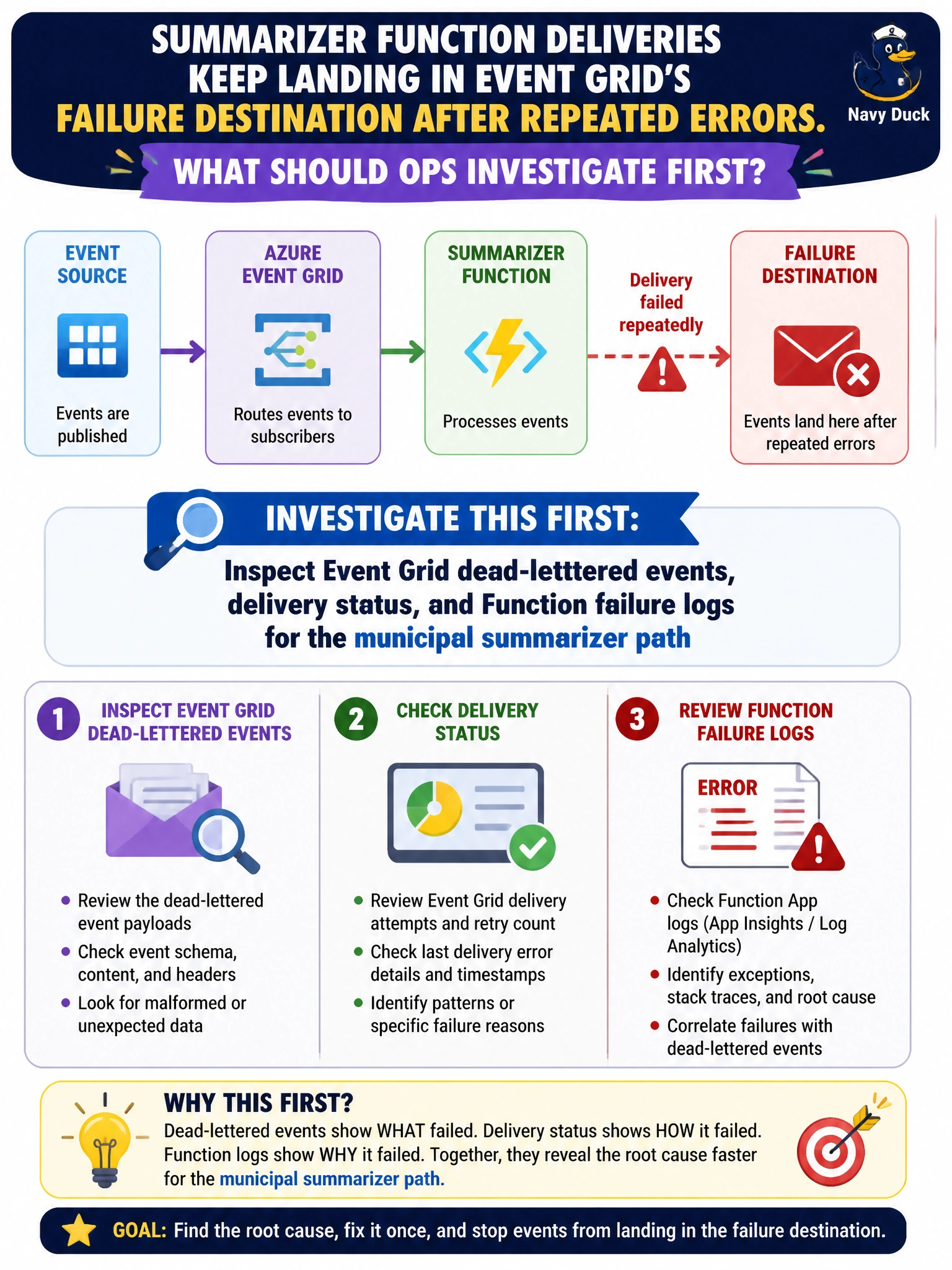
Summarizer Function deliveries keep landing in Event Grid’s failure destination after repeated errors. What should ops investigate first?
Select an answer to reveal the explanation.
Short Explanation
The dead-letter pile is the night-shift inbox—open those Event Grid failures and the Function logs before you start flipping random switches.
Full Explanation
When summarizer Function deliveries repeatedly land in Event Grid's failure or dead-letter destination, operations should first inspect dead-lettered events, delivery status codes, and Function failure logs for the municipal summarizer path. Those artifacts explain whether the city hit auth failures, payload schema drift, cold-start timeouts, OpenAI throttling, or application exceptions. Fixing the root cause restores automatic delivery; ignoring the pile leaves ordinance and packet summaries stuck outside the AI lane.
Deleting the custom topic to make failed deliveries "vanish" destroys the event fabric and loses forensic evidence residents and auditors may need. Ignoring dead-letter depth while blindly raising Function concurrency can amplify bad requests or deepen poison loops without addressing failure reasons. Disabling Application Insights hides the signal path that AI-200-style operations depend on for municipal reliability.
Exam caveat: Event Grid dead-lettering is the deliberate last stop after delivery attempts fail; treat it as an ops inbox, not as trash. Distinguish subscription delivery failures from Function-level poison handling on Service Bus—both need review, but the diagnostic starting point for "Event Grid failure destination" is the dead-lettered events plus handler logs.
Operational check: open the Event Grid dead-letter destination for the summarizer subscription, sample recent payloads and lastDeliveryOutcome, correlate timestamps with Function and App Insights exceptions, remediate (auth, timeout, schema), republish or replay a known event, and confirm dead-letter depth stops climbing while successful summarizations resume.