
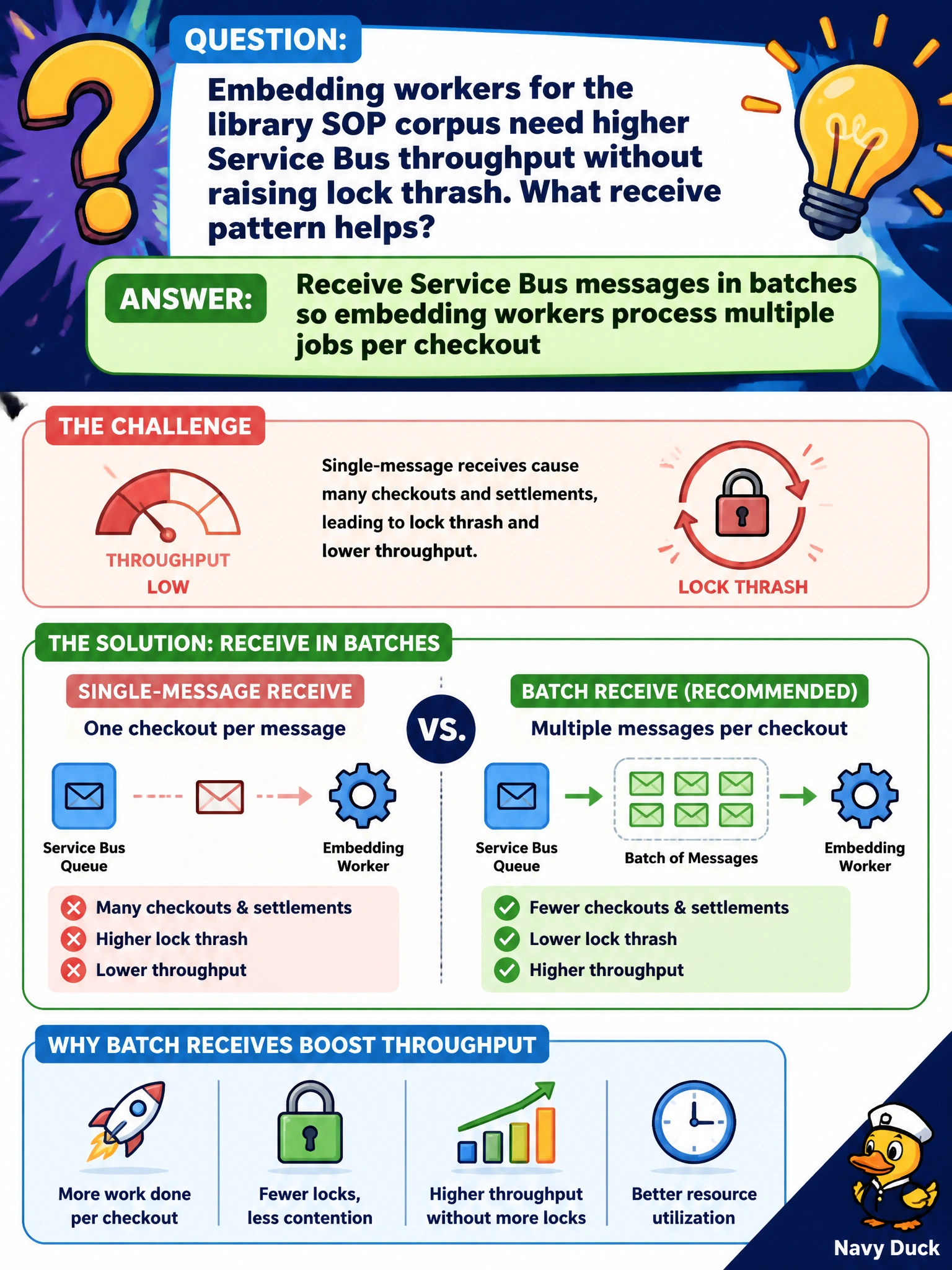
Embedding workers for the library SOP corpus need higher Service Bus throughput without raising lock thrash. What receive pattern helps?
Select an answer to reveal the explanation.
Short Explanation
Batch receive is like grabbing a stack of books from the returns cart in one trip—fewer trips, more embedding work per handshake.
Full Explanation
Library SOP embedding workers that pull jobs from Azure Service Bus need higher effective throughput without amplifying lock contention. Batch receive (with appropriate prefetch) lets each Function or worker checkout check out multiple messages in one broker round-trip, then process those embedding jobs while holding locks for the batch. That reduces chatty receive loops, improves GPU or Azure OpenAI embedding utilization for the SOP corpus, and keeps lock thrash lower than naïve one-message-at-a-time patterns under load.
Receiving and abandoning every message singly with no batching or prefetch maximizes broker chatter, extends the time locks are churned, and leaves embedding capacity idle between checkouts. Replacing Service Bus with synchronous HTTP polls from each worker reintroduces coupling, loses competing-consumer scale-out semantics, and turns the library pipeline into fragile request storms. Forcing a single-threaded consumer and rejecting parallel checkout artificially caps throughput when the municipal SOP backlog grows after policy updates.
Exam caveat: Service Bus throughput improvements for AI job queues usually combine partitioned entities (where needed), competing consumers, prefetch/batch receive, and right-sized lock duration—not abandoning the broker for HTTP. Prefetch and batch sizes must still respect processing time so locks do not expire mid-embed; tune maxAutoLockRenewalDuration and complete messages only after durable write of vectors.
Operational check: raise batch/prefetch for the SOP embedding subscription in a non-production namespace, flood a controlled message volume, and verify Active message count drains faster, lock timeout and abandon rates stay flat or improve, and embedding completion latency per message declines without duplicate vector writes.