
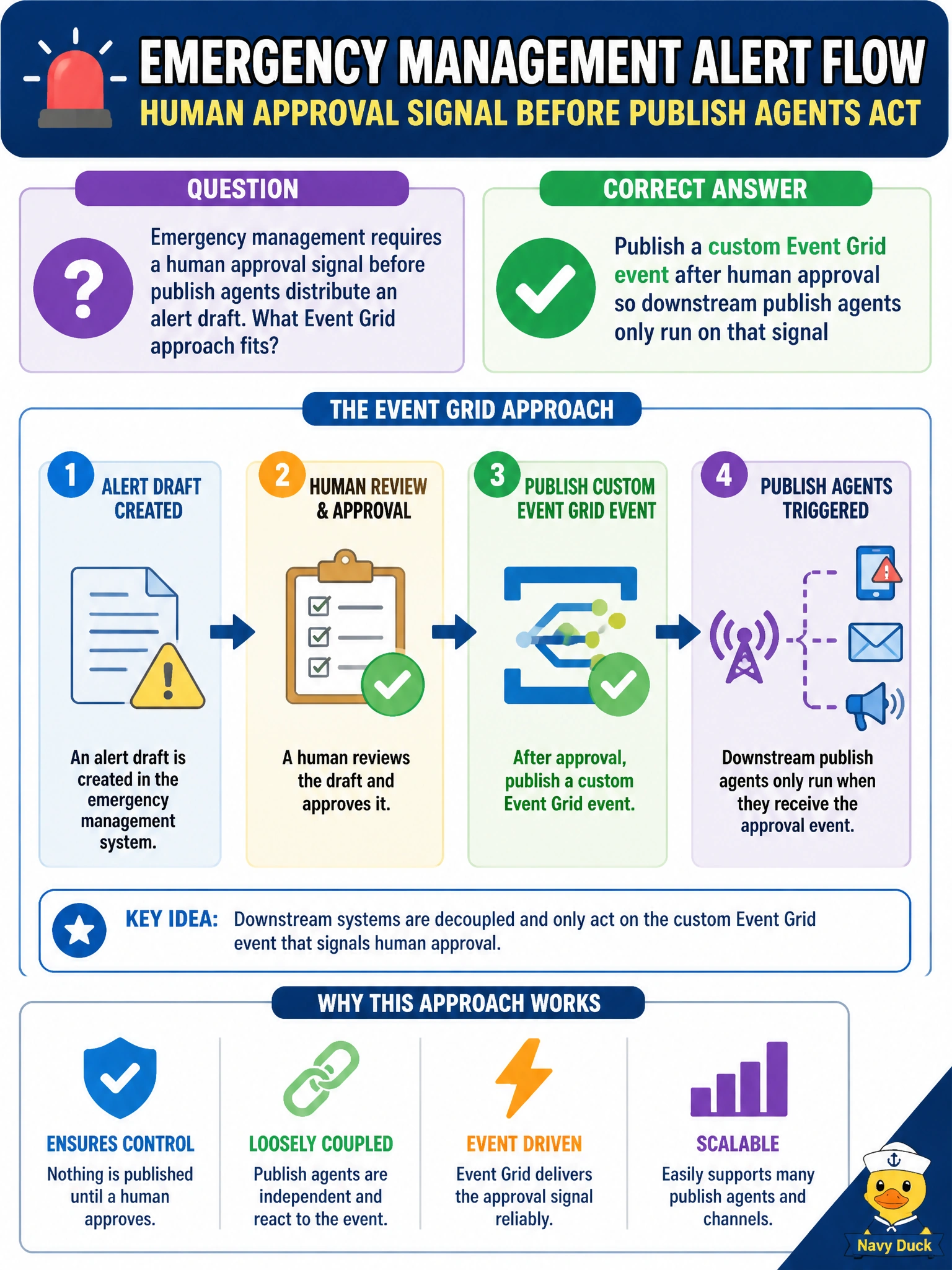
Emergency management requires a human approval signal before publish agents distribute an alert draft. What Event Grid approach fits?
Select an answer to reveal the explanation.
Short Explanation
Think of the approval event as your stamped “approved” signal: until emergency management publishes it, the alert-distribution agents stay put. Custom Event Grid events give you a clear gate between drafting and publishing.
Full Explanation
Emergency management’s publish agents must not distribute alert drafts until a human approval signal exists. Publish a custom Event Grid event after approval is recorded, so downstream agents subscribe to that authorization signal rather than running on every draft autosave. The event can carry approval metadata and correlation IDs, separating authoring from authorization to publish in the municipal workflow. Letting agents run on every autosave fails governance because unfinished or incorrect emergency language could reach the public. Recording approvals in a shared spreadsheet and having agents poll it fails as a reliable integration approach: agents lack a cloud-native event trigger and a retryable delivery contract. Using Service Bus duplicate detection as a substitute for an approval gate confuses duplicate handling with authorization; duplicate detection drops repeated MessageIds but cannot establish that a human approved an alert. Exam caveat: define a clear custom-event schema and have subscribers filter on its event type; pair the approval signal with identity and audit logging that records who approved. Practical check: save a draft without approval and confirm agents do not publish, then emit the approval event and confirm distribution handlers run only then; verify that unauthorized callers cannot forge the approval event type without proper credentials.