
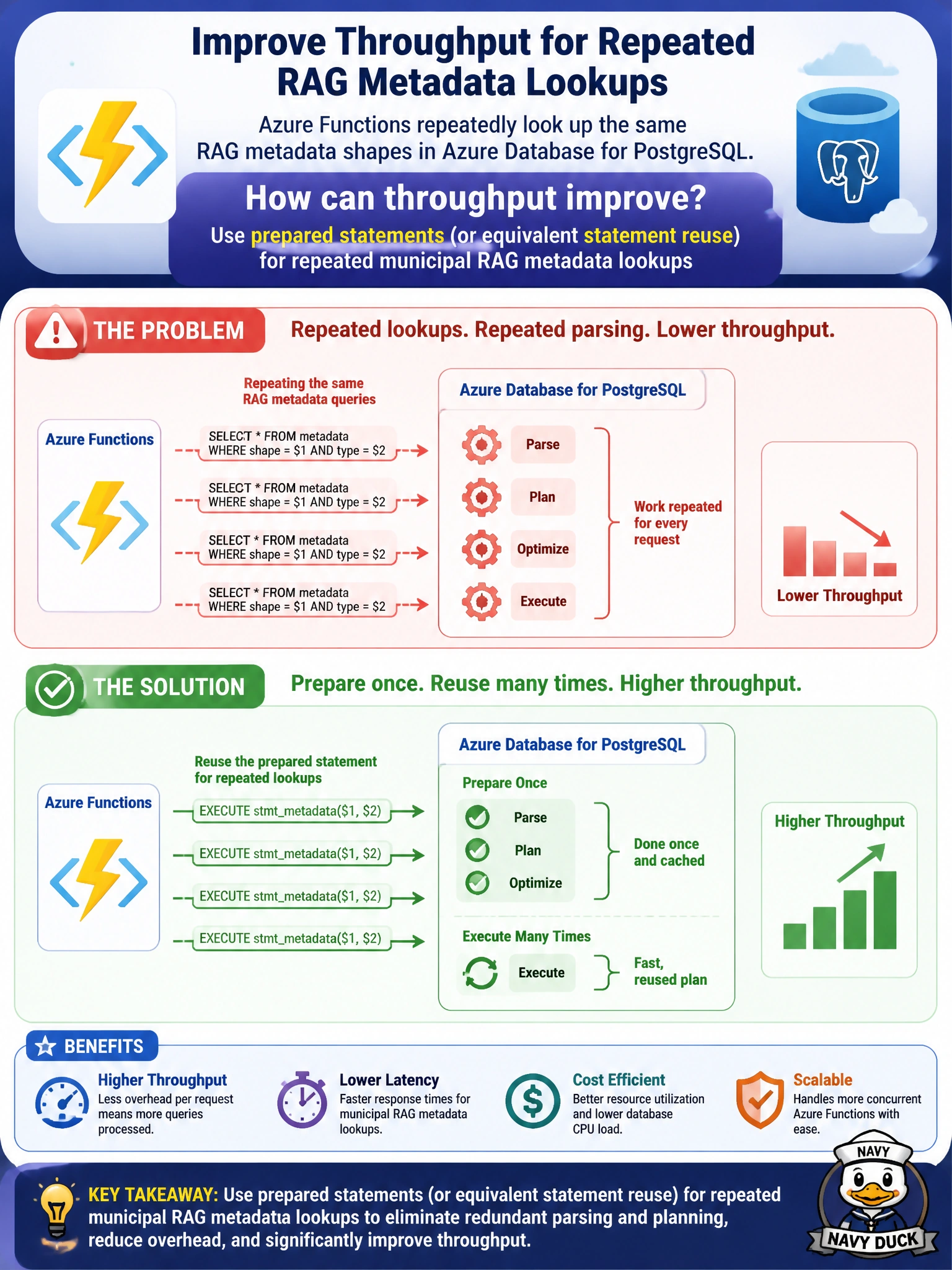
Azure Functions repeatedly look up the same RAG metadata shapes in Azure Database for PostgreSQL. How can throughput improve?
Select an answer to reveal the explanation.
Short Explanation
Prepared statements are saving the clerk’s form template—Functions fill in the blanks instead of rewriting the whole query from scratch every time the RAG metadata path fires.
Full Explanation
Azure Functions that repeatedly look up the same RAG metadata shapes in Azure Database for PostgreSQL improve throughput by reusing prepared statements (or equivalent statement reuse) instead of re-parsing and re-planning identical SQL on every invocation. That cuts parse/plan overhead on hot municipal metadata paths that fire for every resident or staff RAG call. Parsing and planning a brand-new ad hoc SQL string on every identical Functions invocation wastes database CPU on work the planner already solved for the same shape. Opening a new database cluster for each metadata lookup from Functions is an absurd scale-out anti-pattern that multiplies cost and connection chaos without helping statement efficiency. Replacing PostgreSQL lookups with unauthenticated public internet scrapes abandons the governed municipal database and introduces integrity and security failures. Exam caveat: prepared statements help repeated shapes; they do not replace connection pooling, RLS, or correct indexing for civic RAG metadata. Operationally, use parameterized prepared statements from Functions, pool connections appropriately for Functions scale-out, and measure database CPU and query latency before versus after reuse on the hot path.